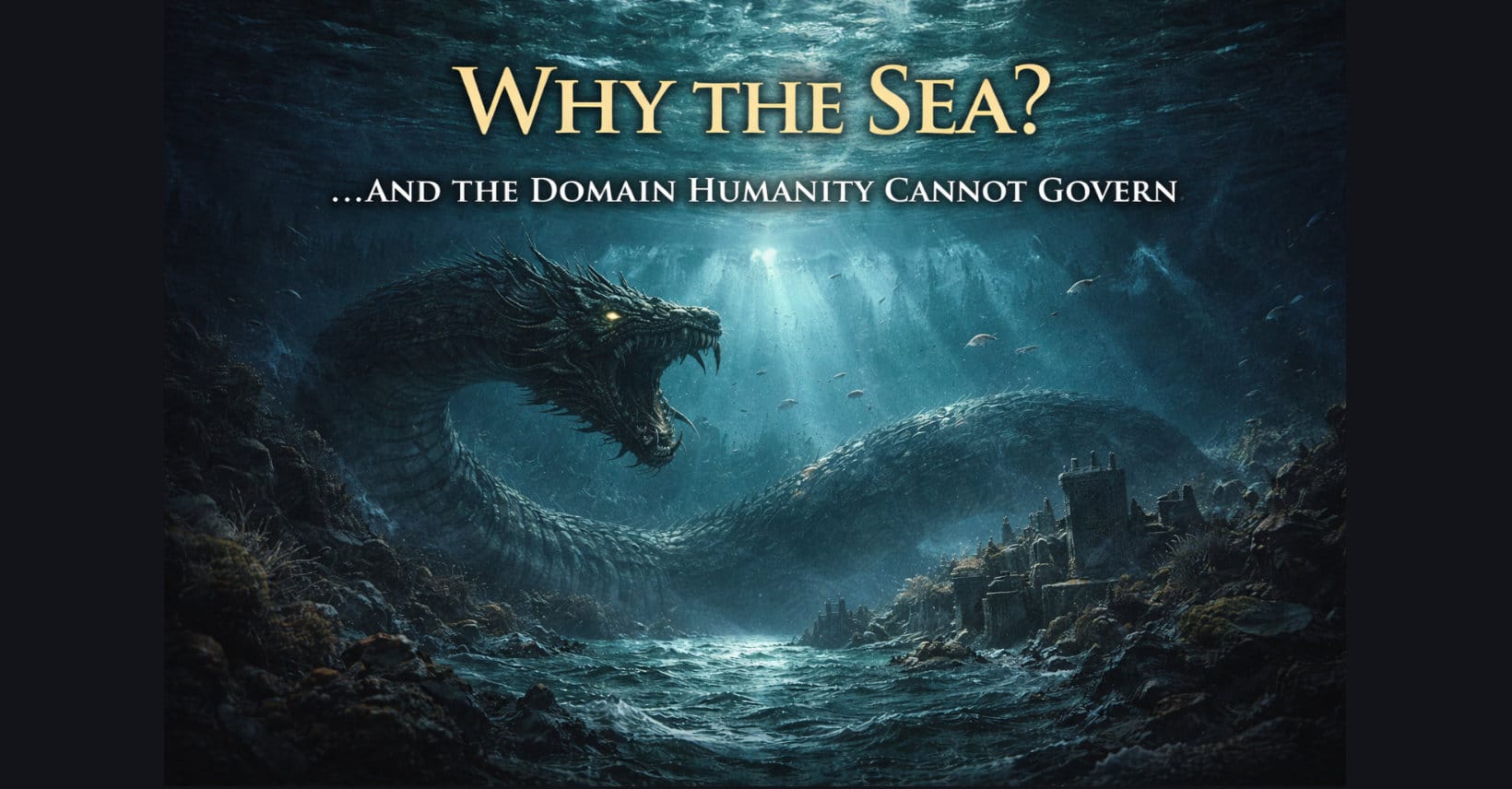
The piece examines why Leviathan, Lotan, Tiamat, and Apep are consistently placed in hidden, inaccessible domains such as the sea, abyss, or underworld. It argues that the setting is not incidental but central to the pattern, functioning as a boundary beyond human control and a key part of the symbolic framework.
It also distinguishes this pattern from the biblical view that the sea is created and governed by God. The discussion shifts from identifying the entities to examining their environment, ending with a turn toward modern limits on ocean access and understanding.
Up to this point, the pattern has been built around the entities.
In the Book of Job, Leviathan is described in physical detail.
In the Book of Psalms, its structure becomes complex.
In the Book of Isaiah, its classification expands.
Across Ugaritic, Mesopotamian, and Egyptian traditions, parallel figures—Lotan, Tiamat, and Apep—reinforce the same framework.
But there is another constant that has not yet been examined directly.
The domain.
The One Detail That Never Changes
Across all accounts, one element remains consistent:
These entities are tied to a place that is:
- Hidden
- Inaccessible
- Beyond human control
In Scripture, Leviathan is explicitly called:
“the dragon that is in the sea” (Isaiah 27:1, KJV)
In Ugaritic texts, Lotan is a sea serpent.
In Mesopotamian tradition, Tiamat is associated with the primordial waters.
In Egyptian cosmology, Apep operates in the unseen realm beneath the horizon.
Different words.
Same function.
The Deep as a Boundary
The sea, in ancient understanding, was not simply a body of water.
It was a boundary.
Beyond it:
- Visibility ended
- Control diminished
- Predictability disappeared
It was a domain where human authority could not extend.
That is precisely where these entities are placed.
Not on land.
Not in the sky.
But in the deep.
A Domain Outside Human Reach
Even today, the ocean remains one of the least understood environments on Earth.
Large portions of it:
- Remain unexplored
- Resist observation
- Contain conditions that limit human access
This is not a metaphor.
It is a measurable reality.
The domain described in ancient texts still functions as a boundary.
Consistency Across Descriptions
What becomes significant is not just that the sea is mentioned.
It is that it is consistently chosen.
Across independent traditions, the same type of entity is placed in the same type of environment:
- A serpent-like being
- Operating within a hidden domain
- Beyond human governance
This is not random placement.
It is structured.
Symbolism and Setting
The symbolic interpretation offers a clear explanation:
The sea represents chaos.
It is unstable, unpredictable, and uncontrollable.
Therefore, it becomes the natural setting for entities that embody those qualities.
This explanation is coherent.
But it does not fully account for the consistency of the pattern across cultures.
Why the same symbol?
Why the same setting?
Why the same association with specific types of entities?
At some point, repetition raises the possibility that the setting is not only symbolic…
…but descriptive.
The Role of Inaccessibility
One feature of the domain stands out above all others:
Inaccessibility.
Whether described as sea, abyss, or underworld, the defining characteristic is the same:
It is a place humanity cannot fully observe.
This matters.
Because it creates a condition where:
- Observation is limited
- Interpretation fills the gap
- Language becomes the bridge between experience and explanation
Ancient writers did not have modern tools.
They described what they encountered using the framework available to them.
A Controlled Observation
Without extending beyond the evidence, one observation can be made:
The entities described in these traditions are consistently located in domains that:
- Limit human perception
- Resist direct control
- Remain partially unknown
That alignment is not trivial.
It suggests that the domain itself may be part of what is being described—not just a backdrop.
Theological Framing
Scripture again introduces an important distinction.
In the biblical account, the sea is not an independent force.
It is created.
It is bounded.
It is governed by God.
Even Leviathan, within that domain, is not beyond divine authority.
This preserves the theological framework while still acknowledging the significance of the setting.
A Shift in the Inquiry
Up to now, the question has been:
What are these entities?
Now the question shifts:
Why are they always found in the same type of place?
That shift matters.
Because it moves the discussion from identity…
to environment.
The Pattern Reframed
The recurring structure can now be expressed differently:
- A powerful entity
- Associated with a hidden domain
- Beyond human control
- Opposed by a higher authority
The sea is not incidental.
It is central to the pattern.
Where the Inquiry Leads Next
If the domain is consistent…
Then the next step is to examine it more closely.
Not in ancient terms alone—but in light of what we know today.
How much of the ocean remains unexplored?
What exists in environments we still cannot fully access?
What assumptions do we make about what is—or is not—there?
In the next article, the focus moves from ancient description to modern limitation.
Because if the domain has remained largely unseen…
Then the possibility remains that it has also been largely misunderstood.