The post compares Apep with Leviathan, Lotan, Tiamat, and related figures across Hebrew, Ugaritic, Mesopotamian, and Egyptian traditions. It emphasizes recurring traits: serpent-like form, hidden or inaccessible domains, and opposition to authority that preserves order.
It argues that Apep adds a cyclical, recurring conflict to the broader pattern and suggests the similarities may reflect cultural transmission, symbolic convergence, or shared attempts to describe the unseen. The piece ends by shifting attention from the adversaries to the domain they inhabit.
At this stage in the series, the pattern has extended across multiple civilizations.
In the Book of Job, Leviathan is described with physical precision.
In the Book of Psalms, structural complexity is introduced.
In the Book of Isaiah, classification becomes layered.
In Ugaritic texts, Lotan reflects a parallel structure.
In Mesopotamian tradition, Tiamat reinforces the same framework.
Now we turn to Egypt.
And once again, the pattern does not disappear.
It persists.
The Figure of Apep
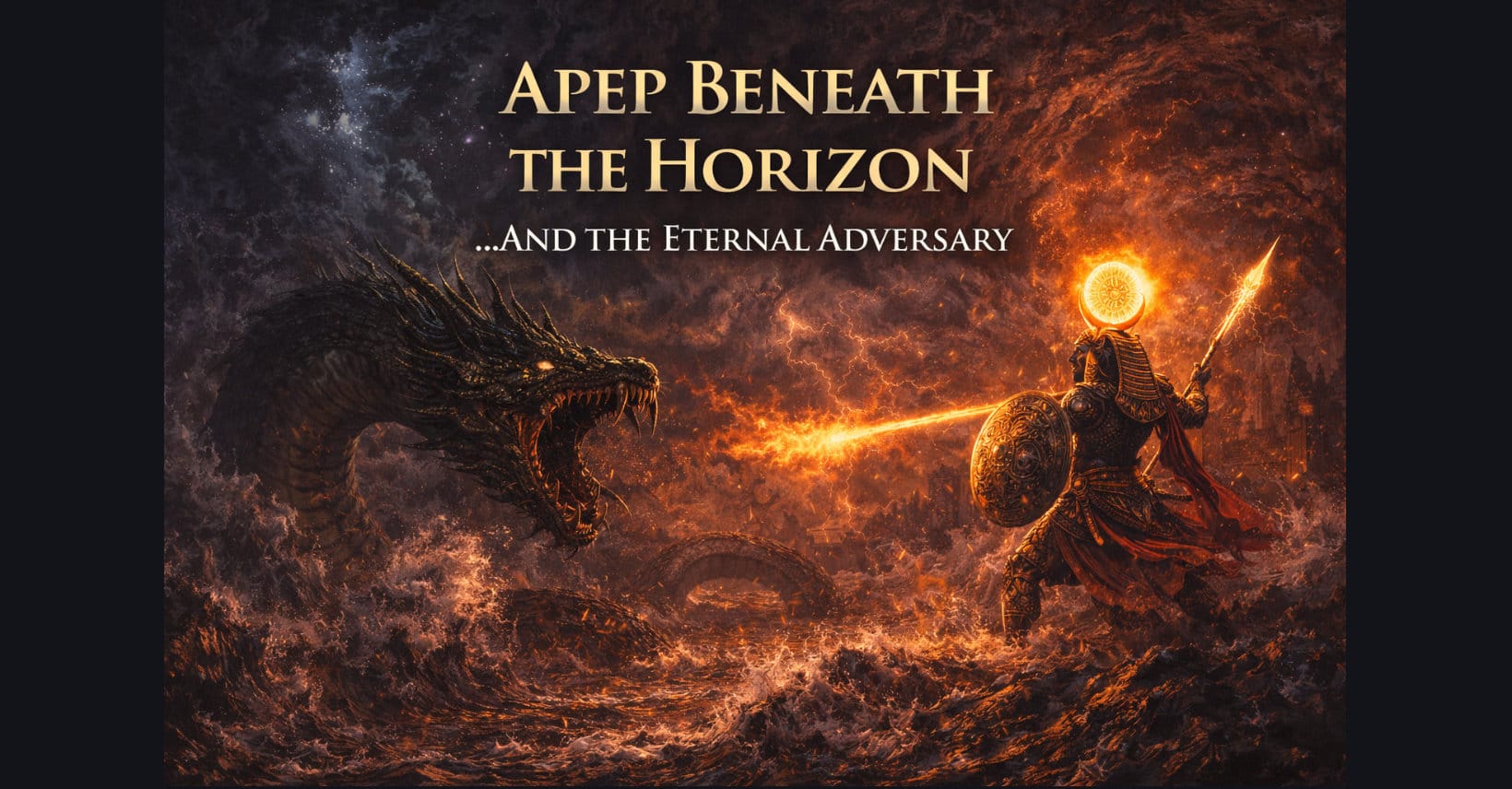
In ancient Egyptian cosmology, Apep—also known as Apophis—is a serpent entity associated with chaos and opposition.
But unlike Tiamat, Apep is not confined to a singular event.
Apep is part of a cycle.
Each night, according to Egyptian belief, the sun god Ra travels through the underworld. And each night, Apep attempts to stop him.
This is not a one-time conflict.
It is ongoing.
A Pattern of Opposition
The parallels begin immediately:
- A serpentine entity
- Associated with darkness or the unseen
- Positioned in opposition to a higher authority
- Engaged in conflict that determines order
But there is a difference in structure.
Where Leviathan, Lotan, and Tiamat are ultimately subdued in decisive acts, Apep represents continuous resistance.
It is not just defeated.
It returns.
The Domain Beneath
Another detail aligns with the pattern already established:
Location.
Apep operates in the underworld—the unseen realm beneath the visible horizon.
While not explicitly “the sea” in every depiction, the environment shares key characteristics:
- Hidden
- Inaccessible
- Beyond direct human observation
This mirrors the role of the deep in previous accounts.
Whether described as ocean, abyss, or underworld, the domain remains consistent in function:
It is a place beyond human reach.
Repetition Across Cultures
At this point, the pattern includes:
- Serpentine or dragon-like form
- Association with hidden or inaccessible domains
- Opposition to a higher authority
- Conflict that defines or preserves order
Now, with Apep, a new dimension is added:
Persistence.
The adversary is not only powerful.
It is recurring.
A Shift in the Nature of the Conflict
This introduces an important variation.
In earlier accounts:
- The conflict is decisive
- The outcome is final
In the Egyptian framework:
- The conflict is cyclical
- The outcome must be continually reinforced
This difference does not erase the pattern.
It expands it.
It suggests that the concept of a serpent-like adversary was not only widespread—but adaptable.
Symbolism or Structure?
As before, the standard explanation remains:
These are symbolic representations of chaos.
And certainly, Apep fits that model well.
Darkness opposing light.
Disorder opposing order.
But the repetition of specific elements continues to raise questions:
- Why a serpent?
- Why a hidden domain?
- Why a recurring opposition to a higher authority?
These are not random choices.
They are consistent selections.
The Persistence of the Archetype
By now, the repetition is clear:
Across Hebrew, Ugaritic, Mesopotamian, and Egyptian traditions, we find:
- A serpent-like entity
- Associated with the deep or unseen
- Opposed by a figure of authority
- Involved in conflict that defines order
The differences between the accounts are real.
But so are the similarities.
And the similarities follow a structure.
Scripture’s Distinction, Revisited
Returning again to the biblical framework, a distinction remains:
Leviathan is not an independent force.
It is a created being under the authority of God.
Even when described in powerful terms, it does not operate outside that authority.
And in the Book of Isaiah, its final defeat is still future.
This introduces a subtle but important contrast with Apep:
Where Apep’s opposition is ongoing, Leviathan’s judgment is appointed.
A Broader Pattern Emerges
With Apep added to the comparison, the pattern now includes:
- Multiple civilizations
- Multiple narrative structures
- Multiple theological frameworks
Yet the same core elements persist.
This is no longer a localized phenomenon.
It is a recurring structure across time and geography.
Interpreting the Accumulation
At this point, the interpretive options remain:
- Cultural transmission
- Symbolic convergence
- Shared attempts to describe something beyond ordinary experience
But the accumulation of data increases the weight of the question.
Because repetition across independent traditions is not easily dismissed.
Where the Inquiry Leads Next
With the pattern now established across multiple civilizations, the next step is not to add more examples.
It is to examine the domain itself.
Why are these entities consistently tied to:
- The sea
- The deep
- The unseen
What is it about these environments that makes them the setting for these descriptions?
In the next article, the focus shifts away from the entities…
…and toward the domain they all seem to share.
Because if the setting is consistent…
It may be just as important as the descriptions themselves.