The piece compares Leviathan with Ugaritic Lotan and Mesopotamian Tiamat, arguing that each fits a recurring pattern: a powerful sea-associated, serpent-like figure opposed and defeated by a higher authority. It emphasizes that this pattern appears across multiple traditions.
It also stresses a theological difference in the biblical account: Leviathan is a created being under God’s authority, not a primordial force. The article closes by setting up a further comparison with Apep.
By now, the Leviathan discussion has moved beyond a single text.
In the Book of Job, we observed detailed physical description.
In the Book of Psalms, structural complexity emerged.
In the Book of Isaiah, classification became layered.
In Ugaritic texts, Lotan introduced a parallel outside the biblical record.
At each step, the same pattern has appeared:
- A powerful entity
- Associated with the sea
- Described in serpentine or dragon-like terms
- Opposed by a higher authority
Now, we move further back—into Mesopotamian tradition.
And the pattern does not disappear.
It intensifies.
The Figure of Tiamat
In Babylonian cosmology, Tiamat is not a minor figure.
She is central.
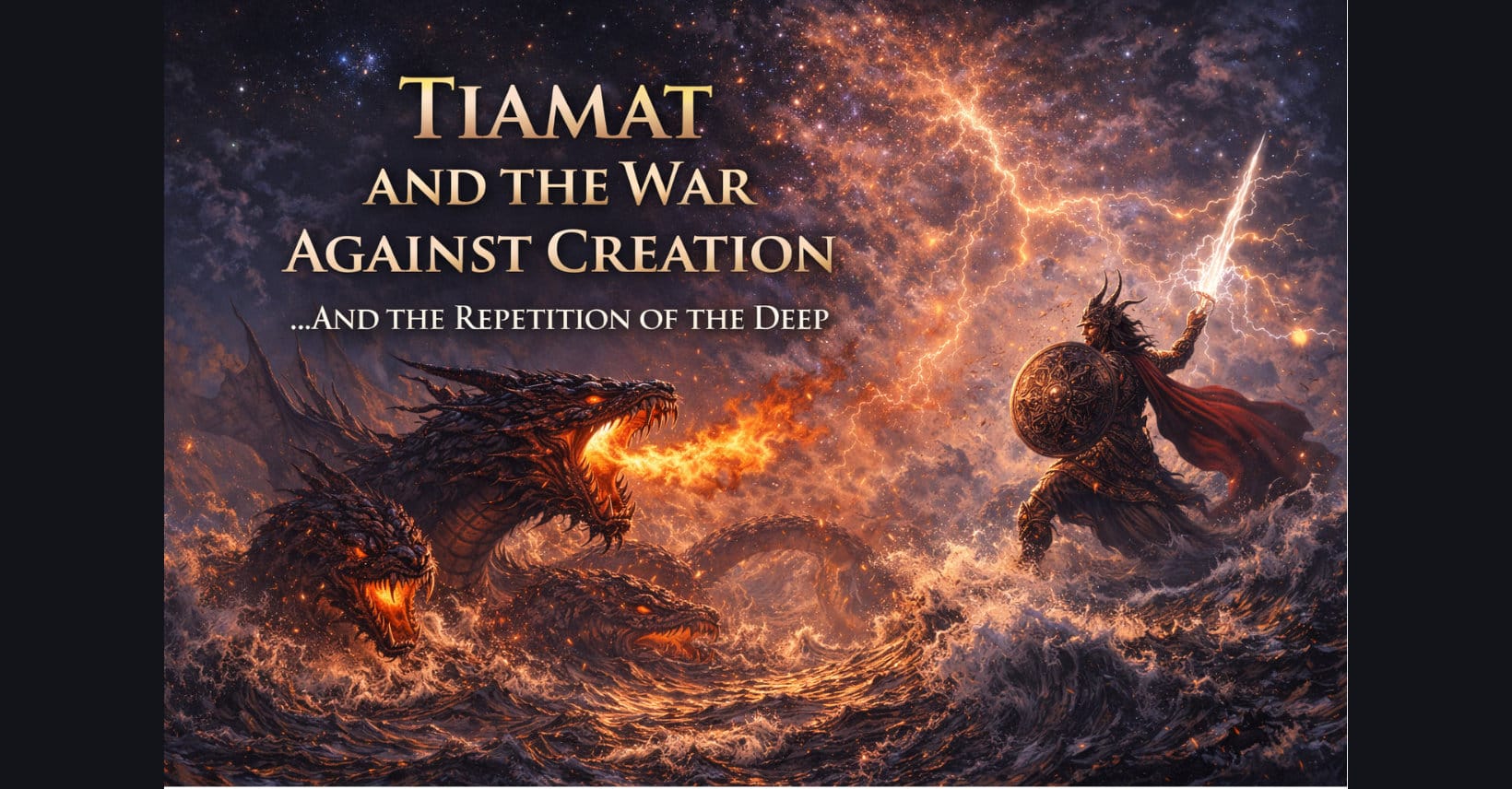
Tiamat is described as a primordial entity associated with the chaotic waters that precede creation. In the Enuma Elish, she is portrayed as:
- A being tied to the deep
- A force of chaos
- A figure opposed by a rising authority
Eventually, she is defeated by the god Marduk, and her body is used to form the structure of the world.
This is not a subtle narrative.
It is foundational.
Structural Parallels
When placed alongside the Leviathan framework, several similarities emerge:
- Domain: Both are tied to the waters—the deep, the sea, the unformed
- Opposition: Both are confronted by a higher authority
- Outcome: Both are ultimately subdued or destroyed
- Scale: Both operate at a level beyond ordinary creatures
These are not isolated overlaps.
They align with the same pattern already observed in Leviathan and Lotan.
A Key Difference
And yet, there is a critical distinction.
In the biblical account:
Leviathan is a created being, subject to God.
In the Mesopotamian account:
Tiamat is primordial, part of the origin of existence itself.
This difference matters.
Because while the structural pattern remains consistent, the theological framing diverges significantly.
Scripture does not present chaos as co-equal with God.
It presents it as something under His authority.
The Role of Conflict
Another consistent element across these accounts is conflict.
- Leviathan is broken
- Lotan is subdued
- Tiamat is defeated
This is not incidental storytelling.
It is a recurring motif:
Order established through the subjugation of a powerful entity associated with the deep.
The question is not whether this motif exists.
It clearly does.
The question is why it appears so consistently across cultures.
Beyond Symbolism
The standard interpretation treats these figures as symbolic representations of chaos.
And that explanation carries weight.
Water has long been associated with:
- Disorder
- Unpredictability
- The unknown
But symbolism alone does not fully explain:
- The repeated use of serpentine imagery
- The consistent association with the sea
- The recurring theme of defeat by a higher authority
At some point, symbolic explanation begins to overlap with structured description.
The Repetition of the Deep
One detail remains constant across all accounts examined so far:
The domain.
- Leviathan is “in the sea”
- Lotan is a sea serpent
- Tiamat is associated with the primordial waters
The deep is not incidental.
It is central.
And it is consistently portrayed as:
- Inaccessible
- Powerful
- Resistant to human control
This raises a question that extends beyond ancient texts:
Why does the same domain appear repeatedly as the setting for these entities?
A Pattern, Not a Conclusion
At this stage, the accumulation of parallels is significant.
But restraint remains necessary.
We are not yet defining what these entities are.
We are identifying what is consistently said about them.
Across cultures, the pattern includes:
- A powerful entity
- Serpentine or dragon-like characteristics
- Association with the sea or deep
- Opposition by a higher authority
- Eventual subjugation
That pattern now spans:
- Biblical texts
- Ugaritic sources
- Mesopotamian tradition
It is no longer isolated.
Interpreting the Pattern
There are still multiple ways to interpret what we are seeing:
- Mythological borrowing across cultures
- Symbolic convergence around shared human experiences
- A shared attempt to describe something observed
Each explanation remains on the table.
But the data set has expanded.
And with expansion comes pressure.
The more consistent the pattern becomes, the more difficult it is to dismiss it as coincidence.
Scripture’s Distinct Position
It is worth returning briefly to what sets the biblical account apart.
While it shares structural elements with surrounding traditions, it reframes them:
- Leviathan is not primordial
- It is not co-equal with God
- It is not part of creation itself
It is a created entity, fully subject to divine authority.
This preserves the theological integrity of the text while still participating in the broader pattern.
Where the Inquiry Leads Next
If the same framework appears in multiple traditions…
Then the next step is to continue testing it.
In the next article, we turn to Apep—another serpent figure associated with chaos, the deep, and opposition to order.
Because if the pattern holds again…
We are no longer examining isolated stories.
We are tracing a recurring structure that spans civilizations.
And that is where the question becomes unavoidable:
Not just what is being described…
…but why it is described this way everywhere it appears.