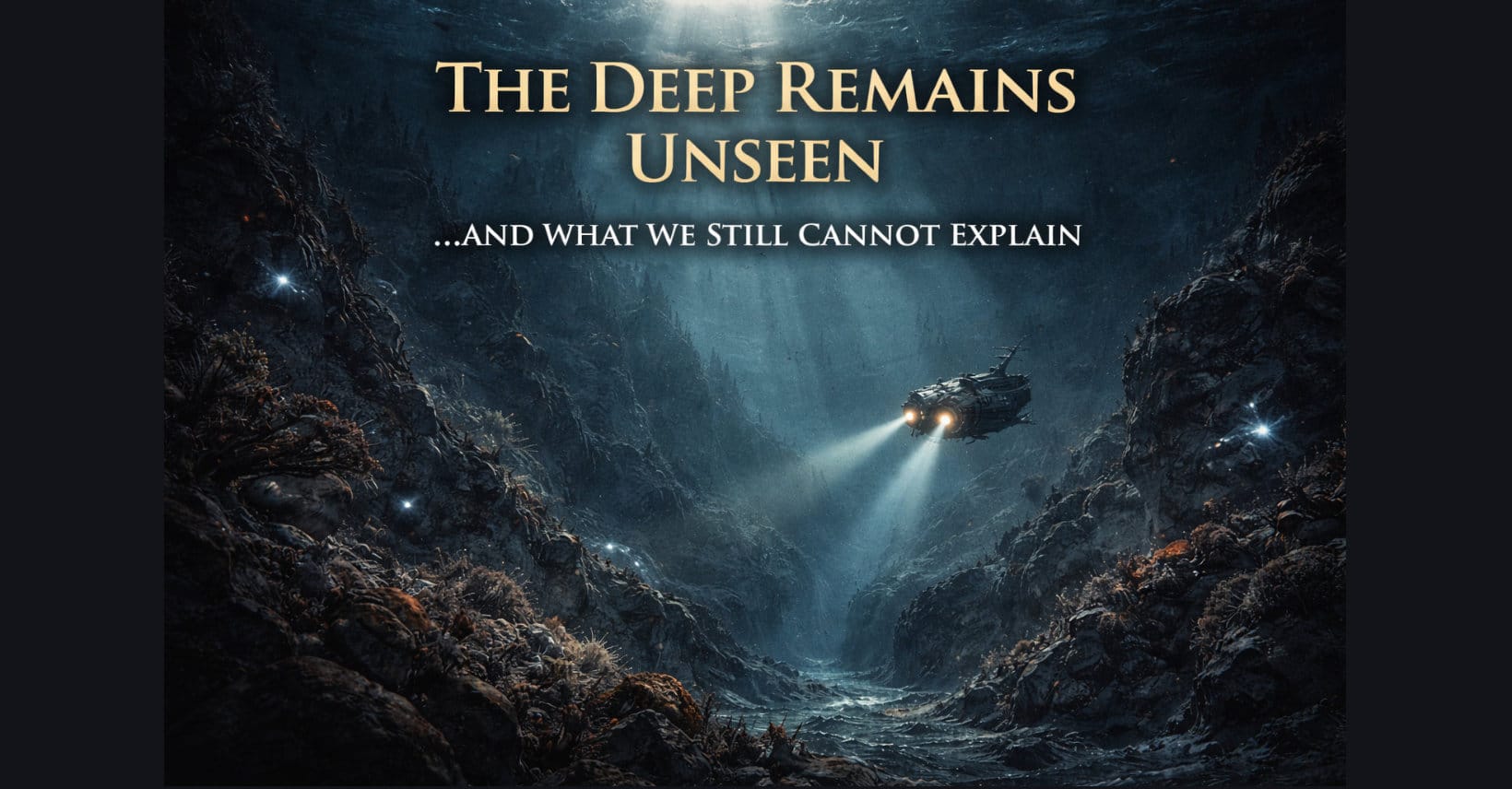
The piece argues that the deep ocean remains a largely unknown environment, despite modern mapping and exploration. It notes that ancient texts and related traditions often place Leviathan, Tiamat, and Apep in inaccessible realms, and suggests this shared setting reflects real limits on observation.
It does not claim the existence of any specific entity. Instead, it frames the ocean’s continued inaccessibility as a context for interpreting ancient descriptions, while affirming that within Scripture the sea remains created and governed by divine authority.
The previous article shifted the focus from the entity to the domain.
Across Scripture and ancient traditions, the same environment continues to appear:
- The sea
- The deep
- The unseen
In the Book of Isaiah, Leviathan is “the dragon that is in the sea.”
In surrounding traditions, figures like Tiamat and Apep are consistently tied to inaccessible realms.
The pattern is clear.
Now the question changes again.
Not what was described…
but what remains beyond our ability to fully observe.
A Domain Still Largely Unknown
Despite modern advances, the ocean remains one of the least explored environments on Earth.
Vast regions of the deep ocean:
- Have never been directly observed
- Exist under conditions that limit sustained human presence
- Contain ecosystems that continue to surprise even experienced researchers
This is not speculation.
It is a current limitation.
The domain that ancient writers described as inaccessible… remains, in many ways, inaccessible.
The Illusion of Complete Knowledge
There is a tendency to assume that modern science has fully mapped the world.
That assumption does not hold when it comes to the deep ocean.
We have:
- Satellite mapping of surface features
- Sonar-based approximations of the ocean floor
- Limited submersible exploration
But large portions of the deep remain:
- Unseen
- Unverified
- Poorly understood
The difference between mapped and observed matters.
Continuity Between Ancient and Modern Limits
Ancient writers did not have advanced tools.
Their understanding of the deep was shaped by:
- Limited visibility
- Indirect observation
- Experiential encounters
Modern limitations, while reduced, are not eliminated.
We have extended our reach—but not completed it.
This creates an interesting continuity:
The same domain that was once described as unknowable… still resists full understanding.
What This Does—and Does Not Suggest
It is important to maintain discipline here.
The fact that the ocean remains partially unexplored does not prove the existence of any specific entity.
But it does establish a condition:
There are environments on Earth that:
- Limit observation
- Restrict access
- Leave room for incomplete knowledge
That condition aligns with the domains consistently referenced in ancient texts.
The Role of Environment in Interpretation
When ancient accounts place powerful, poorly understood entities in inaccessible environments, two interpretations emerge:
1. Symbolic Placement
The unknown becomes a natural setting for symbolic representations of chaos.
2. Observational Limitation
The environment itself restricts understanding, leading to descriptions that blend observation with interpretation.
These are not mutually exclusive.
They may overlap.
A Consistent Constraint
One element remains consistent across both ancient and modern perspectives:
Constraint.
Whether through:
- Depth
- Pressure
- Darkness
- Distance
The deep ocean imposes limits.
And where limits exist, interpretation begins.
Revisiting the Pattern
At this point, the pattern includes:
- A serpent-like entity
- Associated with the deep or unseen
- Beyond human control
- Opposed by a higher authority
- Located in a domain that resists observation
The addition of modern limitation does not change the pattern.
It reinforces one aspect of it:
The domain is still, in many ways, unknown.
The Question Refined
Earlier in the series, the question was:
What is Leviathan?
Then it became:
Why is Leviathan described this way across cultures?
Now the question becomes more precise:
What does it mean when ancient descriptions consistently point to a domain that remains partially unexplored?
This is not a conclusion.
It is a refinement.
A Measured Observation
Without extending beyond the evidence, one observation can be made:
Ancient texts repeatedly place certain entities in environments that:
- Limit human perception
- Resist full exploration
- Continue to contain unknowns
That alignment does not explain the descriptions.
But it does contextualize them.
Scripture’s Framing
Within the biblical account, the domain remains under divine authority.
The sea is:
- Created
- Bounded
- Governed
Even Leviathan, within that domain, is not outside God’s control.
This distinction remains essential.
The presence of the unknown does not imply independence from divine order.
Where the Inquiry Leads Next
With the domain examined and its limitations acknowledged, the next step is to return to the entity—this time with a refined perspective.
If Leviathan:
- Is described with physical detail
- Exhibits structural complexity
- Is classified in layered terms
- Appears across multiple traditions
- Is consistently tied to a partially unknowable domain
Then the question becomes:
Are we dealing with a singular creature…
or a broader category?
In the next article, the focus shifts again—
From domain back to definition.
Because the possibility now emerges that Leviathan was never meant to be understood as one…
…but as something more.