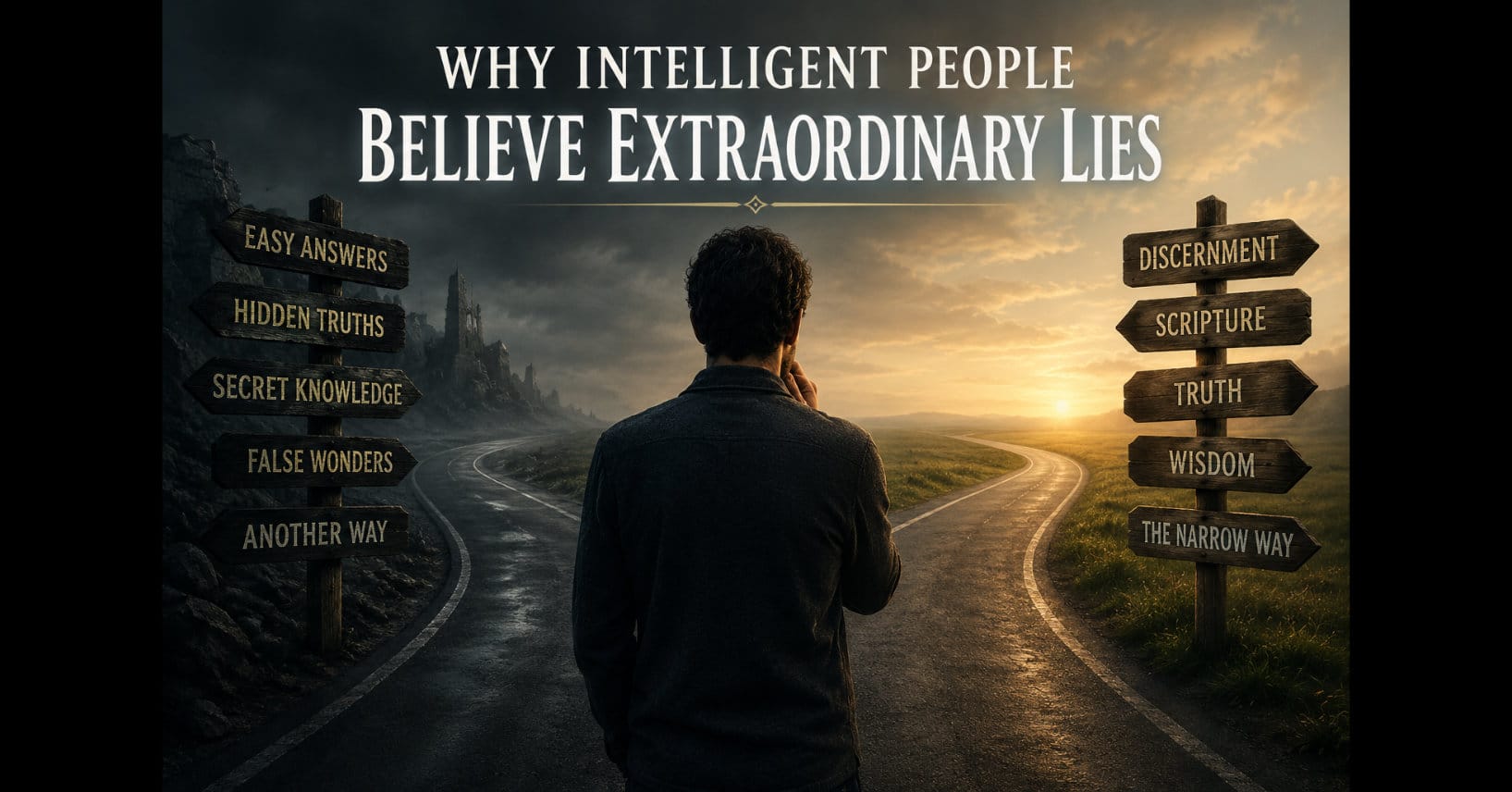
The piece argues that intelligence does not protect people from deception and that many false ideas are believable because they mix truth with error. It frames deception as a spiritual problem, warning that pride and confidence in human reasoning can make people more vulnerable.
It calls for biblical discernment, using examples such as Eden and the Bereans to show the need to test claims against Scripture. In a world filled with competing voices, it says wisdom, humility, and commitment to truth are more important than intellect alone.
One of the most dangerous assumptions a person can make is that intelligence provides immunity from deception.
History tells a different story.
Some of the most educated societies in human history have embraced destructive ideologies. Brilliant scientists, accomplished leaders, respected scholars, and influential thinkers have all fallen prey to ideas that later proved false. Intelligence alone has never been a reliable defense against deception.
This is an uncomfortable truth because most people assume that if enough evidence is presented, truth will naturally prevail. Yet the Bible presents a very different picture of human nature. Scripture repeatedly shows that deception is not primarily an intellectual problem. It is a spiritual one.
The first deception in human history did not occur because Eve lacked information. She knew God’s command. She understood the boundary that had been established. The serpent’s success came not from overwhelming her with facts but from causing her to question the source of truth itself.
“Yea, hath God said…” (Genesis 3:1, KJV)
The attack was subtle. The serpent did not begin with a blatant lie. He began with a question.
That pattern has not changed.
Most successful deceptions do not begin by denying truth outright. They begin by reframing it. They introduce uncertainty. They shift authority. They encourage people to trust their own judgment above God’s revealed Word.
The result is often a lie wrapped in enough truth to appear reasonable.
This helps explain why intelligent people can believe extraordinary things.
A person’s intellect may help them process information, but intelligence does not determine the source of the information being trusted. A brilliant mind operating from false assumptions can arrive at spectacularly wrong conclusions.
In fact, intelligence can sometimes make deception more difficult to recognize.
The more educated we become, the more tempted we may be to trust our own reasoning. We become confident in our ability to evaluate claims, identify flaws, and reach conclusions. Yet confidence can create blind spots. When pride enters the equation, discernment often exits.
Scripture repeatedly warns against this danger.
“There is a way which seemeth right unto a man, but the end thereof are the ways of death.” (Proverbs 14:12, KJV)
Notice that the verse does not describe something that appears obviously wrong. It describes something that seems right.
That distinction is critical.
The greatest deceptions are rarely absurd on the surface. They are believable. They appeal to human desires. They offer explanations that appear logical. They often contain enough truth to make the falsehood difficult to detect.
Consider some of the ideas gaining popularity in our own time.
People are told they can manifest reality through focused intention.
Others are taught that spirit guides offer wisdom and enlightenment.
Some believe humanity is evolving toward a higher state of consciousness.
Others look to advanced technology as the solution to every human problem.
Still others place their hope in mysterious intelligences from beyond our world.
The specific claims differ, but the underlying pattern remains remarkably consistent. Each offers knowledge, power, enlightenment, or salvation apart from God.
That should sound familiar.
It is the same promise that appeared in Eden.
“Ye shall be as gods…” (Genesis 3:5, KJV)
The details change. The temptation remains.
This is why discernment matters.
Discernment is not the same as intelligence.
Discernment is the ability to distinguish truth from error, even when error appears attractive. It is the ability to evaluate claims according to God’s standards rather than our own preferences. It requires humility, spiritual maturity, and a willingness to submit our conclusions to Scripture.
The Bereans provide one of the clearest examples.
These were not gullible people. They listened carefully to Paul’s teaching. Yet they did not accept his words blindly. They compared what they heard against the Scriptures.
“These were more noble than those in Thessalonica, in that they received the word with all readiness of mind, and searched the scriptures daily, whether those things were so.” (Acts 17:11, KJV)
Their nobility was not found in skepticism alone. It was found in their commitment to testing claims against God’s Word.
That remains the standard today.
The modern world offers an endless stream of information. News, videos, podcasts, social media, artificial intelligence, experts, influencers, and self-proclaimed spiritual authorities all compete for our attention. Never before have so many voices spoken so loudly at the same time.
Yet access to information does not automatically produce wisdom.
In many cases, it simply produces confusion.
The question is no longer whether information is available. The question is which voices deserve to be trusted.
That is where discernment becomes essential.
The challenge facing Christians today is not a lack of knowledge. It is learning how to evaluate competing claims in a world saturated with counterfeits.
The coming years will likely present even greater challenges. Extraordinary claims will continue to emerge. New technologies will blur old distinctions. Spiritual experiences will be offered as evidence of truth. Signs and wonders will persuade many.
Those who rely solely on intelligence may find themselves vulnerable.
Those who cultivate biblical discernment will be better prepared.
The goal is not to become cynical. It is not to reject every unusual claim automatically. Nor is it to live in constant suspicion.
The goal is to love truth enough to test everything.
Discernment begins with a simple recognition: intelligence is a gift, but it is not a shield against deception.
Truth requires more than knowledge.
It requires wisdom.
It requires humility.
And above all, it requires a commitment to the One who is Himself the Truth.