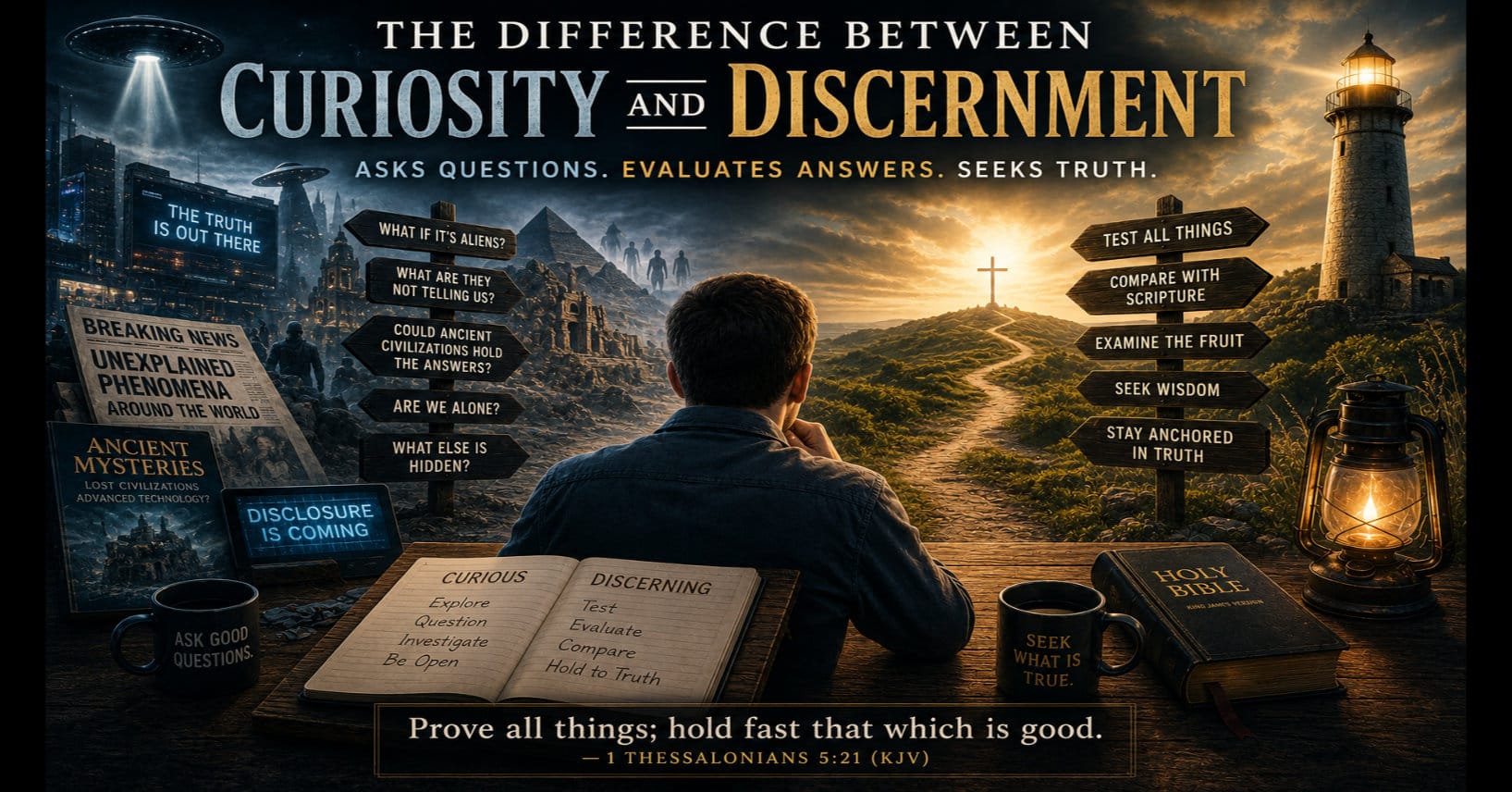
The piece argues that abundant information has not produced greater wisdom because knowledge and discernment are different. It warns that curiosity without evaluation leaves people vulnerable to deception, especially amid misinformation, sensational claims, and persuasive digital content.
Using Scripture and the Bereans as examples, it presents discernment as a practiced biblical skill grounded in God’s Word. Christians are urged to test claims, compare them with Scripture, and pursue truth rather than merely collecting information.
Curiosity is one of God’s gifts to humanity.
It drives exploration.
It fuels discovery.
It inspires questions.
Without curiosity, civilizations would never have crossed oceans, studied the stars, explored the natural world, or pursued knowledge. Curiosity motivates us to seek understanding about the world around us and our place within it.
Yet curiosity alone is not enough.
Curiosity asks questions.
Discernment evaluates answers.
The distinction is subtle, but it is one of the most important lessons a Christian can learn.
In an age filled with extraordinary claims, curiosity often receives praise while discernment is neglected. We are encouraged to keep an open mind, challenge assumptions, and explore new possibilities. These can be healthy impulses when properly directed.
The danger arises when curiosity becomes disconnected from discernment.
A person who is curious without discernment may spend a lifetime chasing mysteries while never arriving at truth.
Scripture never condemns curiosity itself.
In fact, the Bible is filled with individuals who asked difficult questions.
The prophets sought understanding.
The disciples questioned Jesus repeatedly.
Daniel desired insight into visions and future events.
The Bereans examined teachings to determine whether they were true.
The issue was never the existence of questions.
The issue was how those questions were pursued.
God never asks His people to stop thinking.
He asks them to think wisely.
This distinction becomes increasingly important when exploring subjects that naturally provoke curiosity.
Questions about unidentified aerial phenomena.
Ancient civilizations.
Archaeological mysteries.
Anomalous discoveries.
Legends of giants.
Claims of extraterrestrial contact.
Reports of supernatural encounters.
Advanced technologies.
Hidden histories.
These subjects fascinate millions of people because they touch something deeply human.
We want answers.
We want understanding.
We want to know whether there is more to reality than we currently perceive.
There is nothing inherently wrong with those desires.
The problem arises when curiosity becomes the destination rather than the starting point.
Many people assume that because a question is legitimate, every proposed answer deserves equal credibility.
That is not discernment.
That is vulnerability.
Discernment recognizes that some explanations are more trustworthy than others.
Some are supported by evidence.
Some are contradicted by evidence.
Some align with Scripture.
Some undermine it.
The Christian’s responsibility is not merely to ask questions.
It is to evaluate answers.
This is precisely where many modern discussions about anomalous phenomena become difficult.
Consider the subject of UFOs.
A curious person asks:
“What are people seeing?”
That is a reasonable question.
A discerning person asks:
“What evidence supports the various explanations being offered?”
That is a better question.
A curious person asks:
“Could extraterrestrial life exist?”
A discerning person asks:
“What assumptions accompany the answers being proposed?”
A curious person asks:
“What if ancient civilizations possessed advanced knowledge?”
A discerning person asks:
“Does the evidence support that conclusion, and how does it align with a biblical worldview?”
Notice the difference.
Curiosity focuses on possibilities.
Discernment focuses on evaluation.
Both are important.
Only one protects against deception.
This distinction can be seen throughout Scripture.
When Eve encountered the serpent, curiosity was not her greatest problem.
Curiosity prompted a conversation.
The failure occurred when discernment disappeared.
The serpent offered an explanation that contradicted God’s Word.
Instead of testing that explanation against what God had already revealed, Eve accepted the alternative narrative.
The issue was not curiosity.
The issue was discernment.
The same pattern appears repeatedly throughout history.
False religions often begin with legitimate questions.
Cults frequently emerge around genuine mysteries.
Conspiracy theories usually contain fragments of truth.
Occult movements often promise hidden knowledge.
The initial curiosity may be understandable.
The conclusions often become dangerous.
This is why Christians should resist two opposite errors.
The first error is gullibility.
This occurs when curiosity overwhelms discernment.
Every claim is accepted.
Every mystery becomes evidence.
Every anomaly confirms a theory.
Questions become conclusions before sufficient evaluation occurs.
The second error is cynicism.
This occurs when fear replaces curiosity.
Every unusual claim is dismissed automatically.
Every mystery is ignored.
Every anomaly is rejected without examination.
Questions are abandoned before investigation begins.
Neither approach reflects biblical wisdom.
The Bereans demonstrated a better path.
They listened carefully.
They investigated diligently.
They examined evidence.
Most importantly, they compared everything against Scripture.
“These were more noble than those in Thessalonica, in that they received the word with all readiness of mind, and searched the scriptures daily, whether those things were so.” (Acts 17:11, KJV)
Notice the balance.
They were open-minded enough to listen.
They were discerning enough to verify.
That balance is desperately needed today.
We live in a world overflowing with extraordinary claims.
Social media rewards speculation.
Algorithms amplify sensationalism.
Videos promise hidden truths.
Influencers claim secret knowledge.
Artificial intelligence can generate persuasive explanations for almost anything.
The temptation is either to believe everything or reject everything.
Discernment chooses a different path.
Discernment remains curious without becoming gullible.
It remains skeptical without becoming cynical.
It welcomes questions while demanding evidence.
It explores mysteries while remaining anchored to truth.
Most importantly, it recognizes that God’s Word remains the ultimate standard for evaluating every claim.
This principle has guided much of the exploration found throughout The Alien Deception Chronicles.
Questions about UFOs, ancient mysteries, transhumanism, artificial intelligence, unexplained phenomena, and spiritual experiences deserve thoughtful consideration.
But curiosity alone is not enough.
The goal is not merely to collect mysteries.
The goal is to pursue truth.
A person can spend a lifetime chasing fascinating questions and never arrive at wisdom.
Discernment ensures that curiosity serves truth rather than replacing it.
In the end, curiosity asks, “What if?”
Discernment asks, “What is true?”
Both questions matter.
Only one leads safely through a world filled with competing explanations, hidden agendas, and persuasive deceptions.
That is why curiosity is valuable.
But discernment is essential.