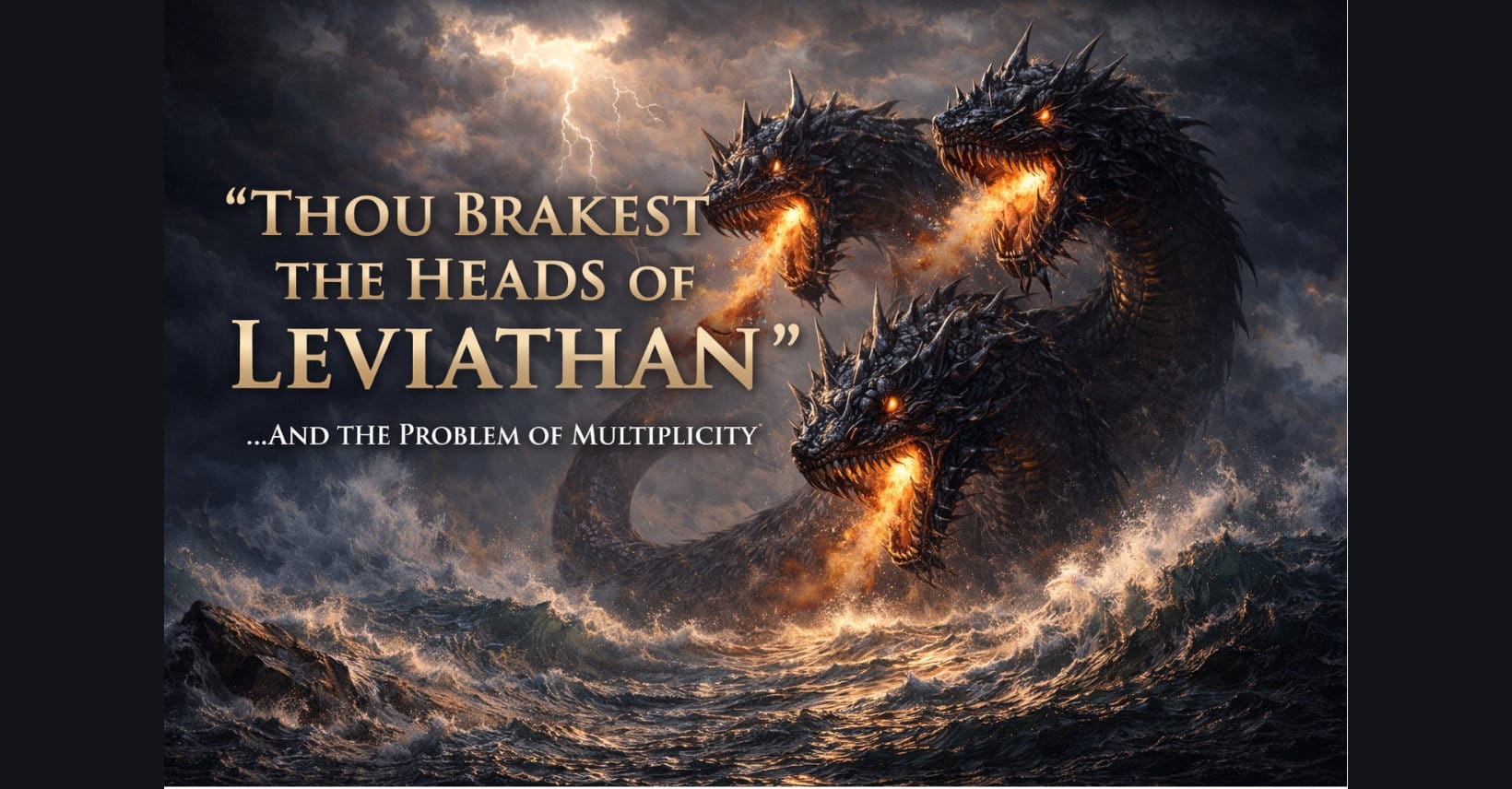
The passage examines Psalm 74’s reference to “the heads of leviathan,” arguing that the plural form complicates any simple reading of Leviathan as a single creature. It outlines possible interpretations, including a multi-headed being, a collective entity, or poetic emphasis.
It also contrasts Job’s detailed physical description with Psalms’ language of defeat, showing that Leviathan remains both concrete and ambiguous across texts. The discussion ends by proposing that Isaiah may further alter Leviathan’s classification.
If the account in the Book of Job establishes Leviathan as a creature described in precise and unsettling detail, the next reference complicates the picture.
Not slightly.
Fundamentally.
Because when we encounter Leviathan again in the Book of Psalms, the language shifts in a way that cannot be ignored:
“Thou brakest the heads of leviathan in pieces…” (Psalm 74:14, KJV)
Not the head.
The heads.
A Single Phrase That Expands the Category
This is where interpretive simplicity begins to break down.
If Leviathan were a singular, straightforward creature—as many assume from Job 41—this phrasing introduces a structural problem.
We are now faced with three possibilities:
1. A Multi-Headed Creature
Leviathan is a singular being, but with multiple heads—placing it within a class of creatures known in ancient literature but difficult to reconcile with natural categories.
2. A Collective Entity
“Leviathan” may refer to a group or class of beings, described as a singular concept but existing in plurality.
3. A Symbolic Amplification
The plural language is poetic—used to emphasize total defeat rather than describe physical structure.
Each of these interpretations has merit.
But none of them allows us to return to a simple reading.
Context Matters
Psalm 74 is not a zoological account. It is a historical and theological reflection—recalling God’s acts of power and deliverance.
Within that context, Leviathan appears alongside other acts associated with divine authority over creation:
- Dividing the sea
- Breaking the strength of enemies
- Establishing order over chaos
This has led many to interpret Leviathan as symbolic—a representation of opposing forces rather than a literal being.
And yet, the language remains specific.
“Thou brakest the heads…”
Even in poetic form, this is an unusually concrete expression.
It does not merely say Leviathan was defeated.
It describes how.
The Persistence of Physical Language
This is where the tension from the previous article carries forward.
In the Book of Job, Leviathan is described with physical precision:
- Scales
- Teeth
- Strength
- Behavior
In the Book of Psalms, the description shifts in tone—but not entirely in substance.
We are still dealing with:
- A defined entity
- A physical act of destruction
- A structure that includes multiple “heads”
If this were purely symbolic, the question becomes:
Why maintain such consistent, tangible imagery across different contexts?
Singular Name, Plural Implication
Another detail worth noting is the use of the name itself.
“Leviathan” remains singular in form.
Yet the description introduces plurality.
This is not unusual in ancient literature, where a singular term can represent:
- A class of beings
- A collective force
- Or a category understood as one concept
But it does introduce ambiguity.
And ambiguity, when consistent across texts, becomes a signal—not a flaw.
A Pattern Begins to Form
At this point, two observations can be made without forcing a conclusion:
First, Leviathan is not consistently described as a simple, singular creature.
Second, the language surrounding it allows for complexity—whether structural, collective, or symbolic.
This matters because it expands the interpretive field.
We are no longer asking:
“What is Leviathan?”
We are now asking:
“What kind of category does Leviathan belong to?”
That is a more demanding question.
The Role of Defeat
Another element introduced in this passage is outcome.
In Job, Leviathan is:
- Untamable
- Beyond human control
In Psalms, Leviathan is:
- Overpowered
- Broken
- Defeated by God
This is not a contradiction.
It is a distinction of authority.
What humanity cannot subdue, God can.
And does.
That reinforces the central theological theme while leaving the nature of the entity itself open for examination.
Interpretation Without Overreach
It would be easy at this point to push toward a definitive model:
- A multi-headed sea creature
- A class of entities
- A symbolic construct of chaos
But restraint remains critical.
The text gives us data points, not a finalized system.
What it clearly does is this:
- It complicates the singular reading of Leviathan
- It introduces plurality into the description
- It maintains physical language even in poetic context
That combination is not accidental.
Where the Inquiry Moves Next
If Leviathan can be described as both singular and plural…
If it can be both untamable and defeated…
If it can carry both physical and symbolic weight…
Then the next step is not to resolve the tension.
It is to examine whether this pattern appears elsewhere.
In the next article, we turn to the Book of Isaiah, where Leviathan is given a different classification altogether:
“The piercing serpent… the crooked serpent… the dragon that is in the sea…”
Because once Leviathan is called a serpent… and a dragon…
we are no longer just dealing with multiplicity.
We are dealing with taxonomy.