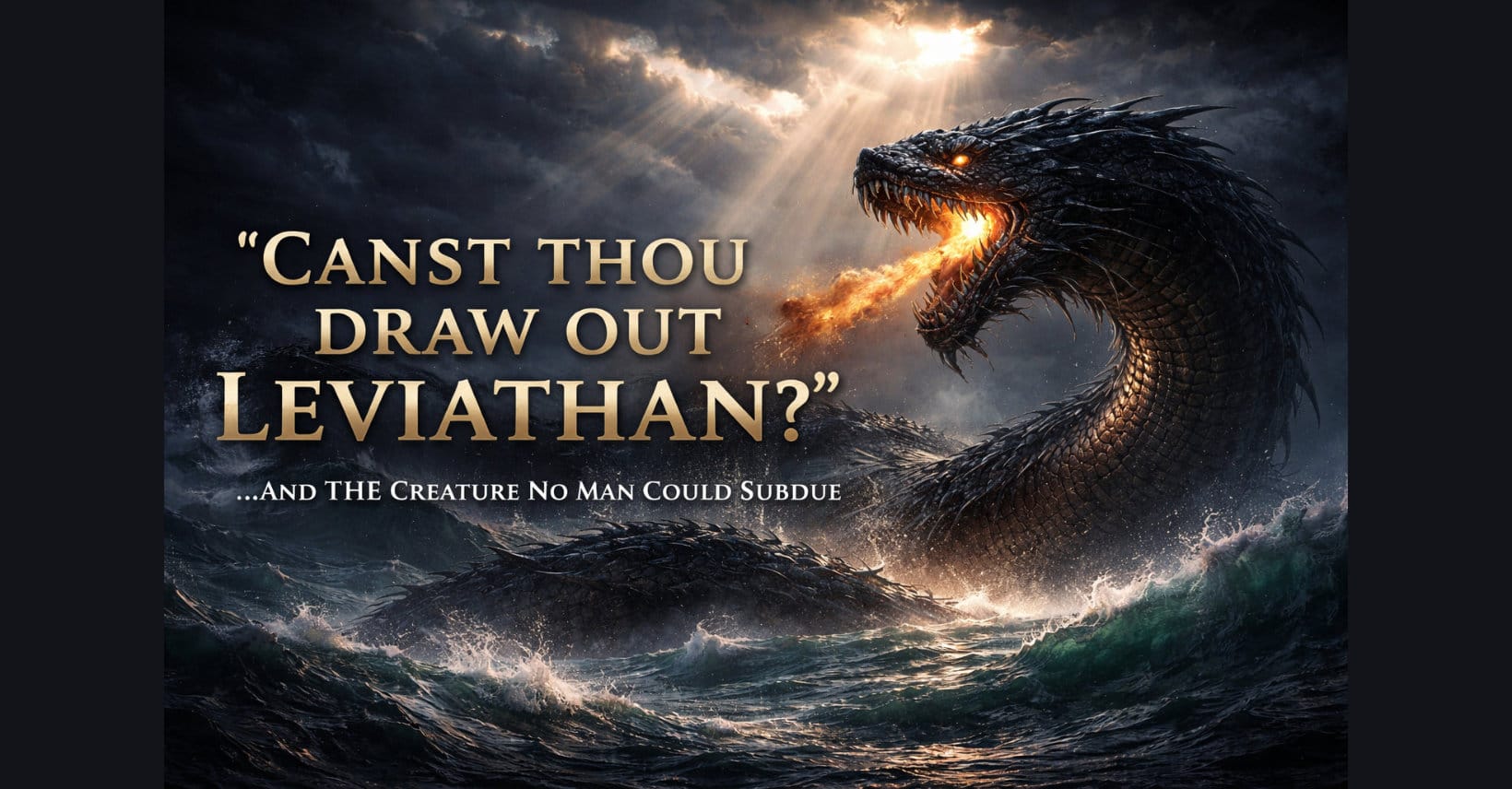
The passage argues that Leviathan in Job is presented as a real, detailed, and uncontrollable entity rather than a simple metaphor. It emphasizes the text’s physical descriptions and its use of Leviathan to illustrate the limits of human power.
It also notes that common explanations, such as a crocodile or an allegory for chaos, do not fully fit the language. The post ends by proposing further comparison with other biblical passages, especially Psalms.
There are passages in Scripture that invite reflection.
And then there are passages that resist it.
Leviathan belongs to the latter.
Most readers encounter the term briefly—often grouped with poetic imagery, assumed to be symbolic, and quickly passed over. But when we slow down and examine the text carefully, particularly in the Book of Job, something unexpected emerges.
The description does not read like metaphor.
It reads like observation.
The Question That Frames the Inquiry
The account begins not with a declaration, but with a challenge:
“Canst thou draw out leviathan with an hook? or his tongue with a cord which thou lettest down?” (Job 41:1, KJV)
This is not abstract theology. It is a direct comparison between human capability and something beyond it.
The structure of the passage is important. God is not explaining Leviathan. He is using it as evidence—demonstrating the limits of human authority, knowledge, and control.
That alone should give us pause.
Because whatever Leviathan is, it is presented as something real enough to serve as a point of contrast.
A Description That Refuses Simplification
As the passage unfolds, the level of detail intensifies.
Leviathan is described as possessing:
- Scales so tightly sealed that “one is so near to another, that no air can come between them” (Job 41:16)
- A presence that inspires fear even among the mighty
- Strength that renders human weapons ineffective
And then the description shifts into something even more difficult to categorize:
“Out of his mouth go burning lamps, and sparks of fire leap out.” (Job 41:19, KJV)
“Out of his nostrils goeth smoke…” (Job 41:20, KJV)
This is where many readers instinctively retreat into symbolism.
But notice what the text does not do.
It does not signal metaphor.
It does not qualify the description.
It does not step back into poetic abstraction.
Instead, it continues—line after line—layering physical characteristics with behavioral traits, as though documenting something observed rather than imagined.
The Problem with Easy Answers
There have been attempts to explain Leviathan in familiar terms.
Some suggest a crocodile. Others point to extinct marine reptiles. These interpretations attempt to reconcile the text with known categories.
But they encounter immediate friction.
A crocodile does not emit fire or smoke.
No known creature aligns cleanly with the totality of the description.
This creates a tension that is often resolved by defaulting to allegory.
Leviathan becomes a symbol:
- Of chaos
- Of evil
- Of opposition to divine order
And while those interpretations may carry theological weight, they do not fully account for the precision of the language.
The text reads as if the author is describing something specific—not merely invoking an idea.
A Creature Beyond Human Authority
One of the most consistent themes in the passage is not just what Leviathan is—but what humanity cannot do in relation to it.
“Lay thine hand upon him, remember the battle, do no more.” (Job 41:8, KJV)
This is not a poetic flourish. It is a warning.
Leviathan is presented as:
- Uncontrollable
- Unsubduable
- Immune to human force
The implication is clear: whatever this entity represents, it exists outside the domain of human governance.
That distinction matters.
Because throughout Scripture, created things are typically categorized within human reach—animals to steward, land to cultivate, systems to understand.
Leviathan stands apart.
Observation or Illustration?
This brings us to the central question:
Is Leviathan a symbolic construct…
or a recorded encounter described in the only language available at the time?
At this stage, the text does not force a conclusion.
But it does establish a pattern:
- Specific physical attributes
- Consistent behavioral traits
- A defined relationship to human limitation
This is not how abstract concepts are typically communicated.
It is how phenomena are described.
Why This Matters
The significance of Leviathan is not found in proving what it is.
It is found in recognizing how it is presented.
If the passage is purely symbolic, then its function is straightforward—it illustrates the power of God over chaos.
But if the language reflects observation, then we are faced with a different possibility:
That ancient writers were documenting encounters with something they did not fully understand, using the vocabulary available to them.
That possibility does not overturn Scripture.
It invites us to read it more carefully.
A Controlled Approach
For now, restraint is necessary.
There is no need to leap beyond the text. No need to assign modern explanations or force alignment with contemporary theories.
The passage in the Book of Job stands on its own.
It presents Leviathan as:
- Real within the narrative
- Detailed in its description
- Beyond human control
- Subject only to God
That is enough to establish the foundation.
Where the Inquiry Leads Next
If Leviathan is described this precisely in one part of Scripture, the next logical step is not speculation—it is comparison.
Do other passages describe the same entity?
Do they expand or complicate the picture?
Do they confirm a singular creature—or suggest something more complex?
In the next article, we turn to the Book of Psalms and a single phrase that changes the entire conversation:
“Thou brakest the heads of leviathan in pieces…”
Because once Leviathan has more than one head…
we are no longer dealing with a simple category.