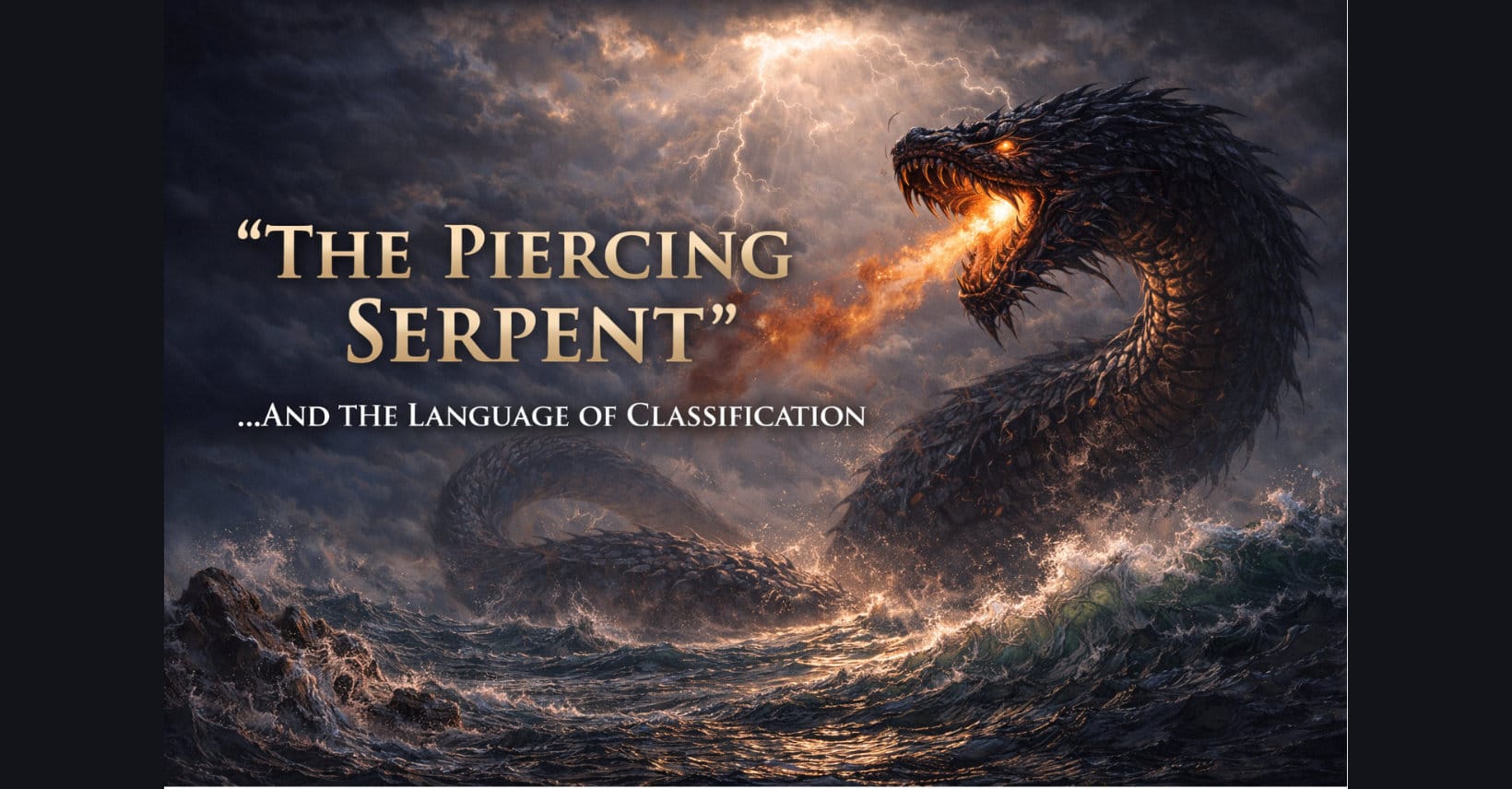
The post examines Isaiah’s description of Leviathan as a “piercing serpent,” “crooked serpent,” and “dragon that is in the sea,” arguing that the language combines form, behavior, scale, and setting rather than simple repetition. It compares this passage with Job and Psalms to show a developing, layered portrayal.
It concludes that Leviathan is consistently linked to the sea and presented in future judgment, leaving open whether the figure is literal, symbolic, or both. The article sets up a comparison with ancient Near Eastern traditions, especially Lotan.
By the time we reach the Book of Isaiah, the discussion surrounding Leviathan has already become complex.
In the Book of Job, it is described in detailed, physical terms—something formidable, untamable, and beyond human control.
In the Book of Psalms, the language introduces plurality—“heads”—raising questions about structure and category.
Now, in Isaiah, the description evolves again.
And this time, the shift is not about structure.
It is about classification.
A Layered Description
Isaiah 27:1 (KJV) presents Leviathan with a series of identifiers:
“In that day the Lord with his sore and great and strong sword shall punish leviathan the piercing serpent, even leviathan that crooked serpent; and he shall slay the dragon that is in the sea.”
Three distinct terms are used:
- Piercing serpent
- Crooked serpent
- Dragon that is in the sea
This is not repetition for emphasis alone.
It is layering.
Each phrase adds a dimension to how Leviathan is understood.
The Precision of Language
Ancient texts often employ repetition for poetic rhythm, but here the structure suggests something more deliberate.
The terms are not identical:
- A serpent implies form—elongated, coiled, deliberate
- A piercing serpent suggests movement—swift, penetrating, directed
- A crooked serpent implies behavior—twisting, elusive, unpredictable
- A dragon introduces scale and power—something beyond ordinary classification
And then the domain is specified:
- “in the sea”
Taken together, this is not a vague reference.
It is a composite description.
Taxonomy Without a System
Modern readers are accustomed to formal classification—species, genus, defined categories.
Ancient writers did not operate within that framework.
Instead, they described what they observed using layered identifiers:
- Form
- Behavior
- Environment
- Effect
Isaiah’s description follows that pattern precisely.
It does not attempt to name Leviathan within a fixed system.
It describes it from multiple angles.
The Consistency Across Texts
What becomes notable at this stage is not just the variation—but the consistency beneath it.
Across the three passages:
- The Book of Job provides physical detail
- The Book of Psalms introduces structural complexity
- The Book of Isaiah offers categorical layering
Different contexts.
Different purposes.
But a sustained effort to describe the same entity—or category of entity—with increasing dimensionality.
That pattern is difficult to ignore.
The Role of the Serpent
The repeated use of “serpent” invites comparison to other parts of Scripture.
The serpent is not a neutral symbol.
It is associated with:
- Deception
- Subtlety
- Opposition
Yet Isaiah does not stop at “serpent.”
He modifies it.
Piercing.
Crooked.
These are not moral descriptors.
They are behavioral.
They describe how the entity operates.
The Introduction of the Dragon
The transition from serpent to dragon is significant.
In ancient language, “dragon” often denotes:
- Scale beyond the ordinary
- Power beyond containment
- Presence that dominates its environment
This is not a contradiction of the serpent imagery.
It is an expansion.
The same entity is being described at multiple levels of perception.
The Domain Remains Constant
Despite the evolving language, one detail does not change:
Leviathan is consistently tied to the sea.
- In Job, it moves within the waters
- In Psalms, it is broken within that domain
- In Isaiah, it is explicitly called “the dragon that is in the sea”
This consistency anchors the description.
Whatever Leviathan represents, it is not abstracted from environment.
It is located.
That matters.
Because location introduces constraint—and constraint suggests something more than pure symbolism.
Judgment, Not Origin
Another important shift in Isaiah is temporal.
The passage is not describing Leviathan’s nature alone.
It is describing its future:
“In that day… he shall slay the dragon that is in the sea.”
This is prophetic.
It points forward, not backward.
Which raises a question:
If Leviathan were purely symbolic—representing chaos already overcome—why position its destruction in the future?
The text does not answer that directly.
But it does preserve the tension.
Interpreting Without Collapsing the Framework
At this stage, the cumulative description of Leviathan includes:
- Detailed physical traits
- Structural complexity
- Layered classification
- Consistent domain
- Future judgment
Each addition expands the picture.
None resolves it.
That is not a weakness in the text.
It is an indication that the category may be more complex than a single interpretive model allows.
A Working Observation
Without forcing a conclusion, one observation can be made:
Leviathan is described in a way that combines:
- Physicality
- Behavior
- Classification
- Environment
This is how entities are typically documented—not merely symbolized.
Whether the language is fully literal, partially symbolic, or something in between remains open.
But the structure of the description is deliberate.
Where the Inquiry Leads
If Leviathan is:
- Not strictly singular
- Not easily classified
- Not confined to symbolic language
Then the next step is not to define it.
It is to compare it.
Do other cultures describe similar entities?
Do they use similar language?
Do they place them in the same domain?
Because if the pattern extends beyond Scripture…
Then we are no longer examining a single text.
We are examining a recurring framework.
In the next article, we turn to ancient Near Eastern sources and a name that closely mirrors Leviathan:
Lotan.
And with that comparison, the question shifts again—
From what is being described…
to why it is being described the same way across civilizations.