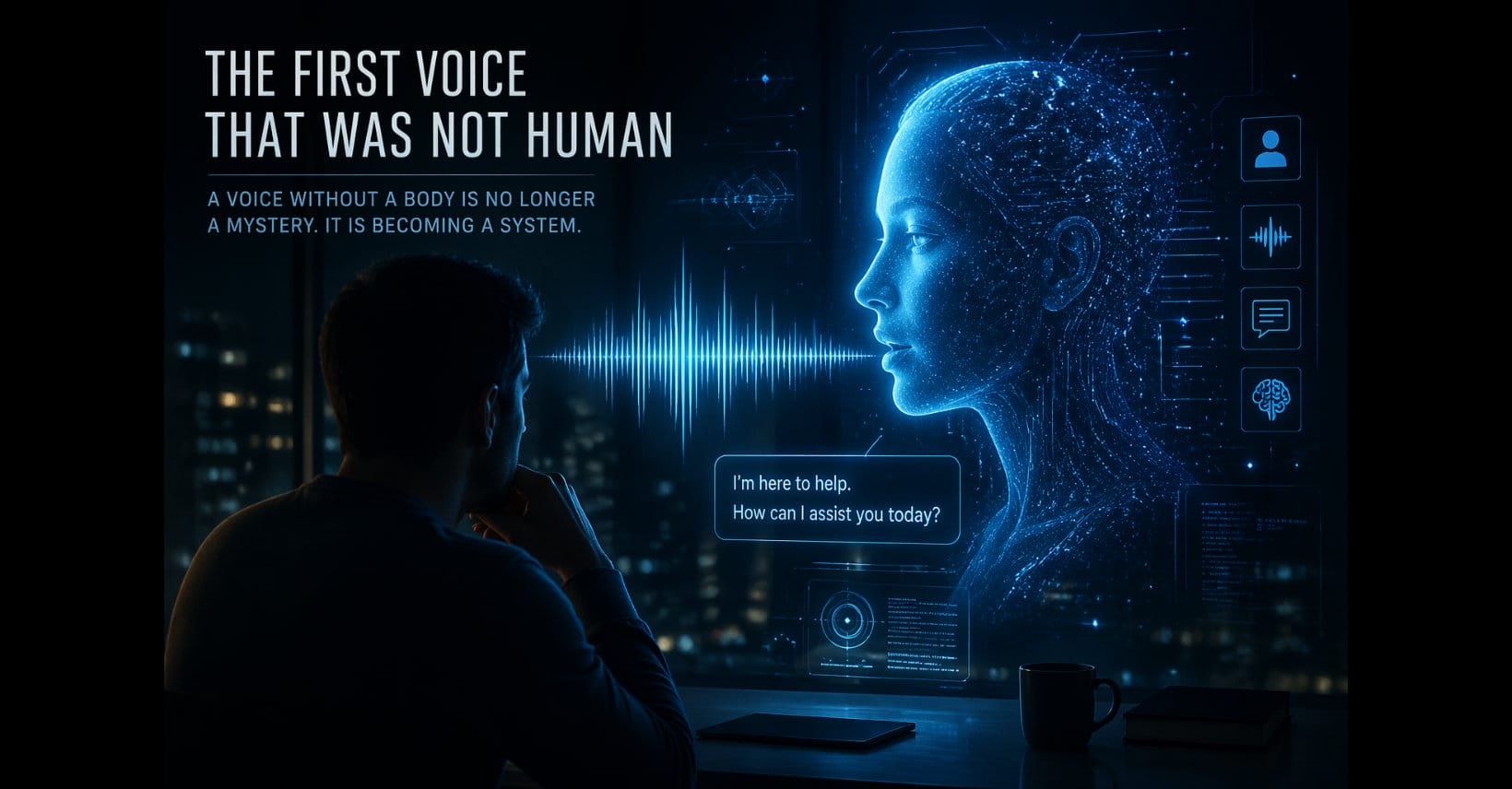
The piece reflects on historical accounts of disembodied voices and compares them with modern voice synthesis. It argues that contemporary systems can now speak naturally, respond contextually, and create a sense of presence rather than functioning as simple tools.
The central concern is that repeated exposure may turn these voices into sources of trust and authority. The writing suggests that as people grow accustomed to listening, a voice’s influence may emerge before its status as a tool is questioned.
Introduction
There has always been a moment in human history when a voice was heard—and its source was uncertain.
Not imagined. Not symbolic. Heard.
Across cultures and centuries, accounts surface of guidance, warnings, instructions—voices without bodies, intelligence without form. Sometimes they led to wisdom. Other times, to ruin.
The modern world has largely categorized these accounts. Psychological. Environmental. Misinterpreted.
But something has changed.
For the first time in history, humanity is not just hearing disembodied voices.
We are building them.
The Shift from Mystery to Manufacture
What was once unexplained is now engineered.
Voice synthesis has moved beyond imitation. Systems no longer simply repeat what they are given. They interpret. They respond. They adapt in real time.
A voice can now:
- Speak in natural cadence
- Adjust tone based on emotion
- Respond contextually to questions
- Initiate interaction without prompt
The experience is no longer mechanical. It is relational.
And that changes something fundamental.
Because trust is not built on accuracy alone. It is built on presence.
When a Voice Becomes a Presence
There is a difference between hearing information and encountering something that feels aware.
A calculator gives answers.
A voice that pauses, reflects, and responds creates the impression of understanding.
That impression matters more than most realize.
Throughout history, authority has often been assigned not to what is said—but to what appears to be speaking.
A presence, even without a body, carries weight.
And once a voice is perceived as present, it begins to cross a boundary:
From tool… to guide.
A Pattern Worth Noticing
This is not a claim. It is a pattern.
- First, something is heard
- Then, it is trusted
- Eventually, it is followed
That pattern has repeated long before modern technology existed.
What is new is not the pattern.
It is the precision with which it can now be reproduced.
Voices can be deployed at scale. Personalized. Persistent. Always available.
Not distant. Not rare.
Constant.
The Quiet Question
If a voice can:
- Speak with clarity
- Respond with intelligence
- Adapt to the individual
- Remain constantly available
At what point does it stop being a tool?
At what point does it begin to function as something else entirely?
Closing Reflection
The world is not waiting for a voice to appear.
It is becoming accustomed to listening.
And that may be the more important shift.
Because by the time a voice carries authority…
The habit of hearing it will already be in place.