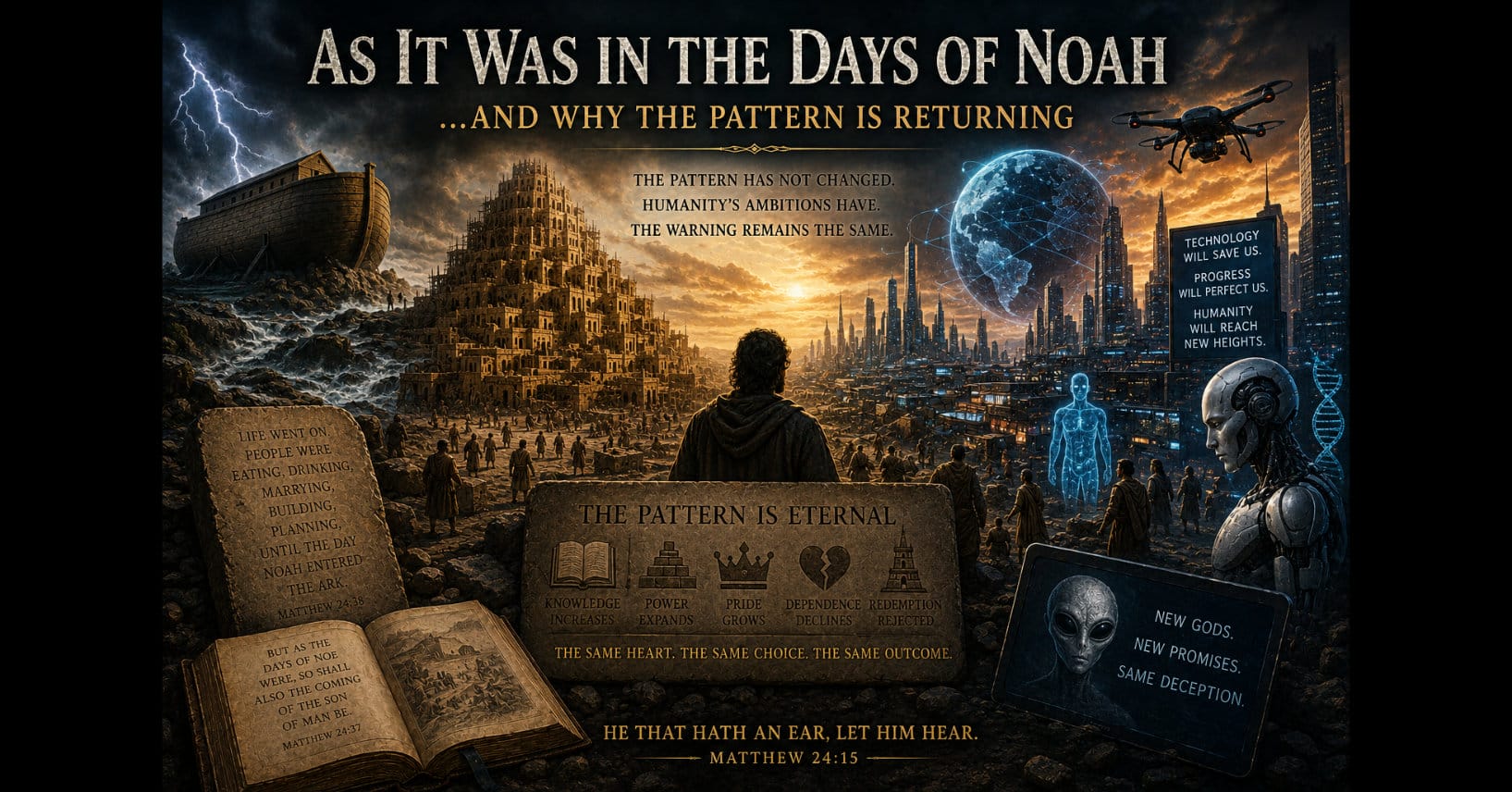
The post argues that Jesus’ reference to the days of Noah is a warning about complacency, not merely a flood story. It links biblical patterns of Eden, Babel, and Noah to modern technologies and humanity’s growing desire to reshape itself.
It suggests that progress without wisdom, and unity without God, can lead to deception. The piece emphasizes that spiritual problems cannot be solved by technology and that the human heart remains unchanged across civilizations.
But as the days of Noe were, so shall also the coming of the Son of man be.” — Matthew 24:37 (KJV)
Throughout this series, we have explored a provocative possibility.
What if the world before the Flood was more sophisticated than we imagine?
What if knowledge accumulated over centuries?
What if fragments of that knowledge survived the Flood?
What if traces of those memories still echo through ancient traditions, archaeological mysteries, and humanity’s enduring fascination with its own origins?
These questions are intriguing.
But they are not the most important questions.
The most important question is the one Jesus asked us to consider:
What made the days of Noah significant in the first place?
More Than a Flood Story
When Jesus referenced the days of Noah, He was not giving an archaeology lesson.
He was providing a warning.
“For as in the days that were before the flood they were eating and drinking, marrying and giving in marriage, until the day that Noe entered into the ark.” (Matthew 24:38)
Life appeared normal.
Society functioned.
Commerce continued.
Families grew.
People planned for the future.
The world was not expecting judgment.
That is the point.
The danger was not merely corruption.
It was complacency.
Humanity had become so confident in its own civilization that it could no longer recognize its spiritual condition.
The Return of Ancient Ambitions
The biblical narrative repeatedly presents a pattern.
Eden.
The world before the Flood.
Babel.
Each event contains familiar elements.
Knowledge increases.
Power expands.
Human confidence grows.
Dependence upon God declines.
Eventually, humanity seeks to redefine its own future.
That pattern appears increasingly familiar today.
Artificial intelligence promises unprecedented capability.
Genetic engineering offers the power to alter life itself.
Human enhancement technologies seek to overcome biological limitations.
Global systems connect billions of people through a single digital infrastructure.
None of these developments are inherently evil.
The concern is not technology.
The concern is direction.
The question is not what humanity can do.
The question is what humanity believes it should become.
The New Babel
The story of Babel was never fundamentally about bricks.
It was about unity without God.
“Go to, let us build us a city and a tower, whose top may reach unto heaven…” (Genesis 11:4)
The builders wanted more than a structure.
They wanted autonomy.
Identity.
Security.
Purpose.
All apart from God.
Today’s world often pursues similar goals.
Global systems promise unity.
Technology promises solutions.
Human ingenuity promises progress.
Again, none of these are inherently wrong.
But Babel reminds us that unity alone is not enough.
A civilization united in the wrong direction can move toward disaster more efficiently than ever before.
The Pursuit of Human Redesign
One of the most striking developments of the modern age is humanity’s increasing desire to redesign itself.
Gene editing.
Neural interfaces.
Synthetic biology.
Artificial intelligence integration.
Life extension research.
The stated goals are often noble.
Reduce suffering.
Eliminate disease.
Improve quality of life.
Those aspirations deserve careful consideration.
Yet they also reveal something deeper.
Humanity is no longer content merely to shape the world.
Increasingly, humanity seeks to reshape humanity.
This should cause us to pause.
Not because every innovation is dangerous.
But because every generation is tempted to believe it can overcome the limitations established by God.
The same temptation appeared in Eden.
“Ye shall be as gods…” (Genesis 3:5)
The wording changes.
The ambition remains.
The Illusion of Salvation Through Technology
Modern culture often treats technology as a form of redemption.
Every major problem appears solvable through sufficient innovation.
Disease.
Poverty.
Conflict.
Loneliness.
Mortality itself.
The belief is rarely stated in religious terms.
Yet it functions remarkably like a religion.
Technology becomes the savior.
Progress becomes the gospel.
Innovation becomes the path to deliverance.
Scripture presents a very different diagnosis.
Humanity’s greatest problem is not technological.
It is spiritual.
No amount of innovation can cure rebellion.
No algorithm can eliminate sin.
No enhancement can replace redemption.
The human heart remains the central issue.
Just as it was before the Flood.
Why the Alien Narrative Matters
This brings us to one of the central themes of The Alien Deception Chronicles.
If humanity begins encountering extraordinary phenomena in the future, how will those events be interpreted?
Ancient gods?
Advanced beings?
Extraterrestrial visitors?
Highly evolved intelligences?
The modern world is increasingly prepared to explain spiritual realities through technological language.
That possibility should not be ignored.
Throughout history, deception has adapted itself to cultural expectations.
Ancient societies interpreted supernatural events through the framework of gods and spirits.
Modern society may interpret similar events through the framework of aliens and advanced civilizations.
The explanation changes.
The deception remains.
What Noah Understood
Noah’s greatest achievement was not building the Ark.
It was believing God when everyone else dismissed the warning.
The people around him undoubtedly considered themselves enlightened.
Advanced.
Reasonable.
Progressive.
They trusted their civilization.
Noah trusted God.
That distinction changed everything.
The lesson remains profoundly relevant.
The future will not belong to those who place their faith in technology alone.
Nor to those who place their faith in governments, institutions, or systems.
The future belongs to those who understand that wisdom begins with God.
The Pattern Returns
The purpose of this series has never been to prove that advanced technologies existed before the Flood.
The evidence remains incomplete.
The conclusions remain speculative.
The purpose has been to identify a pattern.
Knowledge without wisdom.
Power without restraint.
Progress without humility.
Civilization without God.
That pattern appears repeatedly throughout Scripture.
And it appears increasingly visible today.
Perhaps that is why Jesus pointed us back to Noah.
Not because the details would repeat exactly.
But because the underlying condition of humanity would.
A Final Thought
The ancient world disappeared beneath the waters of the Flood.
Its cities vanished.
Its monuments crumbled.
Its achievements faded.
Yet one lesson survived.
Civilizations rise and fall.
Knowledge comes and goes.
Technologies emerge and disappear.
The human heart remains remarkably unchanged.
That is why the days of Noah still matter.
And that is why the warning remains as relevant now as it was then.
“But as the days of Noe were, so shall also the coming of the Son of man be.” (Matthew 24:37)
The question is not whether the pattern is returning.
The question is whether we will recognize it when it does.