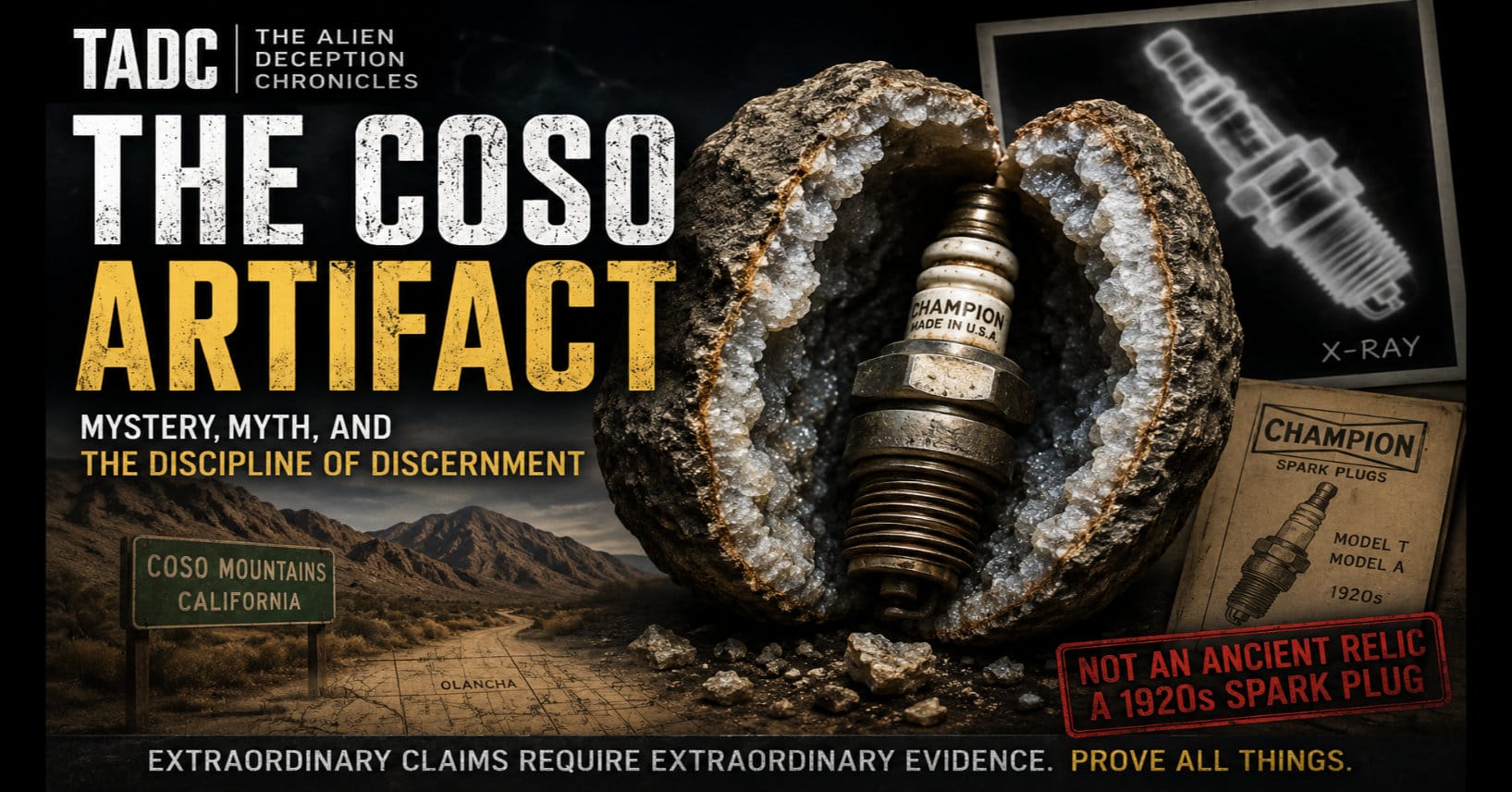
The Coso Artifact is presented as a famous out-of-place artifact claim involving a supposed spark-plug-like object found in a very old geode in California. The article argues that the age claim lacks published evidence and that the surrounding material was likely a concretion, not a geode.
Experts identified the object as a 1920s Champion spark plug, making a modern origin more plausible than ancient technology. The post uses the case to illustrate how speculation can outrun evidence and why careful discernment matters when evaluating sensational claims.
“Prove all things; hold fast that which is good.” — 1 Thessalonians 5:21 (KJV)
Few stories capture the imagination quite like the discovery of an impossible artifact.
A mysterious object found where it should not exist has long been one of the most popular themes in alternative history. Such discoveries are often called “out-of-place artifacts” (OOPArts)—objects that allegedly challenge accepted history, archaeology, or science.
Among the most famous examples is the Coso Artifact.
For decades, the story has circulated through books, documentaries, websites, and social media posts. According to the legend, researchers discovered a spark-plug-like object encased within a 500,000-year-old geode in California. If true, the implications would be staggering. Such a discovery would suggest advanced technology existed long before recorded civilization. It could point to a forgotten prehistoric culture, visitors from another world, or even evidence supporting ancient astronaut theories.
The story is fascinating.
The evidence is far less impressive.
The Discovery
In 1961, several amateur rock collectors reportedly found an unusual mineralized object near Olancha, California, in the Coso Mountain region.
When the object was cut open, investigators observed what appeared to be a ceramic cylinder surrounded by metal components. X-rays revealed internal structures that resembled a spark plug.
That alone was enough to generate curiosity.
Soon, the story evolved.
Claims began appearing that the object had been recovered from a geode estimated to be 500,000 years old. Others suggested that scientists could not explain its origin. Still others claimed the artifact disappeared before it could be properly studied, implying a cover-up.
The mystery grew larger with every retelling.
The Missing Evidence
One of the first questions a serious investigator asks is simple:
Who determined the age?
The answer is surprisingly difficult to find.
Supporters of the mystery often repeat the claim that a geologist dated the object to approximately 500,000 years old. Yet no published geological report has ever surfaced. No scientific paper exists. No documented testing method has been produced. No peer-reviewed age determination has ever been presented.
The extraordinary age claim rests largely on hearsay.
That should immediately raise concern.
A claim that overturns established history requires more than an anonymous expert and a repeated story.
It requires evidence.
Was It Even a Geode?
Another problem emerges when investigators examine the object itself.
The famous story describes the artifact as being embedded inside a geode.
However, geologists who later reviewed photographs and descriptions concluded that the surrounding material more closely resembled a concretion rather than a geode.
The distinction matters.
A geode forms through geological processes over long periods of time and contains a hollow cavity often lined with crystals.
A concretion, however, can form around an object much more rapidly. Mineral-rich groundwater can gradually encase metal objects, creating a hard outer shell that appears ancient even when the enclosed item is only decades old.
In other words, an old-looking rock surrounding a modern object does not automatically make the object ancient.
The Spark Plug Connection
The strongest evidence emerged when experts in antique spark plugs examined photographs and X-rays of the artifact.
Several collectors independently identified the object as a Champion spark plug commonly used in automobiles during the 1920s.
Specifically, they noted similarities to spark plugs used in early Ford vehicles and other engines of the period.
The dimensions, internal construction, ceramic insulator, and visible components all matched known designs from the early twentieth century.
Rather than being evidence of a lost civilization, the object appeared to be evidence of an old automobile.
Not nearly as exciting.
But far more likely.
Why the Story Refuses to Die
The Coso Artifact continues to circulate because it appeals to something deeper than archaeology.
People enjoy mysteries.
Many are also drawn to stories that challenge established authorities.
The idea that hidden discoveries prove everything we have been taught is wrong can be emotionally satisfying. It creates a sense of secret knowledge and insider understanding.
Unfortunately, this attraction can sometimes weaken our commitment to evidence.
A fascinating possibility is not the same thing as a proven fact.
A compelling narrative is not the same thing as a documented conclusion.
And a mystery is not necessarily evidence of a conspiracy.
Discernment and the Christian Mind
Christians should be especially careful when evaluating sensational claims.
The Bible never commands believers to be gullible.
It commands believers to be discerning.
The Apostle Paul instructed Christians:
“Prove all things; hold fast that which is good.” (1 Thessalonians 5:21)
Notice the order.
First, test.
Then, hold fast.
Many modern mysteries reverse that process. They encourage people to believe first and investigate later.
Biblical discernment demands the opposite.
Whether the claim concerns ancient aliens, hidden technologies, prophetic revelations, secret government programs, or mysterious artifacts, believers should examine the evidence before accepting the conclusion.
Truth does not fear investigation.
The Real Lesson of the Coso Artifact
Ironically, the greatest value of the Coso Artifact may not be archaeological at all.
It serves as a case study in how modern myths are created.
A curious object is discovered.
Speculation fills the gaps.
Extraordinary claims spread faster than careful analysis.
The legend grows larger than the evidence.
Eventually, many people remember the sensational conclusion while forgetting the unanswered questions.
The result is a powerful reminder that discernment is not merely a theological discipline.
It is a practical necessity.
The Coso Artifact remains an interesting historical curiosity.
But the evidence overwhelmingly points to a mineralized twentieth-century spark plug rather than proof of ancient technology.
The mystery is not that an impossible artifact was discovered.
The mystery is how quickly speculation can become accepted as fact.
And in an age overflowing with claims, theories, and viral narratives, that may be the most important lesson of all.