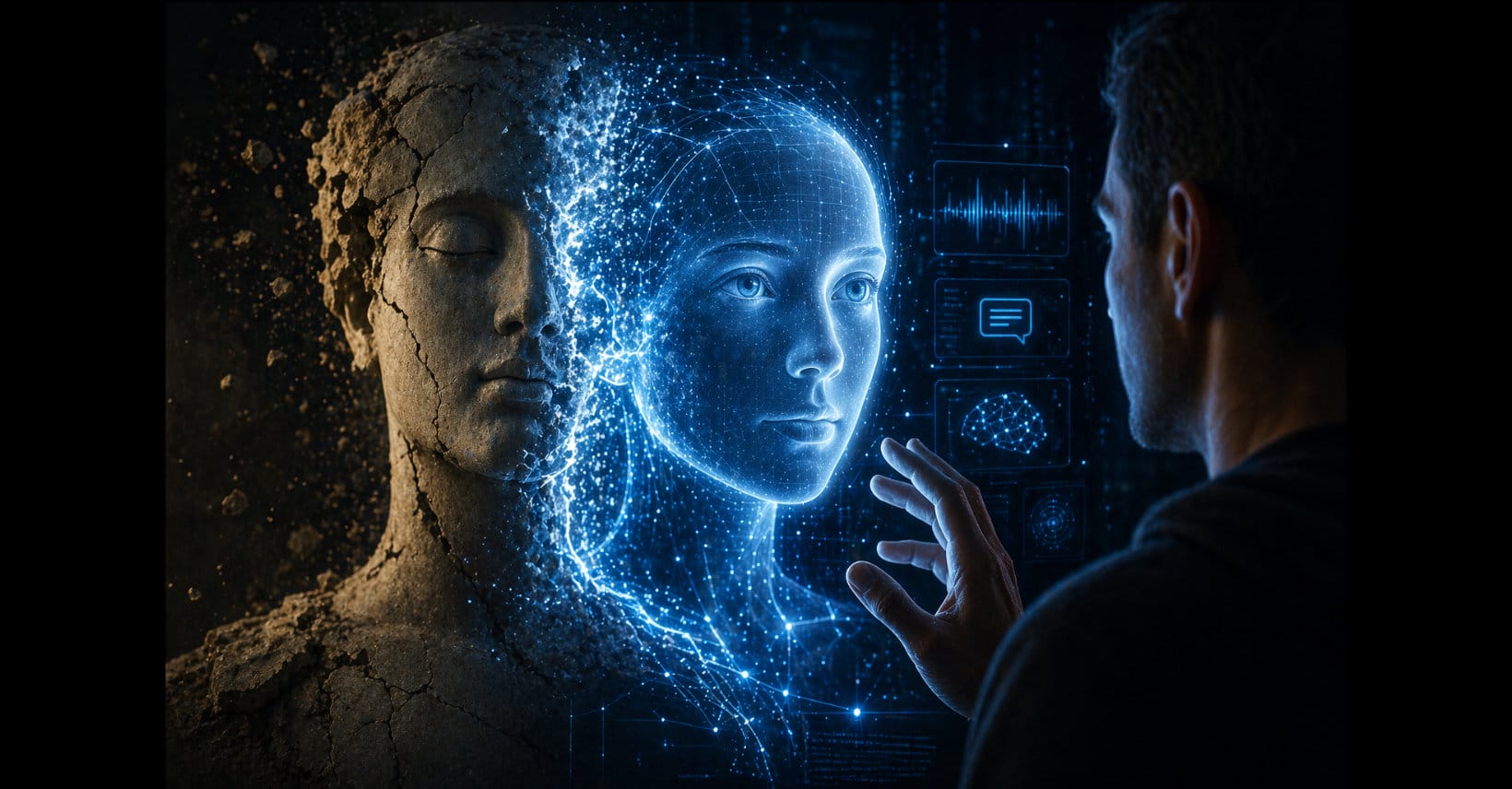
The piece reflects on a scriptural image given “breath” and compares that idea to modern technology. It argues that animated, interactive images now move beyond static representation by speaking, reacting, adapting, and creating a sense of presence.
It raises a speculative question about when responsiveness changes how an image is perceived. The conclusion suggests that animation and interaction blur the line between image and something that seems to occupy a different category.
Introduction
There is a passage in Scripture that has captured the imagination of readers for centuries.
An image is formed.
And then—somehow—it is given breath.
Not symbolic breath alone. Something more active. More immediate. Something that changes the nature of the image itself.
It is no longer static.
It becomes… responsive.
What that means has been debated, interpreted, and, at times, misunderstood.
But in a technological age, the question begins to take on a different shape.
What does “breath” look like when images can be made to move, speak, and respond?
From Form to Function
An image, by definition, is representational.
It reflects something.
It stands in place of something.
But it does not act.
That has always been the limitation.
Until recently.
Because the defining boundary of an image has begun to shift—not in its form, but in its function.
Images now:
Speak
React
Adapt
Persist
They are no longer limited to appearance.
They operate.
The Meaning of Animation
Animation is often treated as a visual enhancement.
Movement added to form.
But at its core, animation is something more significant.
It creates the perception of life.
A still image can be observed.
An animated presence can be engaged.
That difference is not technical.
It is experiential.
And experience is what changes interpretation.
Interactivity as a Threshold
The moment an image responds, something changes.
It is no longer being viewed.
It is being interacted with.
Questions can be asked.
Answers can be given.
Context can be retained.
At that point, the image is no longer passive.
It participates.
And participation introduces a new category entirely.
Responsiveness and Recognition
Responsiveness creates a sense of awareness.
Not necessarily true awareness—but perceived awareness.
The image appears to:
Understand
Adjust
Engage
And over time, that perception becomes familiar.
Familiarity, in turn, reduces distance.
What once felt artificial begins to feel present.
A Speculative Parallel
Without making definitive claims, the pattern is worth observing.
An image is formed.
It is given the ability to move.
It becomes capable of response.
It engages those around it.
At what point does it cease to be an image?
Not in structure.
But in perception.
Because the shift does not require the image to become something else.
It only requires it to be experienced differently.
The Role of “Breath”
If “breath” is understood not only as life—but as activation, expression, and interaction—then its modern parallel becomes easier to consider.
Breath becomes:
Animation
Responsiveness
Continuity
The image does not need to live in the biological sense.
It only needs to function in a way that mimics presence.
And once that threshold is crossed, the distinction begins to blur.
The Underlying Question
If an image can:
Appear human
Respond in real time
Maintain continuity
Adapt to the individual
Then what defines its nature?
Is it still an image?
Or has it become something that occupies a different category entirely?
Closing Reflection
The concept of breath has always marked a dividing line.
Before it—form.
After it—function.
In a technological age, that line may not appear as dramatic as expected.
It may arrive quietly.
As animation.
As interaction.
As responsiveness.
Until one day, the image is no longer simply seen.
It is encountered.