The post argues that Christians should evaluate every new claim by first asking what Scripture says, rather than relying on plausibility, expertise, emotion, or experience. It contrasts biblical discernment with modern deception and cites the Bereans as a model for testing teachings against Scripture.
It warns that false ideas can appear persuasive, spiritually meaningful, or intellectually sophisticated, including claims about aliens, secret knowledge, and spiritual awakening apart from Christ. The piece presents Scripture as the standard that helps believers remain anchored to truth in a time of increasing deception.
Every generation faces new claims about truth.
A new teacher appears. A new movement gains momentum. A new documentary goes viral. A new spiritual experience captures attention. A new discovery is said to rewrite history. A new voice claims to reveal what the church has supposedly missed for centuries.
Most people immediately ask:
“Is it interesting?”
“Is it convincing?”
“Does it explain something?”
“Could it be true?”
But Christians should begin somewhere else.
The first question is not whether something sounds reasonable.
The first question is not whether experts support it.
The first question is not whether it feels spiritually meaningful.
The first question every Christian should ask is:
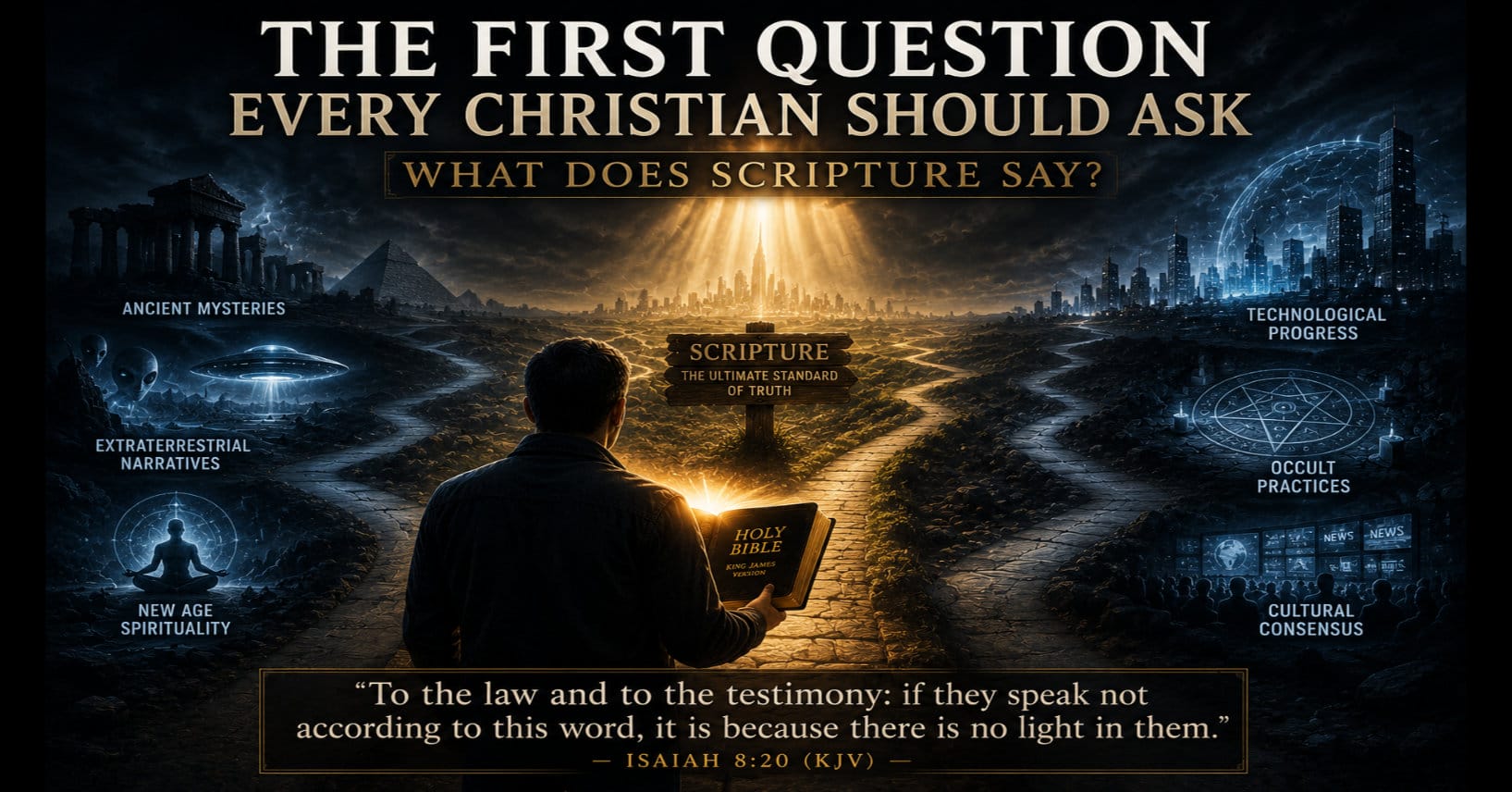
“What does Scripture say?”
That question seems simple, yet it is often neglected.
Throughout history, deception has rarely arrived wearing a name tag that says “False Teaching.” Instead, it appears wrapped in partial truths, persuasive arguments, emotional experiences, and intellectual sophistication.
Satan’s first recorded words to humanity were not an outright denial of God’s existence. They were a question designed to undermine God’s Word.
“Yea, hath God said…?” (Genesis 3:1, KJV)
The strategy has never changed.
Modern deception often begins by encouraging believers to evaluate truth through experience, emotion, science, secret knowledge, ancient mysteries, extraterrestrial narratives, mystical encounters, or cultural consensus before consulting Scripture.
Once Scripture becomes secondary, almost any idea can gain a foothold.
This is why the Bereans remain such an important example.
“These were more noble than those in Thessalonica, in that they received the word with all readiness of mind, and searched the scriptures daily, whether those things were so.” (Acts 17:11, KJV)
Notice what they did.
They did not reject Paul’s message because it was unfamiliar.
Neither did they accept it because Paul was persuasive.
They tested it against Scripture.
That remains the biblical model.
When someone claims aliens created humanity, ask what Scripture says.
When someone claims angels produced secret wisdom for mankind, ask what Scripture says.
When someone claims consciousness can evolve into godhood, ask what Scripture says.
When someone claims ancient civilizations possessed knowledge superior to God’s revelation, ask what Scripture says.
When someone claims spiritual awakening can occur apart from Jesus Christ, ask what Scripture says.
The issue is not whether a claim is fascinating.
Many false ideas are fascinating.
The issue is whether it aligns with God’s revealed truth.
The coming deception described in Scripture will not succeed because it lacks evidence. It will succeed because it offers an explanation people want to believe.
Paul warned:
“And for this cause God shall send them strong delusion, that they should believe a lie:” (2 Thessalonians 2:11, KJV)
Notice the wording.
Not merely “a mistake.”
Not merely “an error.”
A lie.
And lies only work when people stop measuring claims against truth.
The Alien Deception Chronicles repeatedly returns to this theme because it may be the defining challenge of the last days. The world is being conditioned to seek answers from everywhere except the Word of God. Technology, spirituality, entertainment, academia, and even portions of organized religion increasingly encourage people to trust their experiences above divine revelation.
Yet Scripture remains unchanged.
The Christian who asks, “What does Scripture say?” possesses a compass that still points north in a world increasingly lost in fog.
That question may not make someone popular.
It may not make them fashionable.
It may not make them accepted by the culture.
But it will keep them anchored to truth.
And in an age of deception, that may be one of the most important disciplines a believer can cultivate.
Before accepting a claim.
Before sharing a video.
Before embracing a movement.
Before following a teacher.
Before believing a narrative.
Ask the first question.
What does Scripture say?