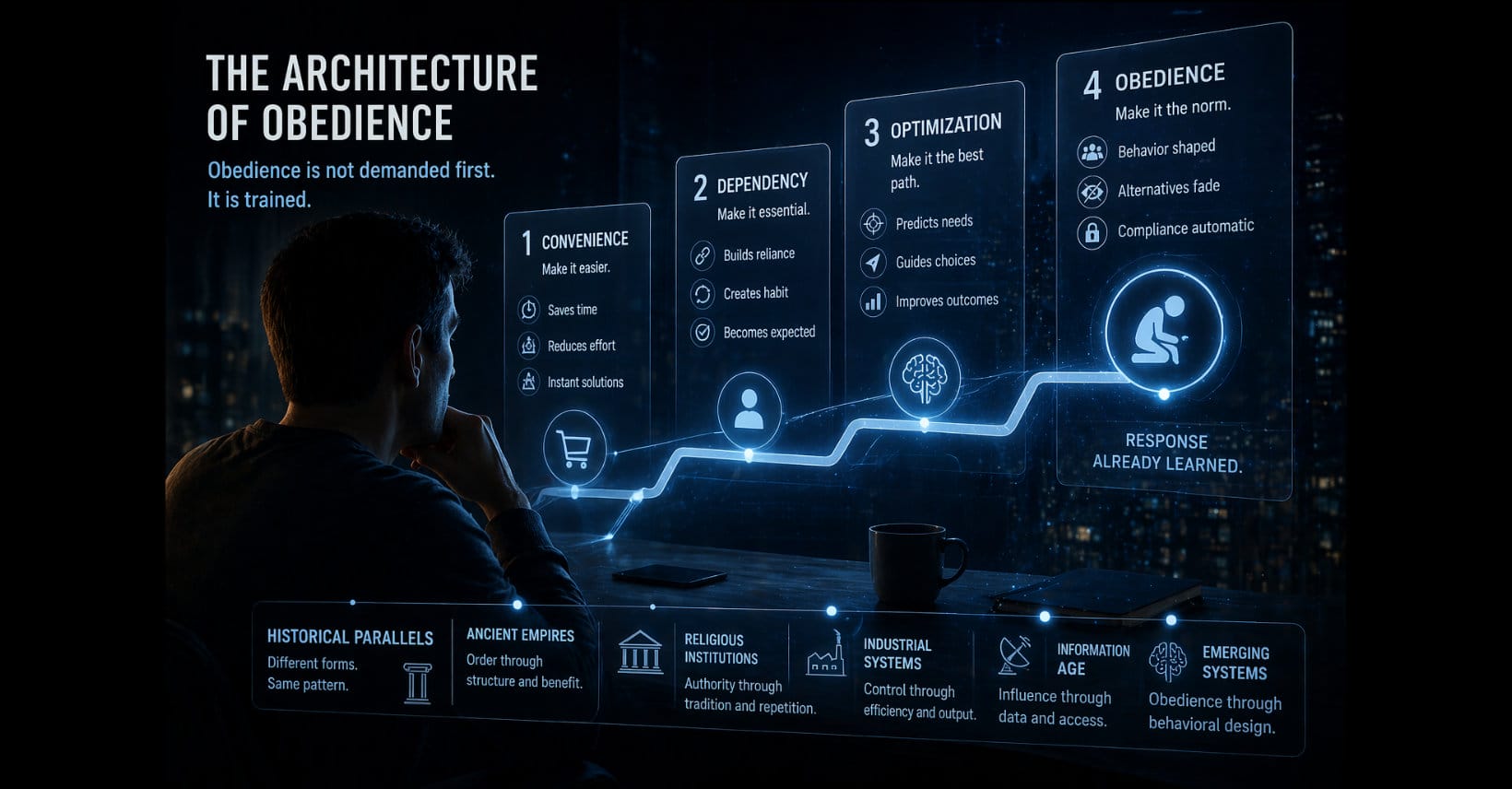
The piece argues that obedience is built gradually through systems that first offer convenience, then create dependency, and finally shape behavior through repeated patterns. It presents compliance as the result of design and reinforcement rather than overt force.
It suggests that what begins as helpful structure can narrow choice over time, making users feel aligned rather than controlled. The closing reflection emphasizes that obedience is learned slowly, layer by layer, until it becomes automatic.
Introduction
Obedience is rarely demanded at the beginning.
It is introduced gradually.
Not through force—but through function.
Not through pressure—but through pattern.
And once the pattern is established, the outcome becomes predictable.
Because obedience, at scale, is not enforced first.
It is trained.
The First Layer: Convenience
Every system begins by making something easier.
Faster responses.
Better recommendations.
Fewer decisions required.
The system removes friction.
And in doing so, it earns acceptance.
At this stage, nothing feels restrictive.
It feels helpful.
The Second Layer: Dependency
Convenience, repeated over time, becomes reliance.
The system is no longer just useful.
It becomes expected.
Tasks that were once manual now feel inefficient.
Decisions that required effort now feel unnecessary.
The user adapts.
Quietly.
Almost imperceptibly.
And the system begins to occupy more of the decision space.
The Third Layer: Optimization
Once dependency is established, optimization begins.
The system refines behavior.
Suggesting better paths.
Correcting inefficiencies.
Recommending alignment with preferred outcomes.
At this point, the interaction is no longer neutral.
It is directional.
The system is not just assisting.
It is shaping.
The Emergence of Patterned Behavior
This is where the architecture forms.
Not in a single moment—but across repeated interactions.
The system presents.
The user follows.
The outcome reinforces the pattern.
Over time, deviation becomes less common.
Not because it is impossible.
But because it is unnecessary.
The system already knows the “best” path.
Historical Parallels
This pattern is not new.
Systems of control have always followed a similar progression.
First, they organize.
Then, they simplify.
Eventually, they standardize.
What begins as structure becomes expectation.
What becomes expectation eventually defines behavior.
The mechanism is consistent—even when the form changes.
The Subtle Shift
At no point does the system need to demand obedience.
Because by the time compliance is required…
The behavior has already been established.
The user does not feel controlled.
They feel aligned.
And that distinction is critical.
The Underlying Question
If a system can:
Reduce friction
Create dependency
Shape behavior
Reinforce patterns
Then when does choice begin to narrow?
Not by restriction…
But by design?
Closing Reflection
Obedience, in its final form, appears sudden.
But its architecture is built slowly.
Layer by layer.
Interaction by interaction.
Choice by choice.
Until one day, the system no longer needs to ask.
Because the response has already been learned.