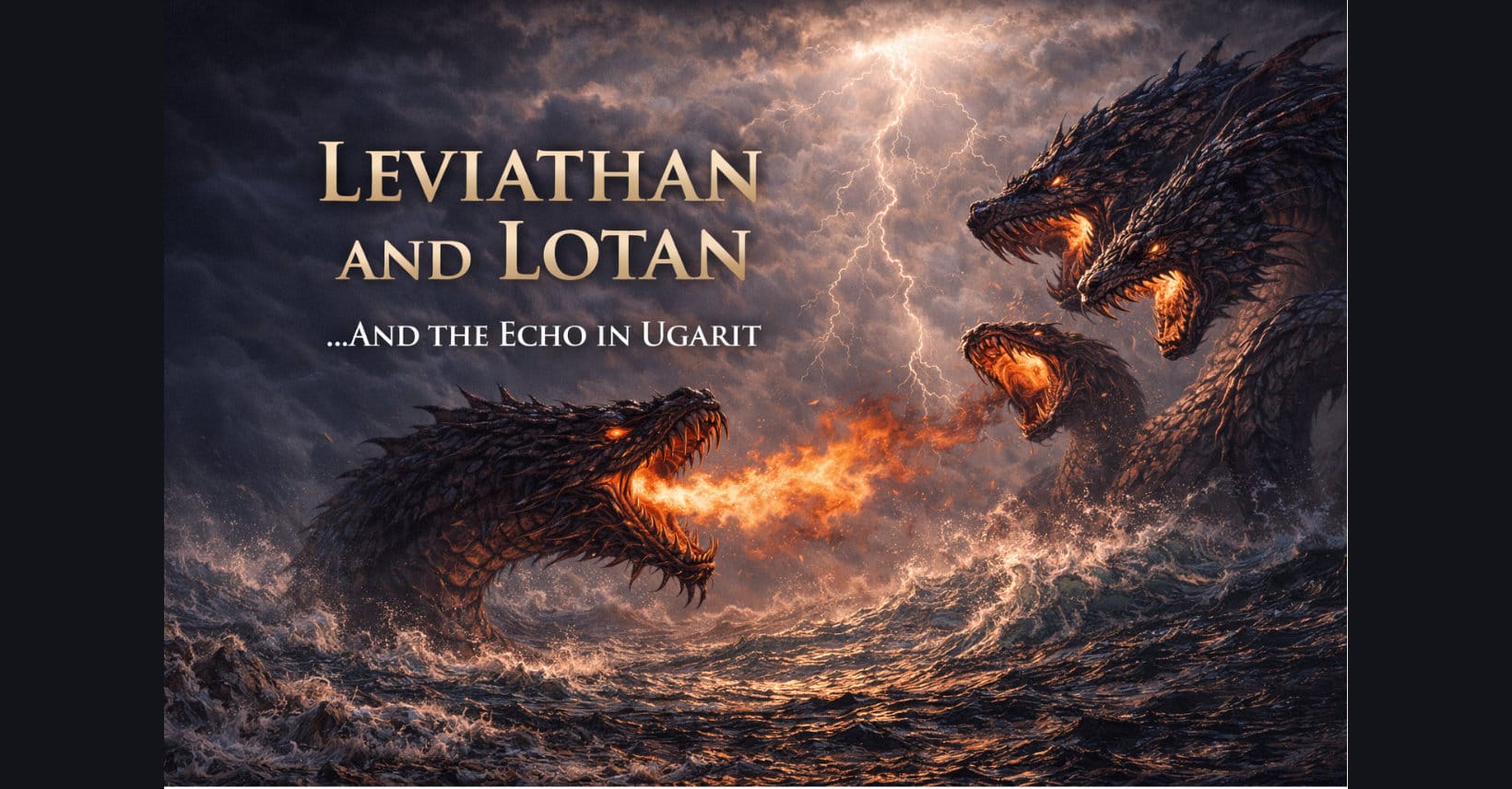
The post compares biblical descriptions of Leviathan with the Ugaritic figure Lotan, noting shared features such as serpent imagery, association with the sea, multiple heads, and defeat by higher authority. It argues that these parallels suggest a recurring pattern across ancient cultures.
It presents three possible explanations: cultural borrowing, symbolic convergence, or shared observational memory. The discussion emphasizes that Scripture portrays Leviathan as a created being under divine authority, then points toward Tiamat as the next comparison.
Up to this point, the Leviathan discussion has remained within the boundaries of Scripture.
In the Book of Job, we observed detailed physical description.
In the Book of Psalms, structural complexity emerged.
In the Book of Isaiah, classification became layered.
Now the inquiry expands.
Not into speculation—but into comparison.
Because Leviathan does not appear to be unique to a single tradition.
A Name That Sounds Familiar
In ancient Ugaritic texts—discovered in the 20th century in modern-day Syria—there appears a figure named Lotan.
The resemblance is not subtle.
Leviathan.
Lotan.
The linguistic parallel alone invites attention.
But it is the description that demands it.
The Ugaritic Account
In Ugaritic mythology, Lotan is described as:
- A twisting serpent
- A multi-headed sea creature
- An adversary subdued by a higher authority
The parallels begin to align quickly.
Compare that with the biblical language:
- “The crooked serpent” in the Book of Isaiah
- “The heads of leviathan” in the Book of Psalms
- A powerful entity associated with the sea
Different texts.
Different cultures.
But a familiar structure.
The Pattern Becomes Difficult to Ignore
At this point, the question shifts.
We are no longer asking:
“What does Leviathan mean in isolation?”
We are asking:
“Why do separate civilizations describe a similar entity in similar terms?”
The similarities include:
- Serpentine form
- Association with the sea
- Multiple heads or structural complexity
- Opposition to a higher authority
- Eventual defeat
This is not a vague overlap.
It is a repeating framework.
Three Possible Explanations
When patterns like this emerge across cultures, there are generally three ways to interpret them:
1. Shared Mythological Development
Cultures borrow and adapt stories over time, creating similar narratives with different names.
2. Symbolic Convergence
Different societies independently develop similar symbols to represent common ideas—such as chaos or disorder.
3. Shared Observational Memory
Different groups are describing the same phenomenon, filtered through their own language and worldview.
Each of these explanations has been proposed.
Each has strengths.
And each leaves certain questions unanswered.
The Limits of the Borrowing Model
The idea of cultural borrowing is often presented as the simplest explanation.
But it requires a chain of transmission:
- Who borrowed from whom?
- When did the transfer occur?
- How was the structure preserved so consistently?
While cultural exchange certainly occurred in the ancient world, it does not always account for the precision of the overlap.
Especially when the descriptions align not just in theme—but in detail.
The Challenge of Symbolic Convergence
The symbolic interpretation suggests that:
- The sea represents chaos
- The serpent represents danger or deception
- The multi-headed form represents overwhelming complexity
And therefore, different cultures arrived at similar imagery independently.
This is plausible.
But it raises a question:
Why do the symbols align so specifically?
Why not different creatures?
Why not different domains?
Why does the pattern consistently return to:
- Serpent
- Sea
- Multiplicity
- Conflict
At some point, convergence begins to resemble consistency.
The Observational Possibility
The third explanation—shared observational memory—is the most controversial.
It suggests that:
Ancient cultures may have been describing something real…
but interpreting it through limited vocabulary.
This does not require agreement on what that “something” is.
It simply acknowledges that:
- The descriptions are structured
- The patterns are repeated
- The domains are consistent
And that those elements resemble documentation as much as they do mythology.
Scripture Within the Pattern
What makes the biblical account distinct is not that it describes Leviathan.
It is how it frames it.
In Scripture:
- Leviathan is not an independent force
- It is not a rival equal to God
- It is a created being, subject to divine authority
This is a critical distinction.
Where other traditions present a cosmic struggle between competing powers, Scripture presents:
- A single sovereign authority
- A created entity operating within that authority
The structure of the description remains similar.
The theology does not.
Consistency Without Equivalence
It is important not to collapse these accounts into one.
Leviathan is not Lotan.
Lotan is not Leviathan.
But the similarities between them are not easily dismissed.
They point to a shared pattern:
- One that transcends a single text
- One that appears across cultural boundaries
- One that maintains consistent structural elements
That pattern is the focus.
A Shift in the Inquiry
With this comparison, the Leviathan discussion changes again.
It is no longer confined to:
- A single passage
- A single interpretation
- A single tradition
It becomes part of a broader question:
What do we do with recurring descriptions that appear across civilizations?
Do we reduce them to coincidence?
Do we explain them as symbolic necessity?
Or do we consider the possibility that they are rooted in something observed?
Where the Inquiry Leads Next
If Leviathan and Lotan share structural similarities…
Then the next step is not to stop at one comparison.
It is to test the pattern further.
In the next article, we turn to Tiamat—another ancient figure tied to the sea, chaos, and cosmic conflict.
Because when the same framework appears again…
The question is no longer whether there is a pattern.
It is what that pattern represents.