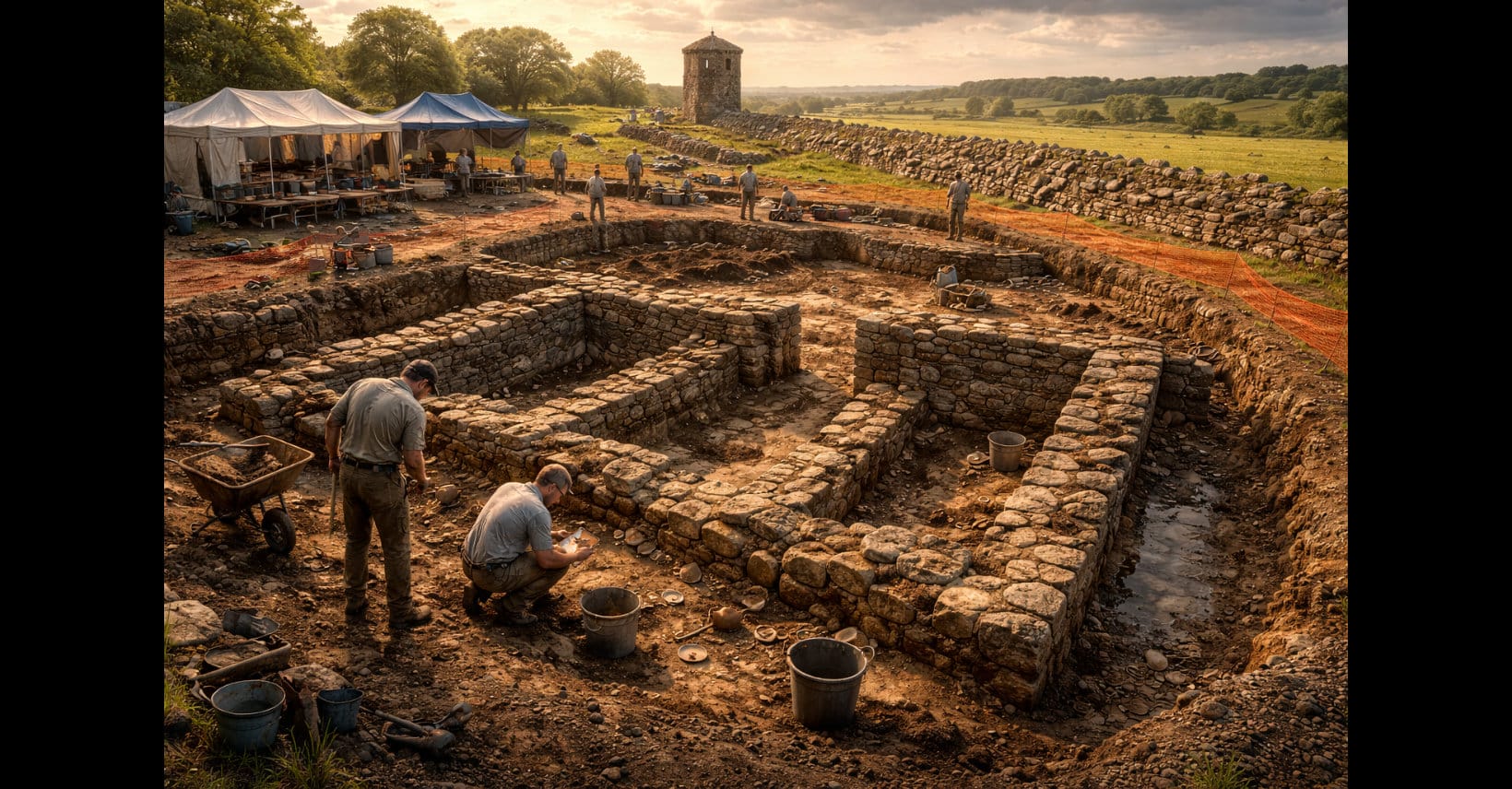
Archaeologists in Scotland uncovered the remains of a previously unknown Roman fortlet along the Antonine Wall, including a stone foundation, defensive rampart, ditch, and Roman pottery. The site likely served as a surveillance outpost on a strategic high point within Rome’s northern frontier system.
The discovery highlights the scale and organization of Roman frontier construction and the role of small outposts in maintaining control. The text also notes that such finds can invite speculative theories, while emphasizing the achievement as evidence of ancient human engineering.
A routine excavation beneath residential gardens in Scotland has revealed the remains of a previously unknown Roman fortlet built along the Antonine Wall roughly 2,000 years ago. Archaeologists discovered a stone foundation supporting a defensive rampart, along with a parallel ditch containing organic materials and fragments of Roman pottery.
The Antonine Wall marked the northernmost frontier of the Roman Empire during the reign of Emperor Antoninus Pius in the second century AD. Stretching roughly 37 miles across central Scotland, the wall served as both a military barrier and a symbol of imperial authority. The newly identified fortlet appears to have occupied a strategic high point overlooking the surrounding terrain, suggesting it functioned as a surveillance outpost within the broader defensive network.
Discoveries like this highlight the remarkable logistical sophistication of ancient empires. The Romans constructed roads, fortifications, communication systems, and supply networks across vast distances, all without the benefit of modern machinery or surveying equipment. Even small outposts like this newly discovered fortlet played a crucial role in maintaining control over frontier territories.
For many observers, the scale and precision of ancient engineering often seem almost inexplicable. How did civilizations thousands of years ago coordinate massive infrastructure projects across continents? The mystery surrounding ancient technological capabilities has led some theorists to propose the influence of lost civilizations or even extraterrestrial guidance.
While such claims remain speculative, they reflect a broader fascination with humanity’s past. When archaeological discoveries reveal unexpectedly advanced achievements, they challenge the long‑standing assumption that ancient societies were technologically primitive.
Within the narrative explored by The Alien Deception Chronicles, discoveries like the Roman fortlet serve as a reminder that genuine historical accomplishments can easily become entangled with speculative interpretations. As our understanding of ancient engineering grows, so too does the temptation to attribute these achievements to forces beyond human ingenuity.
In reality, the true story may be even more impressive: a testament to the intelligence, organization, and ambition of ancient civilizations capable of shaping landscapes long before the modern age.