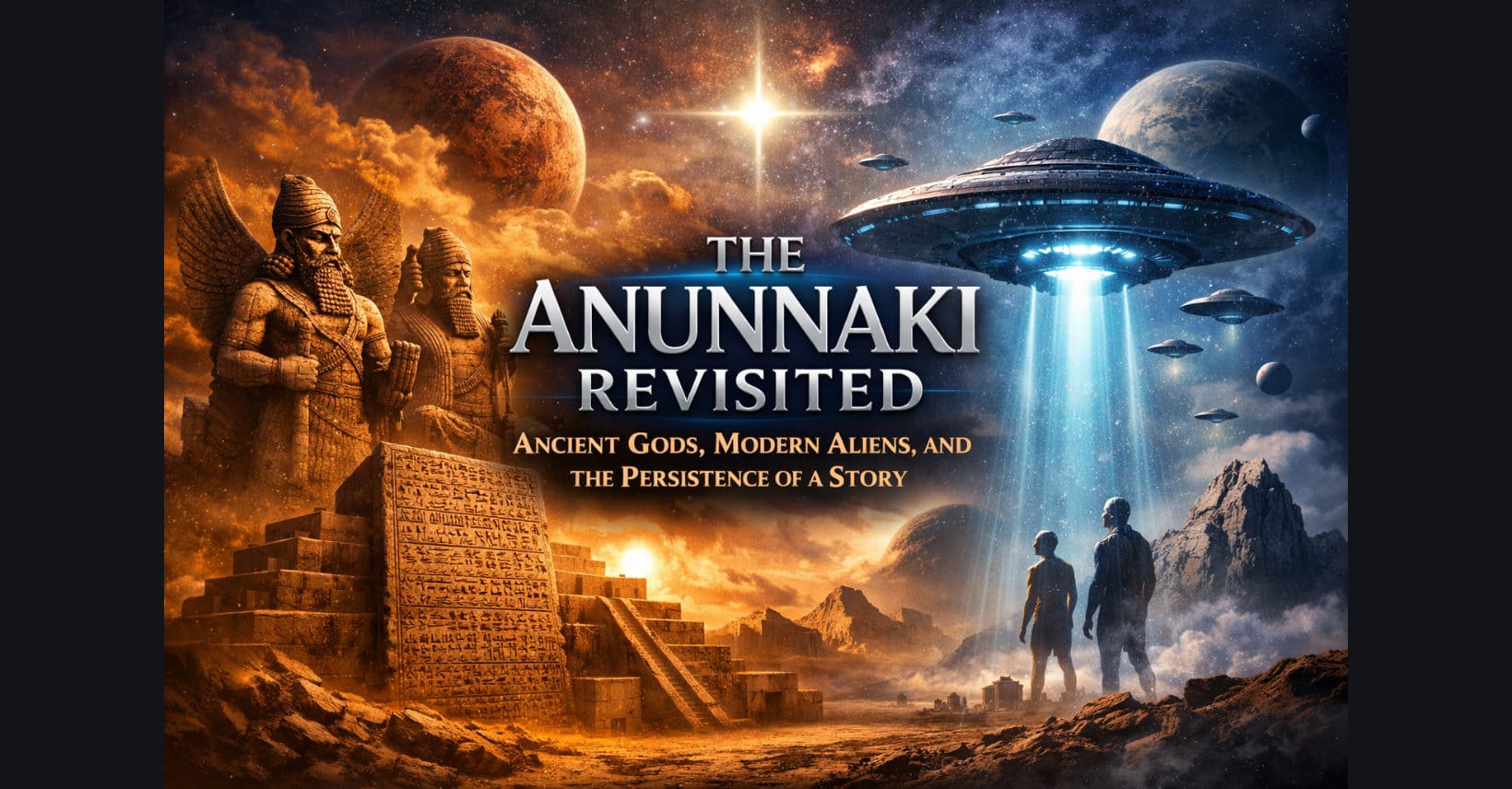
The piece traces the Anunnaki from ancient Mesopotamian gods to modern claims that they were extraterrestrials who engineered humanity. It argues that this shift reflects changing cultural assumptions rather than new evidence, and that ancient divine language is now being recast in technological terms.
It also presents a biblical critique, saying Scripture affirms God as humanity’s Creator and warns against narratives that replace that view. The article emphasizes how repeated stories about non-human creators can shape expectations about human origins, identity, and future interpretations of extraordinary events.
There is a peculiar endurance to certain ideas in human history. They do not disappear. They simply change names.
The Anunnaki are one of those ideas.
If you trace the term back to its origin, you arrive in the ancient world of Mesopotamia—among the Sumerians, Akkadians, and Babylonians. There, the Anunnaki were not visitors from distant stars. They were gods. They governed, judged, and participated in the mythological structure of creation itself. Their stories were inscribed into clay tablets, pressed into cuneiform, and preserved across millennia.
But something has happened to that story.
In the modern era, the Anunnaki have been reintroduced—not as deities of an ancient pantheon, but as extraterrestrial architects of humanity. According to popular reinterpretations, they arrived from a distant world, altered human DNA, and established early civilization for their own purposes.
It is a compelling narrative.
It is also a revealing one.
Because when examined closely, the shift from “gods” to “aliens” is not a discovery. It is a translation—one that reflects the expectations of the age interpreting it.
The Repackaging of the Supernatural
Ancient cultures did not have a category for extraterrestrial life as we define it today. When they encountered something beyond their understanding—whether real, imagined, or spiritual—they described it in the language available to them: divine beings, heavenly visitors, gods.
Modern culture, by contrast, is technologically literate. We think in terms of propulsion systems, genetic engineering, and interstellar travel. So when we revisit those same ancient accounts, we reinterpret them through a different lens.
The beings change form in our imagination, but the attributes remain remarkably consistent:
- Superior knowledge
- Power beyond human capability
- Interaction with humanity at pivotal moments
- A perceived role in shaping civilization
In other words, the modern “alien” begins to look suspiciously like the ancient “god.”
And that should give us pause.
A Biblical Frame of Reference
From a biblical standpoint, the existence of non-human intelligence is not controversial. Scripture affirms the reality of angels and fallen angels—created beings with power, agency, and purpose.
What Scripture does not affirm is the idea that humanity was created by external biological engineers.
Genesis is unambiguous in its claim:
God is the Creator. Humanity is made in His image.
That distinction matters.
Because the Anunnaki narrative—at least in its modern form—does more than reinterpret ancient texts. It subtly replaces the origin of humanity with an alternative explanation. One that removes God from the equation and inserts a created being in His place.
That is not merely a historical curiosity. It is a theological shift.
The Pattern Beneath the Narrative
What makes the Anunnaki discussion particularly relevant to The Alien Deception Chronicles is not whether ancient Mesopotamians believed in these beings.
It is that the same core idea keeps resurfacing in new forms.
Ancient world:
“These beings are our creators.”
Modern world:
“These beings engineered us.”
Future possibility:
“These beings have returned.”
The language evolves. The structure does not.
And if one were attempting to prepare a global population to accept a non-biblical explanation for extraordinary events—events that might otherwise point people toward God—the groundwork is already in place.
The narrative has been seeded.
It has been normalized.
It has been modernized.
Why This Still Matters
It would be easy to dismiss the Anunnaki conversation as fringe speculation or entertainment. After all, much of it lives in documentaries, online forums, and speculative books.
But ideas, even speculative ones, shape expectation.
And expectation shapes interpretation.
If humanity is conditioned to believe that its origins are extraterrestrial…
then any future event that appears to confirm that belief will be readily accepted.
Not questioned.
Not tested.
Accepted.
That is where discernment becomes essential.
A Personal Note
When I revisit these ancient accounts, I am not looking for hidden spacecraft or lost alien technologies. I am asking a simpler question:
What are we being trained to believe about ourselves?
Because at the center of the Anunnaki narrative—ancient or modern—is a claim about human identity.
Who made us.
Why we are here.
And who, ultimately, we belong to.
Scripture answers those questions with clarity.
Every competing narrative answers them differently.
That is why this conversation is worth having.
Not to sensationalize the past—
but to understand how its stories are being used in the present.
And perhaps more importantly,
how they may be used in the future.