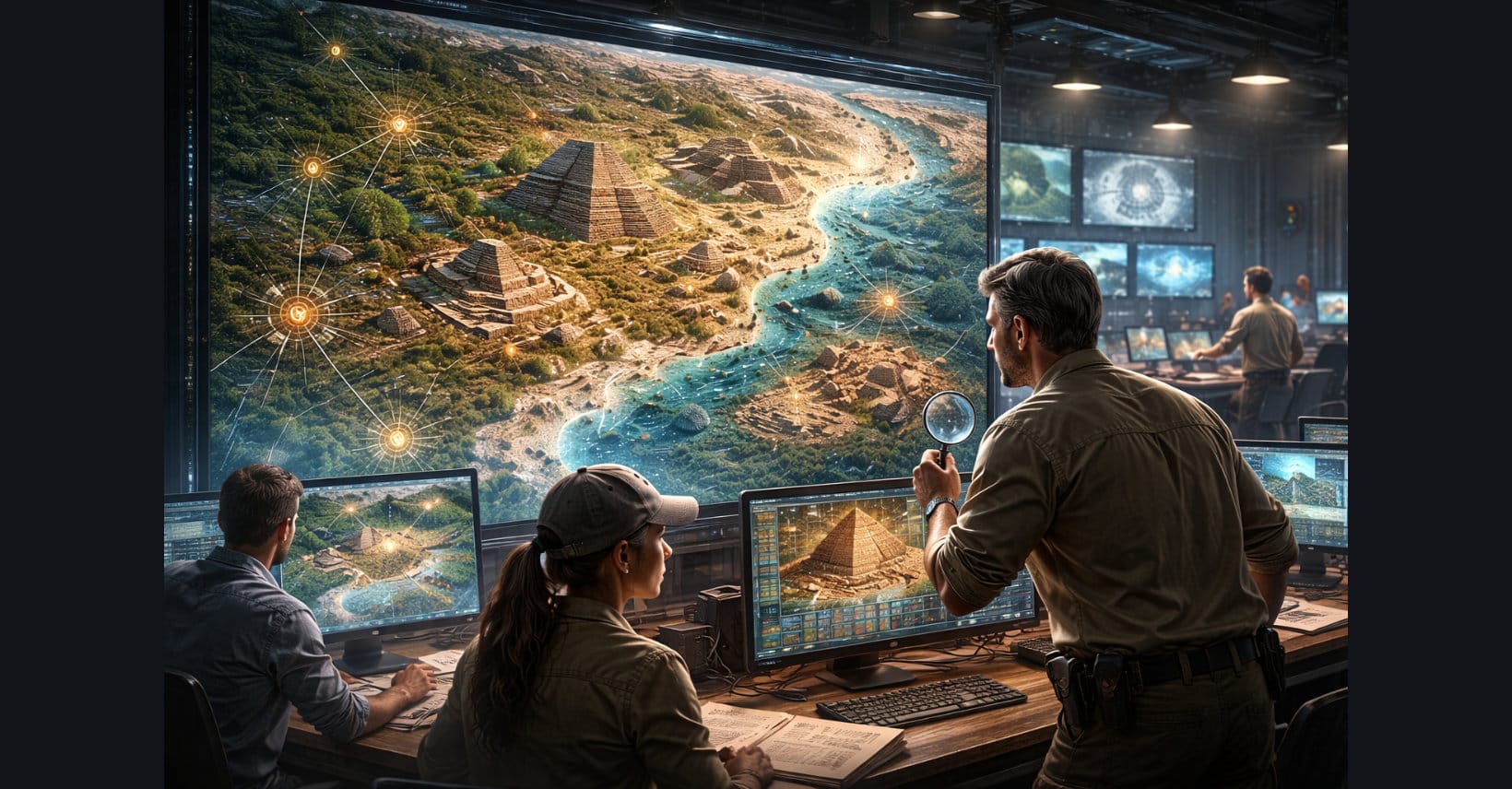
Artificial intelligence is changing archaeology by helping researchers detect hidden structures in satellite imagery, LiDAR scans, and aerial photos. These tools have revealed unknown settlements, roads, burial mounds, and ceremonial sites across several regions, suggesting ancient landscapes were more extensive than previously understood.
The growing visibility of lost cities is also influencing public interpretation of the past. As more of human history is uncovered, it creates space for speculative explanations, including claims about extraterrestrial influence, while underscoring the complexity of ancient human civilizations.
In the past, discovering a lost city required decades of excavation, chance discoveries, or construction projects that accidentally revealed buried ruins. Today, artificial intelligence is transforming that process entirely.
Researchers are now using machine-learning systems to analyze massive volumes of satellite imagery, LiDAR scans, and aerial photographs in search of hidden archaeological structures. These systems can detect patterns—geometric alignments, soil discolorations, and elevation anomalies—that human analysts might overlook.
In recent years, AI-assisted surveys have revealed previously unknown settlements, burial mounds, road networks, and ceremonial complexes across the globe. Dense jungles in Central America, desert plains in the Middle East, and forested landscapes in Europe are beginning to yield entire urban layouts that were invisible from ground level.
In effect, the buried map of human civilization is slowly being reconstructed from space.
For archaeologists, this is a breakthrough. Entire landscapes once believed empty are now showing signs of extensive human occupation. What earlier generations assumed were isolated ruins are increasingly understood to be part of vast networks of cities, roads, and ceremonial centers.
But this technological shift is also reshaping how the public interprets the ancient world.
Every time a previously unknown city appears in satellite imagery, it reinforces a growing realization: much of human history remains undiscovered.
That realization has a cultural side effect.
The more lost civilizations we uncover, the easier it becomes for speculative narratives to flourish—particularly the popular claim that ancient societies possessed knowledge or technologies beyond what historians have traditionally credited them with.
In recent decades those narratives have increasingly taken on a familiar form: the suggestion that extraterrestrial visitors may have influenced early civilizations.
This is where the themes explored in The Alien Deception Chronicles become relevant.
The series examines how genuine archaeological discoveries—real ruins, real artifacts, real civilizations—can be reinterpreted through a modern extraterrestrial lens. As new technologies reveal hidden cities and forgotten cultures, the mystery surrounding the ancient world expands.
And mystery invites explanation.
Artificial intelligence is not uncovering alien civilizations on Earth. What it is revealing is something arguably more remarkable: the extraordinary complexity of human societies thousands of years ago.
Yet the deeper the past becomes, the more interpretive space appears for alternative narratives about who—or what—might have influenced early civilization.
In that sense, AI archaeology is doing more than mapping lost cities.
It is reshaping the conversation about humanity’s origins—and opening the door to new debates about how the ancient world should be understood.