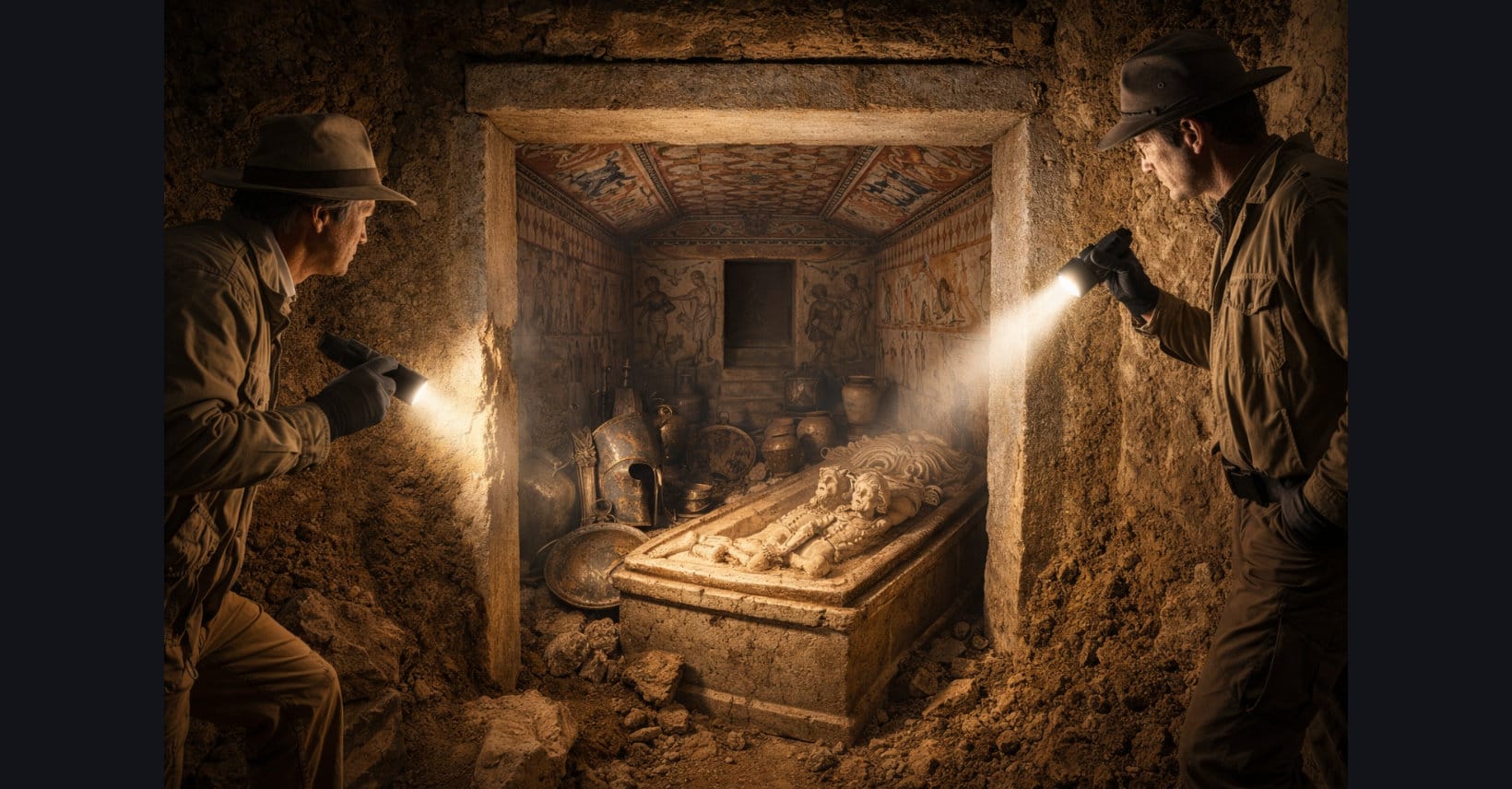
Archaeologists northwest of Rome uncovered a sealed 7th-century B.C. Etruscan tomb that had remained untouched for more than 2,600 years. The chamber held four skeletons on carved stone beds and over 100 grave goods, offering a rare view of elite burial practices in a region where most tombs were looted.
The find highlights the sophistication of Etruscan society, including metallurgy, art, trade, and ritual life. It also notes that such discoveries can invite speculative interpretations, but the evidence supports human achievement rather than extraterrestrial influence.
A sealed Etruscan tomb discovered northwest of Rome is offering archaeologists a rare window into a civilization that flourished before the rise of the Roman Empire. The chamber, dating to roughly the 7th century B.C., remained untouched for more than 2,600 years before researchers opened it.
Inside the burial chamber, archaeologists found four skeletons—likely two pairs of men and women—resting on carved stone beds. Surrounding them were more than 100 grave goods, including ceramic vessels, iron weapons, bronze ornaments, and intricate jewelry.
The discovery is especially significant because most Etruscan tombs in the region were looted centuries ago. This chamber remained intact, preserving a complete snapshot of elite burial customs.
For historians, the find helps reconstruct social structure, ritual practice, and artistic expression within Etruscan society. But for observers of historical narrative trends, discoveries like this serve another role.
They remind us how much of ancient history remains buried.
Every decade, new excavation technologies—ground‑penetrating radar, satellite imaging, drone mapping, and AI‑assisted site detection—reveal structures and artifacts that previous generations never knew existed.
This expanding archaeological horizon fuels speculation about forgotten civilizations and lost technologies.
In popular culture, such discoveries are often interpreted through the lens of ancient astronaut theories. When sophisticated architecture or unexplained symbolism appears, the conclusion sometimes leaps from “unknown human achievement” to “external assistance.”
Yet the evidence from sites like San Giuliano consistently tells a different story.
Human cultures were already extraordinarily complex thousands of years ago.
The Etruscans developed advanced metallurgy, artistic traditions, and elaborate funerary practices long before Rome became dominant in the Mediterranean. Their society included organized city‑states, trade networks, and religious systems rich in symbolism.
The sealed tomb therefore illustrates something crucial.
Ancient civilizations did not require extraterrestrial instruction to build sophisticated societies. Human ingenuity alone accounts for much of what earlier generations underestimated.
However, as more discoveries surface—especially those featuring elaborate symbolism or unexpected technological sophistication—the interpretive environment changes.
Mystery invites explanation.
And when mystery intersects with modern fascination about extraterrestrial life, the ancient world becomes fertile ground for speculative narratives.
The Etruscan tomb reminds us that history is still being uncovered. The deeper archaeologists dig, the more evidence appears that ancient humanity was capable of far more than we once believed.
Discoveries like the sealed Etruscan tomb remind us how incomplete the historical record truly is. Entire civilizations flourished, advanced, and vanished long before modern historians began assembling the timelines we now consider authoritative.
When intact sites emerge—especially those containing advanced metallurgy, complex symbolism, or sophisticated engineering—they inevitably provoke a familiar question: how did ancient people accomplish this?
For most archaeologists, the answer remains firmly rooted in human capability. The Etruscans were skilled metalworkers, accomplished artists, and participants in a vibrant Mediterranean trade network that connected cultures across thousands of miles.
But outside academic circles, the interpretive gap often fills with a different explanation.
In recent decades, discoveries of forgotten cities, unexplored tombs, and buried monuments have increasingly been folded into narratives suggesting extraterrestrial influence on ancient civilizations. What earlier generations attributed to myth or religion is now sometimes reframed as evidence of alien visitors.
This is precisely where the themes explored in The Alien Deception Chronicles become relevant.
The series examines how genuine historical discoveries—real artifacts, real ruins, real civilizations—can be reinterpreted through modern cultural lenses that favor technological explanations over spiritual or historical ones. As more hidden structures emerge from the ground through advanced imaging, excavation, and AI-driven archaeology, humanity gains unprecedented access to the past.
Yet the more mysteries we uncover, the more interpretive space appears for competing explanations.
The sealed Etruscan tomb does not point to extraterrestrial involvement. It reveals something far more important: human history is deeper, richer, and more complex than many people once imagined.
And that complexity creates the very environment in which alternative narratives about ancient aliens continue to flourish.