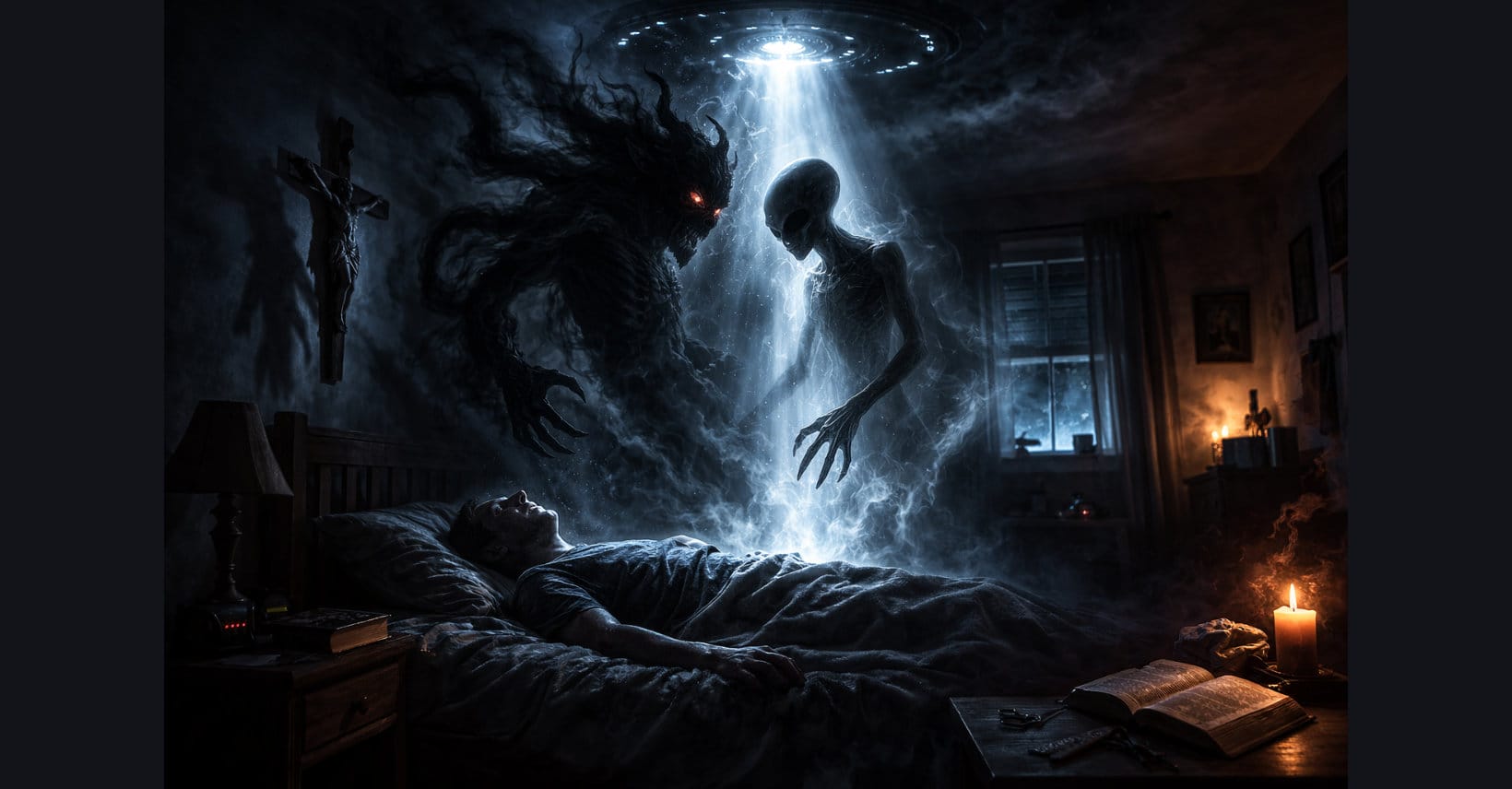
The post compares modern alien abduction reports with historical descriptions of demonic oppression and possession. It argues that recurring features such as paralysis, telepathic communication, memory loss, and nighttime apparitions may reflect spiritual deception rather than extraterrestrial contact.
It also describes a cultural shift from interpreting unexplained experiences as demonic to viewing them as technological or alien. Drawing on Christian theology and exorcist commentary, the piece suggests modern UFO narratives may recast older spiritual phenomena in contemporary terms.
For decades, reports of alien abductions have occupied a strange corner of modern culture—half science fiction, half psychological mystery. Witnesses describe eerily similar experiences: paralysis in the night, beings appearing suddenly in the room, telepathic communication, forced examinations, missing time, and memories that return only under hypnosis.
These accounts are usually interpreted through the framework of extraterrestrial visitation. But an uncomfortable question has begun surfacing among theologians and researchers alike:
What if the category itself is wrong?
What if some of these encounters resemble something much older?
The Historical Language of Spiritual Attack
Long before the language of spacecraft and extraterrestrials existed, Christian theology documented experiences that sound strikingly familiar.
Classical descriptions of demonic oppression and possession, particularly in medieval and early modern demonology, often include:
• sudden paralysis or inability to move
• apparitions appearing in bedrooms at night
• telepathic communication without spoken words
• physical manipulation of the body
• missing or distorted memory of the event
• recurring visitations by the same entities
In earlier centuries these encounters were interpreted through the vocabulary available at the time: demons, spirits, and spiritual attack.
Today, the vocabulary has changed.
The experiences often have not.
The Cultural Shift From Demons to Aliens
In pre-modern societies, unexplained supernatural encounters were almost automatically interpreted in spiritual terms. But the rise of scientific materialism gradually pushed those categories out of mainstream conversation.
If an experience could not be explained psychologically or medically, the next available framework became technological.
Thus, the beings were no longer called demons.
They became extraterrestrials.
The shift is fascinating from a cultural perspective. Many modern abduction narratives include technological motifs—bright lights, metallic rooms, instruments and procedures. Yet the deeper structure of the experience often remains remarkably similar to historical accounts of spiritual oppression.
Some Catholic exorcists have publicly raised this possibility. Among them, Fr. Chad Ripperger has noted that certain abduction narratives share characteristics that mirror demonic encounters rather than extraterrestrial contact.
The suggestion is not that every unexplained experience is demonic. But the overlap raises an important theological question: could modern culture be mislabeling an ancient phenomenon?
The Pattern Within Abduction Narratives
When researchers compare thousands of abduction reports, several recurring features appear.
Paralysis
Witnesses frequently report being unable to move or speak while entities are present. Historically, this state was described in spiritual literature as demonic immobilization or oppression.
Telepathic Communication
Abductees often say the beings communicate directly into their minds. Classical demonology also describes demonic influence through interior suggestion and imposed thoughts.
Manipulation of Perception
Many witnesses describe altered realities: walls that disappear, floating sensations, or sudden transport to another environment. Spiritual traditions have long recorded deceptive apparitions and illusions produced by demonic entities.
Obsession With Reproduction
One of the strangest elements of modern abduction accounts involves reproductive experimentation or hybridization narratives. Curiously, historical demonology also contains references to demons interfering in human reproduction—though interpreted very differently.
These parallels do not prove a spiritual origin. But they complicate the extraterrestrial explanation.
A Deception Prepared for a Technological Age?
If spiritual deception were operating in the modern world, it would likely adapt to the intellectual climate of the time.
In the medieval world, people believed in demons.
In the modern world, people believe in advanced civilizations from distant star systems.
The same phenomenon interpreted through different worldviews could appear completely different.
Within the framework of biblical theology, this idea is not implausible. Scripture repeatedly warns that deception can take on convincing forms.
As the Apostle Paul wrote:
“And no marvel; for Satan himself is transformed into an angel of light.
—2 Corinthians 11:14 (KJV)
The warning suggests that spiritual deception does not always appear dark or sinister. Sometimes it appears advanced, enlightening, even superior.
In a technological age, that deception might easily wear the mask of extraterrestrial intelligence.
Why This Matters to The Alien Deception Chronicles
This question sits at the very heart of the narrative explored in The Alien Deception Chronicles, a series that examines how spiritual realities might be misunderstood—or deliberately reinterpreted—through modern technological assumptions.
Rather than presenting extraterrestrial encounters as science fiction curiosities, the series asks a deeper question: what if humanity is slowly being conditioned to interpret spiritual phenomena through a scientific framework that removes God, angels, and demons from the equation?
If unexplained encounters are automatically attributed to extraterrestrial intelligence, then the possibility of spiritual deception is never considered.
In that sense, the modern alien narrative may not simply be a story about life beyond Earth.
It may be part of a much older story about how humanity understands the unseen world.
A Conversation Worth Having
Whether one approaches the topic from theology, psychology, or cultural anthropology, the intersection between alien abduction narratives and classical demonology deserves careful discussion.
For centuries, humanity understood the unseen world through spiritual categories.
In the modern era, we replaced those categories with technological ones.
The experiences themselves, however, may not have changed nearly as much as we think.
And if that is true, the most important question may not be whether alien visitors exist.
It may be whether humanity has forgotten how to recognize spiritual deception when it appears in unfamiliar form.