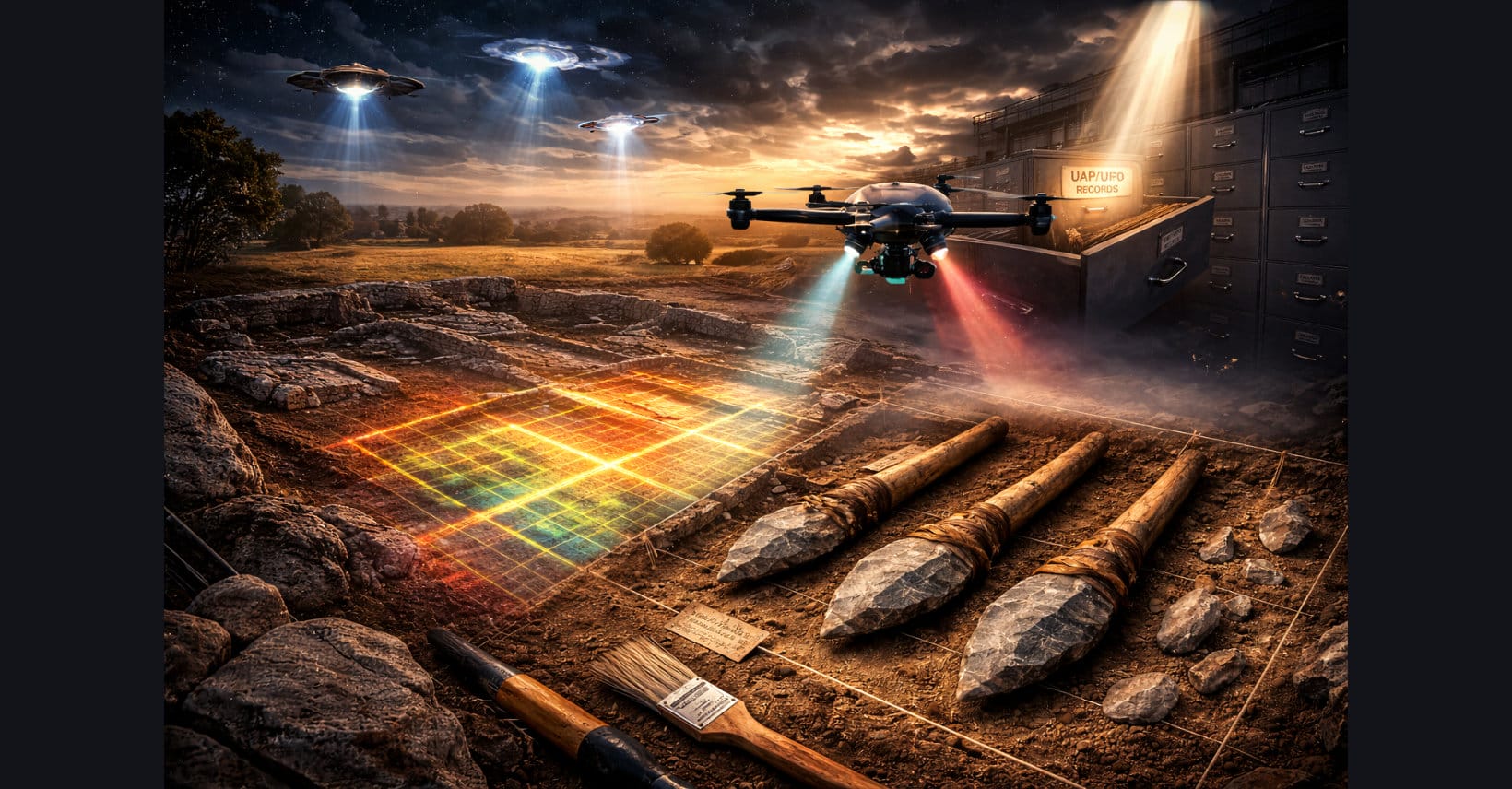
The piece links recent archaeological findings and UAP-related government directives through a shared theme: improved instrumentation changes what people can see and how they interpret it. It highlights a mapped Roman city under farmland and re-dated ancient hafted tools as examples of hidden evidence brought into view by new methods.
It argues that official review of UAP records normalizes anomalous aerial phenomena and may influence public perception. The post frames these developments as part of a broader pattern in which discovery leads to narrative reinterpretation and calls for discernment in assessing new claims.
In recent weeks, three developments—one archaeological, one technological, and one institutional—have converged in a way that deserves careful attention. A hidden Roman city has been mapped beneath Italian farmland using advanced multispectral drone systems. Ancient hafted stone tools have been re-dated, pushing technological sophistication further back in time than regional models predicted. Meanwhile, executive directives regarding UAP files have elevated anomalous aerial phenomena into formal governmental process.
At first glance, these stories appear unrelated. They are not.
They share a common thread: instrumentation is reshaping interpretation.
1. The Hidden Roman Grid
Archaeologists using thermal and multispectral imaging have identified the geometric footprint of a previously unknown Roman city near the Via Appia. Orthogonal streets, monumental structures, and civic planning have emerged not through excavation alone, but through sensor-driven perception.
An Italian field archaeologist noted that such systems allow researchers “to see order where the naked eye sees only agriculture.”
That phrase is telling.
The city did not suddenly appear. It was always there. What changed was visibility.
Historically, this mirrors other moments in which technological shifts altered human understanding: telescopes expanding the cosmos, microscopes revealing unseen life, radar mapping the invisible airspace. Each advancement expanded knowledge—but also expanded interpretive latitude.
2. 160,000-Year-Old Hafted Tools
Meanwhile, newly studied hafted stone tools in East Asia suggest complex mechanical abstraction much earlier than previously assumed. Hafting requires conceptual integration—binding stone to handle for amplified force. It is not improvisation. It is system design.
Experts emphasize that the find does not rewrite human origin models, but it does refine assumptions about the timeline of innovation.
Historical pattern mapping reveals something important: whenever new data extends capability backward in time, speculative narratives quickly follow. Lost civilizations. External instruction. Extraterrestrial assistance.
Yet disciplined archaeology repeatedly demonstrates that human ingenuity, when properly evidenced, accounts for more than cultural imagination once allowed.
3. Institutional Disclosure and Psychological Elevation
Simultaneously, formal directives ordering review and release of UAP records have elevated unidentified aerial phenomena into procedural legitimacy. Regardless of the contents of those files, the shift itself alters the psychological landscape.
When authority speaks, perception changes.
Throughout history, official endorsement—whether scientific or political—has acted as a multiplier for public belief. The language shift from ridicule to neutral administrative tone is not trivial. It is normalization.
Historical Correlation Pattern
Across centuries, three recurring stages appear:
- Technological Expansion
- Discovery of Previously Hidden Data
- Narrative Reinterpretation
The Roman city reflects stage two.
The hafted tools reflect stage two.
Disclosure directives represent stage three.
Theological Interpretation Frame
Scripture reminds us that knowledge increases (Daniel 12:4), yet it also warns that signs and wonders may accompany deception (Matthew 24:24).
Technological revelation is not inherently false. Archaeological refinement is not suspect. Institutional transparency is not sinister by default.
But interpretation matters.
When instrumentation expands what humanity can see—beneath soil or in the sky—the temptation to assign extraordinary origin follows quickly. The discipline required is not fear, but discernment.
The Alien Deception Chronicles exists precisely at that intersection: where data, authority, and narrative converge.
What to Watch Next
- Escalation in formal UAP terminology
- Expansion of multisensor sky grids
- Further archaeological revisions pushing complexity backward
- Media tone normalization around anomalous phenomena
The pattern is not chaos. It is progression.
The question is not whether new discoveries will continue.
They will.
The question is how they will be framed—and how we will interpret them.