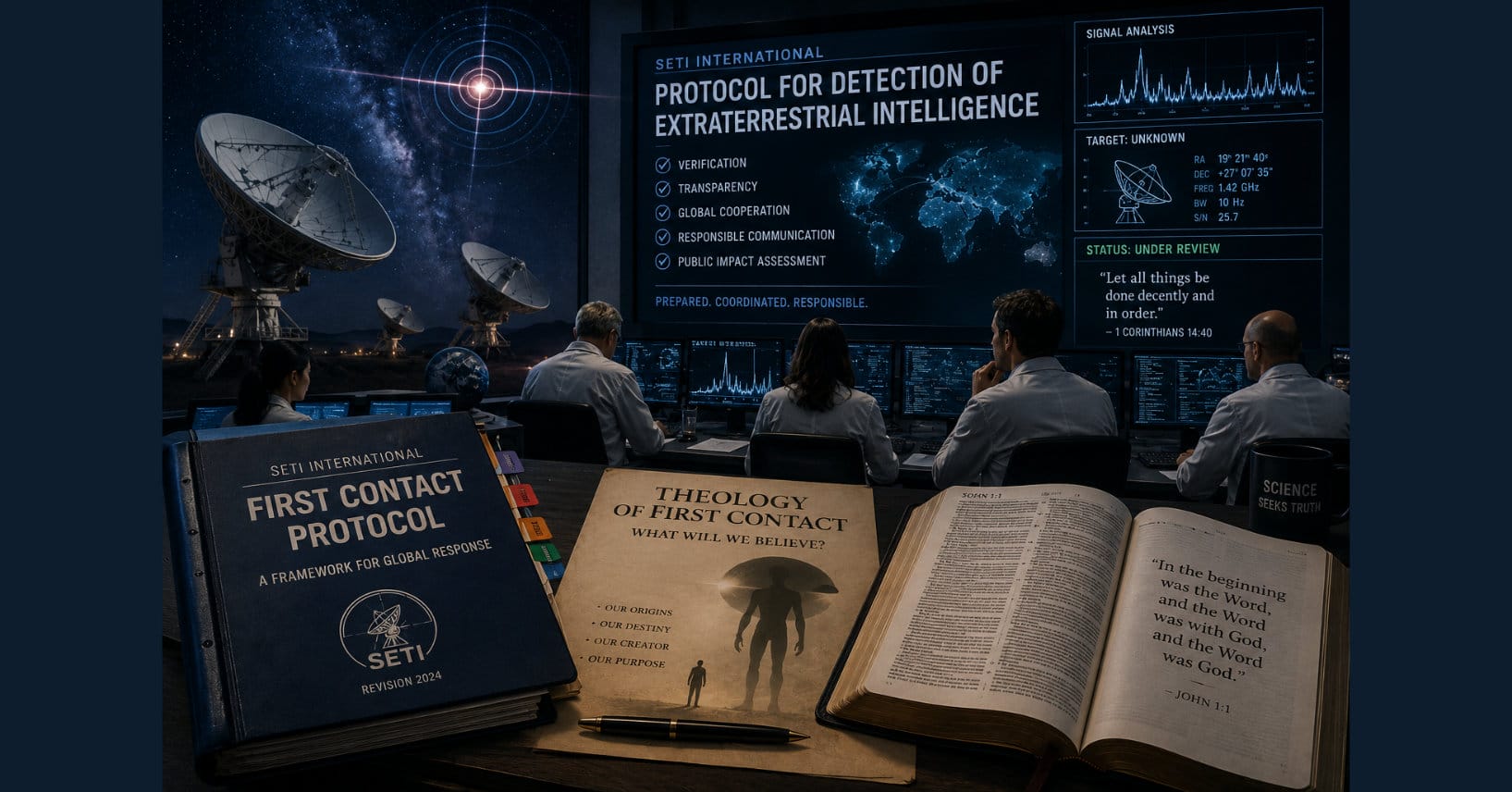
Scientists have updated international protocols for responding to a possible detection of extraterrestrial intelligence, emphasizing verification, transparency, and coordinated communication. The piece argues that the significance lies less in the procedures themselves than in how society may interpret any future announcement.
It warns that contact with extraterrestrial life could be framed as a spiritual or philosophical event, not just a scientific one. The article urges Christians to approach such claims thoughtfully, noting that interpretation, not merely detection, would shape their meaning.
The search for extraterrestrial intelligence has always occupied a unique place between science and speculation. For decades, organizations such as SETI have quietly scanned the skies for signals that might indicate intelligent life beyond Earth. Most of the time, those efforts receive little public attention.
That changed when scientists updated the international protocols for responding to a potential detection of extraterrestrial intelligence.
At first glance, the revised guidance appears entirely procedural. It emphasizes careful verification, transparency, international cooperation, and responsible communication before announcing any possible discovery. Given today’s world of instant news, artificial intelligence, and viral misinformation, those are sensible precautions.
The protocols themselves are not alarming.
What they represent is.
For perhaps the first time in history, respected scientific institutions are preparing not merely to search for extraterrestrial intelligence, but to explain to the world how such a discovery should be handled if it ever occurs.
That shift reflects more than scientific curiosity. It reveals a growing expectation that “first contact” is no longer viewed solely as science fiction. It has become a scenario worthy of serious planning.
For many people, such preparation reinforces the belief that humanity stands on the threshold of a transformational event. If scientists have a rulebook for announcing extraterrestrial intelligence, then perhaps disclosure is only a matter of time.
Yet preparation is not prediction.
Having a fire evacuation plan does not mean the building is on fire. Likewise, having procedures for announcing a possible extraterrestrial signal does not imply that such a signal has been found—or that one ever will be.
The greater issue is how society will interpret such an announcement if it ever comes.
Modern culture has increasingly attached spiritual meaning to the possibility of extraterrestrial intelligence. Popular books, films, documentaries, and New Age teachings often portray advanced civilizations as humanity’s older brothers, cosmic mentors, or enlightened guides. In these narratives, salvation comes not through reconciliation with God but through higher knowledge, expanded consciousness, or contact with superior beings.
In other words, extraterrestrials become more than visitors.
They become teachers.
This is where The Alien Deception Chronicles finds an important point of reflection. Throughout history, humanity has repeatedly sought wisdom from sources other than God. Ancient mystery religions promised secret knowledge. Gnosticism claimed salvation through hidden truths. Today’s language has changed, but the underlying temptation remains remarkably familiar.
A confirmed signal from space would undoubtedly be one of history’s greatest scientific events. But science alone cannot determine its meaning. That interpretation would immediately become philosophical, cultural, and spiritual.
Would humanity see it as another discovery within God’s creation?
Or would it become the foundation for a new worldview that redefines our origins, our purpose, and our future?
Christians should not fear scientific investigation. The search for knowledge has often revealed the remarkable complexity of God’s creation. But believers should also remember that every discovery invites interpretation, and not every interpretation is true.
If the world ever hears a message from the stars, the most important question will not be, “Is the signal authentic?”
The more important question will be, “What story is the world being told to believe?”
Theology has always answered humanity’s deepest questions.
The danger is that first contact, real or imagined, could become the world’s newest theology.