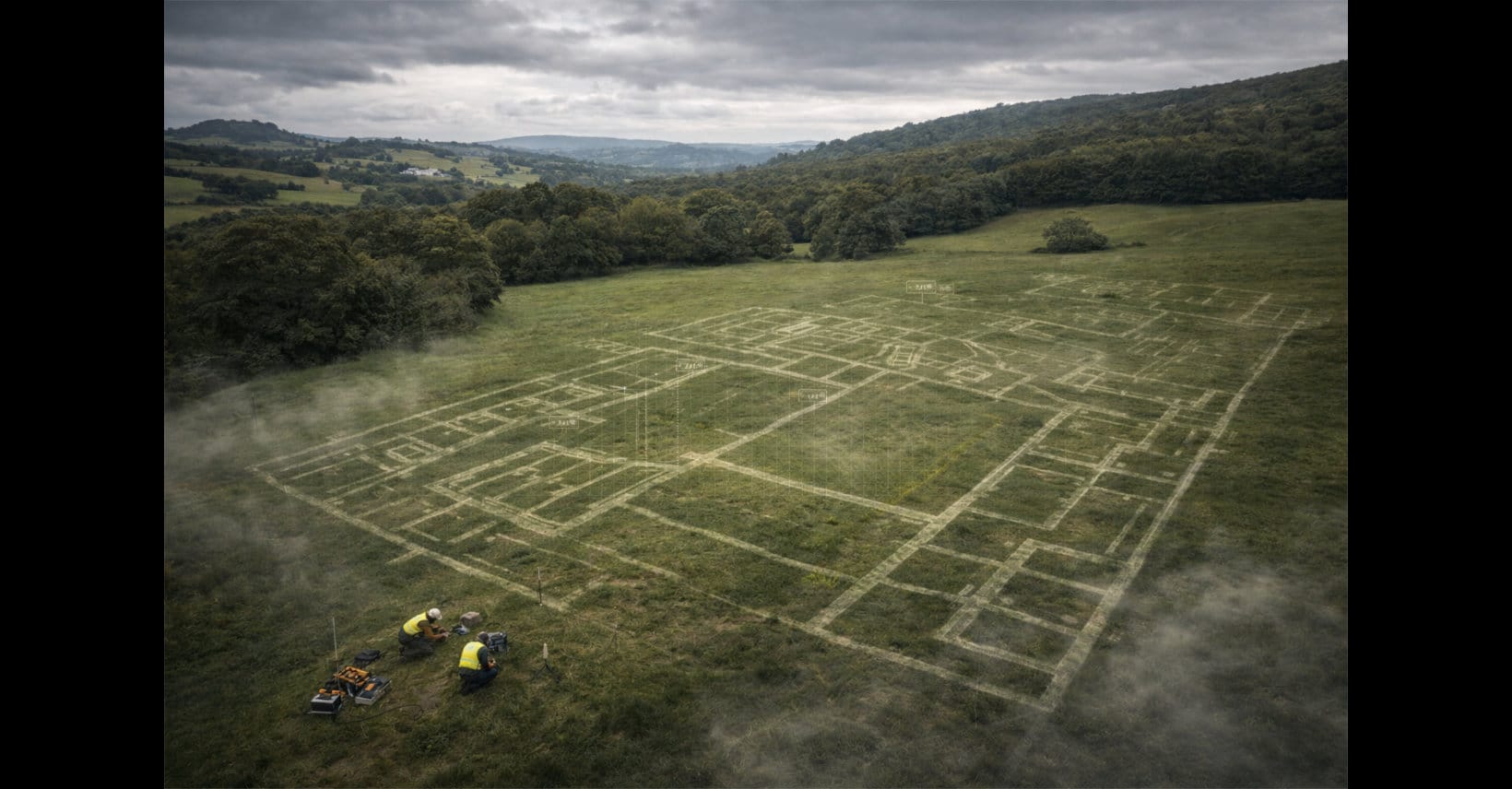
Archaeologists at Margam Country Park near Port Talbot, South Wales, have identified the footprint of what may be the largest Roman villa complex found in Wales. Ground-penetrating radar suggests a 4th-century site that may have served as a major agricultural center, with unusually strong preservation from centuries inside a deer park.
The discovery implies a more complex and productive Roman presence in Wales than a simple frontier outpost. The post uses the find to argue that archaeology often reveals large, sophisticated systems in places where they were not expected.
Archaeologists working at Margam Country Park near Port Talbot, South Wales, have revealed the footprint of what may be the largest Roman villa complex ever discovered in Wales—a find already nicknamed “Port Talbot’s Pompeii.” Detected through ground-penetrating radar, the site appears to date to roughly the 4th century, and its scale suggests something far more ambitious than a remote provincial outpost.
The early interpretation is quietly explosive: this location may have operated as a major Roman agricultural center, possibly with a large enclosed structure that could have been a granary or meeting hall, preserved unusually well due to centuries of protection inside a deer park that escaped modern farming.
Now here’s why The Alien Deception Chronicles should care. Not because Rome was extraterrestrial (Rome had enough problems without aliens), but because this discovery highlights a recurring feature of the historical record: large, sophisticated systems keep appearing in places where the accepted story says they shouldn’t exist.
History tends to be taught like a neat corporate org chart. Civilizations expand logically. Influence travels predictably. Infrastructure appears where textbooks approve it. But archaeology, like a mischievous intern, keeps forwarding emails that management did not authorize.
A villa complex of this magnitude implies supply chains, labor coordination, elite administration, and a stable population base. It also suggests Wales was not merely a peripheral frontier watching the empire from the rain—it may have been a productive, structured component of Roman Britain’s economic engine.
The “alien deception” angle doesn’t require spaceships. It requires pattern recognition. When major finds remain hidden in landscapes that are heavily studied, the question becomes: what else is missing—not because it never existed, but because it didn’t fit the narrative we already believed?
And that’s the real tension: the past may not be mysterious because it’s unknowable. It may be mysterious because we keep insisting it must be simpler than it actually was.
Port Talbot’s buried villa is more than a Roman footprint. It’s a reminder that human history is not a straight line—it’s a layered palimpsest of forgotten systems, overwritten maps, and civilizations that routinely exceeded the expectations we assign them.
The ground, as always, is telling the truth. The story just has to catch up.