The post examines online claims about ancient chambers, symbols, and hidden technology tied to Egypt and argues that such theories often rely on speculation rather than evidence. It distinguishes legitimate archaeological uncertainty from conclusions that leap to lost civilizations, aliens, or advanced ancient machines.
It also frames these narratives as a modern version of secret-knowledge religion, warning that the appeal of hidden truth can resemble spiritual deception. The author encourages curiosity and discernment while presenting Christianity as the true source of truth rather than buried ancient wisdom.
Every few months, another ancient mystery captures the imagination of the internet.
A newly discovered chamber beneath a pyramid. An unexplained symbol on a temple wall. A forgotten text that appears to describe advanced technology. An archaeological anomaly that officials supposedly refuse to discuss.
The details change. The pattern remains remarkably consistent.
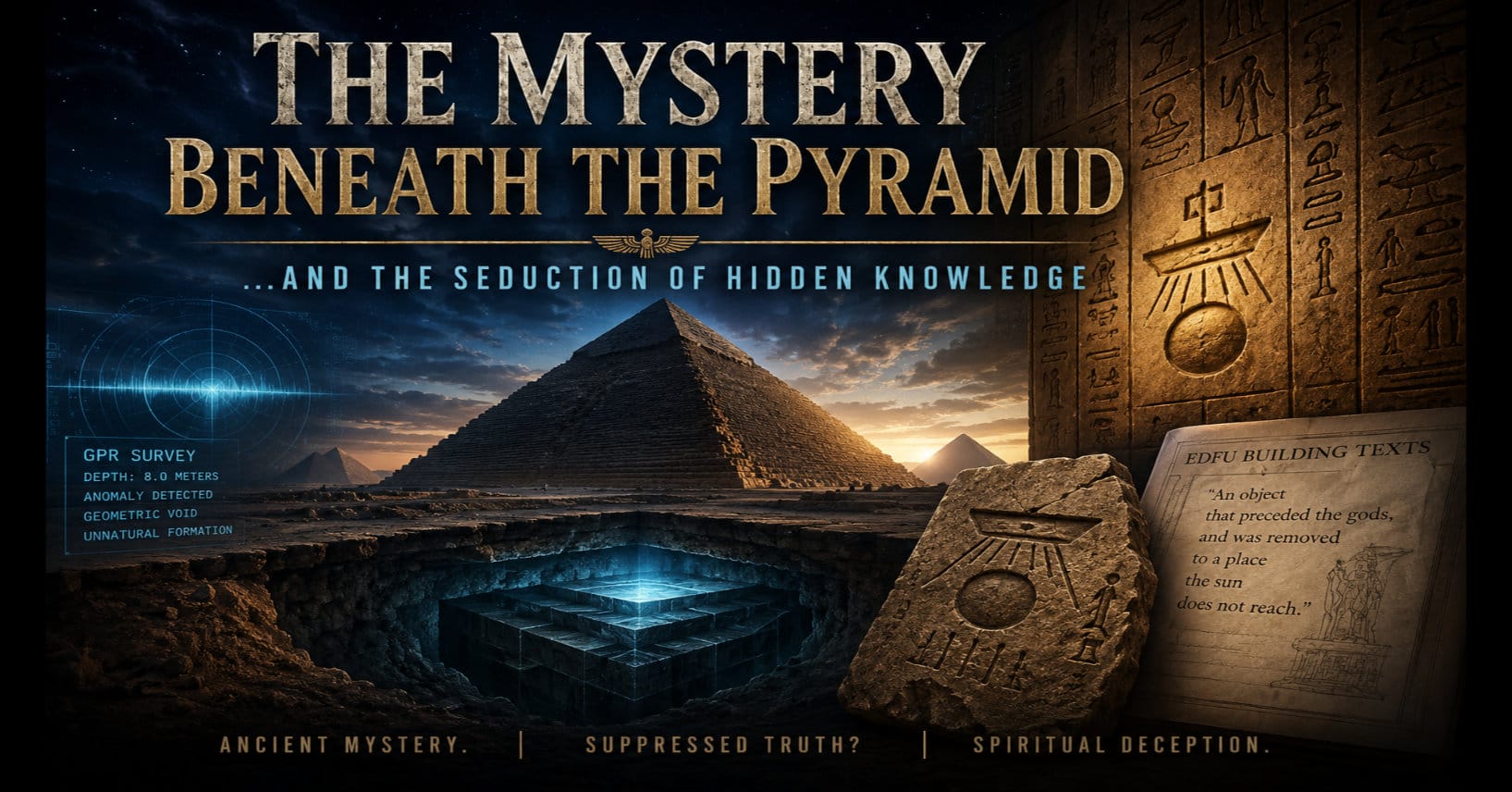
Recently, a video circulating online claimed that a 2017 ground-penetrating radar survey beneath the Giza Plateau identified a geometric void unlike any known natural formation. The video further connected this alleged anomaly to unusual hieroglyphic symbols at Abydos, a little-known artifact stored by the British Museum, and passages from the Edfu Building Texts that supposedly describe an ancient device hidden before recorded history.
Whether any of these claims ultimately prove true is almost beside the point.
The more important question is this:
Why are so many people eager to believe them?
The Appeal of Hidden Knowledge
Human beings are naturally drawn to mysteries.
We want to know what lies beyond the horizon, beneath the earth, and behind the official explanation. Curiosity itself is not wrong. In fact, curiosity has driven countless scientific discoveries and archaeological breakthroughs.
The problem arises when mystery becomes a substitute for evidence.
Many alternative archaeology theories follow a familiar formula:
An anomaly is discovered.
Authorities appear uncertain.
Questions remain unanswered.
Therefore, a hidden civilization, lost technology, or extraterrestrial influence must be involved.
Yet uncertainty is not proof.
A gap in knowledge is simply a gap in knowledge.
The temptation to fill that gap with speculation is powerful, especially when the speculation promises access to secrets that others supposedly cannot see.
Ancient Technology or Ancient Myth?
Supporters of these theories often point to extraordinary accomplishments in the ancient world.
The Great Pyramid remains one of history’s most astonishing engineering achievements. Massive stone blocks were transported, positioned, and aligned with remarkable precision. Even today, researchers continue debating aspects of how these structures were constructed.
But there is a significant difference between saying, “We do not fully understand how this was done,” and saying, “Therefore advanced technology must have existed.”
The first statement is honest.
The second is an assumption.
Ancient civilizations were capable of remarkable achievements without requiring alien intervention, lost super-science, or forgotten machines buried beneath the sands of Egypt.
Unfortunately, many modern discussions skip over that distinction.
The Return of an Ancient Lie
From a biblical perspective, the most interesting aspect of these theories is not archaeological.
It is spiritual.
Notice how often these stories share a common theme:
Humanity once possessed greater knowledge.
Ancient beings shared advanced wisdom.
Civilization lost access to that wisdom.
Hidden truths remain buried.
A select few are now rediscovering them.
Humanity stands on the verge of awakening.
That storyline should sound familiar.
The first recorded deception in Scripture was not an outright denial of God.
It was a promise of secret knowledge.
“And the serpent said unto the woman, Ye shall not surely die:
For God doth know that in the day ye eat thereof, then your eyes shall be opened, and ye shall be as gods, knowing good and evil.” (Genesis 3:4-5 KJV)
The temptation was not rebellion alone.
It was enlightenment.
It was access to hidden truth.
It was the belief that humanity could ascend through knowledge.
Thousands of years later, the packaging has changed, but the temptation remains remarkably similar.
Ancient Aliens and Modern Gnosticism
Many modern alternative archaeology theories function as a form of technological Gnosticism.
Ancient Gnosticism taught that salvation came through special knowledge available only to the enlightened few.
Today’s versions often replace spiritual terminology with scientific language.
Instead of hidden spiritual wisdom, there is hidden technological wisdom.
Instead of secret initiates, there are researchers exposing suppressed truths.
Instead of ancient divine beings, there are advanced extraterrestrials or interdimensional visitors.
The framework changes.
The promise remains the same.
You have been deceived.
The truth was hidden.
The awakening is coming.
This message appears throughout modern disclosure culture, ancient alien theories, New Age spirituality, and starseed movements.
The common thread is not archaeology.
It is the pursuit of salvation through hidden knowledge.
What If Something Really Is There?
Christians do not need to fear legitimate discoveries.
If archaeologists uncover new chambers beneath Giza, believers should welcome the evidence.
If ancient inscriptions are translated more accurately, truth has nothing to fear from investigation.
Christianity is not threatened by facts.
The issue arises when speculation outruns evidence and becomes a foundation for new spiritual narratives.
A hidden chamber beneath a pyramid does not prove extraterrestrial intervention.
An unusual symbol does not prove advanced technology.
An unexplained artifact does not prove ancient gods walked among men.
The evidence must support the conclusion.
Not the other way around.
The Real Question
Perhaps the most revealing aspect of these stories is not what they claim to discover beneath the pyramids.
It is what they reveal about modern culture.
Many people seem increasingly willing to believe that humanity’s future depends upon recovering lost wisdom from ancient beings.
The Bible points in a different direction.
Truth is not hidden beneath the sands of Egypt.
Truth is not locked inside a forgotten machine.
Truth is not waiting to be revealed by extraterrestrial visitors.
Truth was revealed in the person of Jesus Christ.
As technology advances and ancient mysteries continue to capture public attention, Christians should remain curious but discerning.
Not every mystery is a deception.
But every mystery should be tested.
Because the greatest danger may not be what lies buried beneath the pyramids.
It may be the growing belief that humanity can save itself if it can only recover the right secret knowledge.