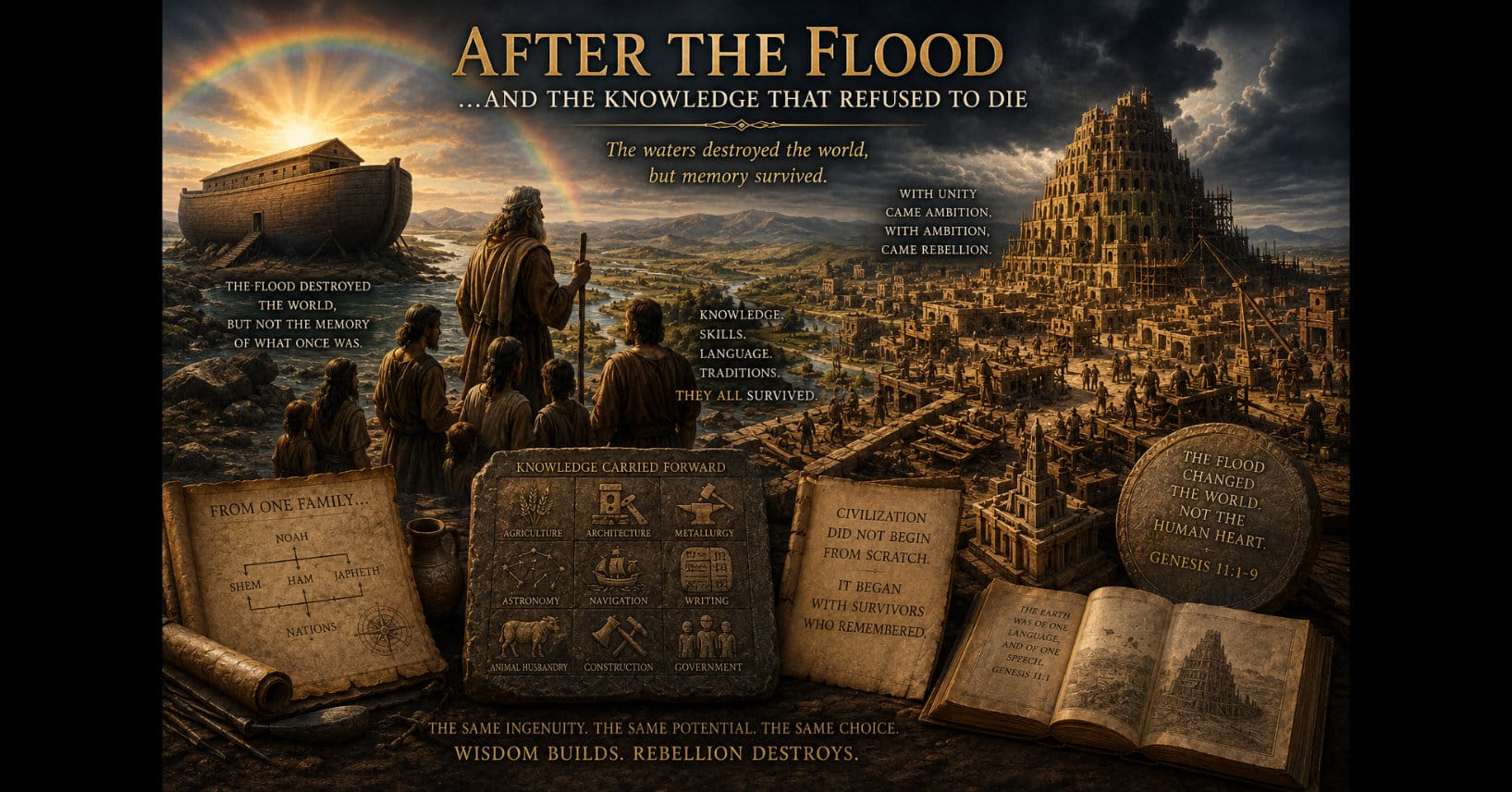
The post argues that civilization after the Flood did not begin from nothing. Noah and his family carried memory, skills, and traditions from the pre-Flood world, allowing knowledge to survive even as infrastructure was destroyed. Babel is presented as evidence of a rapid recovery of organized society and ambition.
It also suggests that flood traditions across cultures may reflect shared memories of a historical catastrophe. The post concludes that knowledge can be lost after collapse, but the deeper human impulse toward rebellion and self-reliance remains unchanged.
“And the whole earth was of one language, and of one speech.” — Genesis 11:1 (KJV)
If the Flood truly reset civilization, one question becomes difficult to ignore:
Why did humanity recover so quickly?
According to Scripture, the Flood destroyed the world that existed before Noah. Cities vanished. Populations disappeared. Entire generations were swept away.
Yet only a few generations later, humanity was once again building cities, organizing societies, and attempting projects of astonishing ambition.
The Tower of Babel stands as the clearest example.
How did civilization rebound so rapidly?
The answer may be simpler than many assume.
The Flood destroyed the world.
It did not erase memory.
Civilization Did Not Start From Zero
Many modern depictions of post-Flood humanity imagine Noah’s descendants emerging into a primitive wilderness with little knowledge of the world that came before.
The biblical account suggests otherwise.
Noah was not an ignorant survivor.
He had lived in the pre-Flood world.
He had observed its achievements.
He had witnessed its corruption.
He possessed knowledge, skills, and experience accumulated over centuries.
His sons shared portions of that knowledge.
Their children inherited it.
Civilization did not begin from scratch after the Flood.
It began with survivors who remembered.
This distinction is critical.
The destruction of infrastructure is not the same as the destruction of knowledge.
The Ark as a Vessel of Memory
The Ark preserved more than life.
It preserved culture.
It preserved language.
It preserved traditions.
It preserved skills.
Every family carries knowledge from one generation to the next.
The same principle would have applied to Noah’s family.
Methods of construction.
Agricultural practices.
Animal husbandry.
Metallurgy.
Navigation.
Astronomy.
None of these would have vanished simply because the Flood occurred.
The Ark was not merely a vessel of survival.
In many ways, it was a vessel of continuity.
When Noah stepped onto dry ground, the memory of the old world stepped off the Ark with him.
Babel and the Return of Ambition
Only a few generations later, humanity gathered on the plain of Shinar.
Scripture records:
“Go to, let us build us a city and a tower, whose top may reach unto heaven; and let us make us a name…” (Genesis 11:4)
Notice the confidence.
The people were not struggling to survive.
They were organizing a civilization.
Planning a massive construction project.
Coordinating labor.
Applying engineering knowledge.
Most importantly, they were united around a common vision.
Babel does not read like the story of a primitive society.
It reads like the story of a civilization rapidly recovering its capabilities.
The same human ingenuity that existed before the Flood was emerging once again.
So was the same rebellion.
The Ancient Memory Problem
One of the most fascinating aspects of world history is the persistence of flood traditions.
Cultures separated by vast distances preserve remarkably similar stories.
A great flood.
Divine judgment.
A small group of survivors.
The preservation of life.
The rebuilding of civilization.
The details vary.
The core narrative remains.
Why?
The simplest explanation is that many cultures preserved distorted memories of the same historical event.
Over time, details changed.
Legends emerged.
Stories evolved.
But fragments of memory survived.
This pattern appears throughout human history.
People forget details.
They rarely forget catastrophes.
The Spread of Knowledge
As Noah’s descendants multiplied and dispersed, they carried more than stories.
They carried knowledge.
Every migration carried skills.
Every settlement carried traditions.
Every generation inherited fragments of the past.
This may explain why ancient civilizations often appear to emerge with surprising sophistication.
Agriculture.
Architecture.
Mathematics.
Astronomy.
Writing systems.
Organized government.
The appearance of these developments sometimes seems abrupt.
Perhaps that is because they were not entirely new.
Perhaps they were inherited.
Not in their complete form.
But as fragments of a world that no longer existed.
Why Knowledge Was Lost
If knowledge survived, why was so much forgotten?
The answer may lie in the nature of catastrophe itself.
When civilizations collapse, specialization disappears.
Infrastructure vanishes.
Resources become scarce.
Survival becomes the priority.
History provides numerous examples.
Wars destroy libraries.
Empires collapse.
Trade networks disappear.
Technologies are forgotten.
Knowledge survives unevenly.
Some skills are preserved.
Others vanish.
The same process may have occurred after the Flood.
Certain capabilities survived.
Others were lost forever.
The result would be a civilization simultaneously advanced and diminished.
Remembering some things.
Forgetting others.
The Persistence of the Original Temptation
The most important thing that survived the Flood was not technology.
It was human nature.
The same temptation that appeared in Eden reappears at Babel.
The desire for autonomy.
The pursuit of significance apart from God.
The confidence that humanity can determine its own destiny.
The Flood changed the world.
It did not change the human heart.
This is why the biblical narrative repeatedly returns to the same pattern.
Knowledge grows.
Power increases.
Civilizations rise.
Rebellion follows.
The technology changes.
The temptation remains remarkably consistent.
Echoes Across the Ancient World
Around the globe, ancient civilizations preserved stories of divine beings, lost wisdom, heavenly teachers, and a golden age that existed before catastrophe.
The names differ.
The cultures differ.
The details differ.
Yet the themes often sound surprisingly familiar.
This does not prove every myth contains historical truth.
It does suggest that many societies were wrestling with the same questions:
Where did civilization come from?
Why was knowledge lost?
What happened in humanity’s distant past?
The biblical account offers a coherent answer.
A world existed before the Flood.
Judgment came.
A remnant survived.
Knowledge endured.
Civilization began again.
Why This Matters Today
Modern society often assumes progress is inevitable.
Each generation believes itself wiser than the last.
More advanced.
More enlightened.
History suggests otherwise.
Knowledge can be lost.
Civilizations can collapse.
Cultures can forget.
The lesson of the Flood is not merely that judgment came.
It is that human achievement is fragile.
Without wisdom.
Without humility.
Without God.
The greatest accomplishments of one generation can become the mysteries of the next.
Looking Ahead
If fragments of pre-Flood knowledge survived and spread throughout the ancient world, why do so many civilizations preserve remarkably similar stories about heavenly beings, divine instruction, and lost ages of wisdom?
In the next article, we will examine the suppression of memory, the fragmentation of history, and the possibility that humanity remembers far less about its origins than it believes.