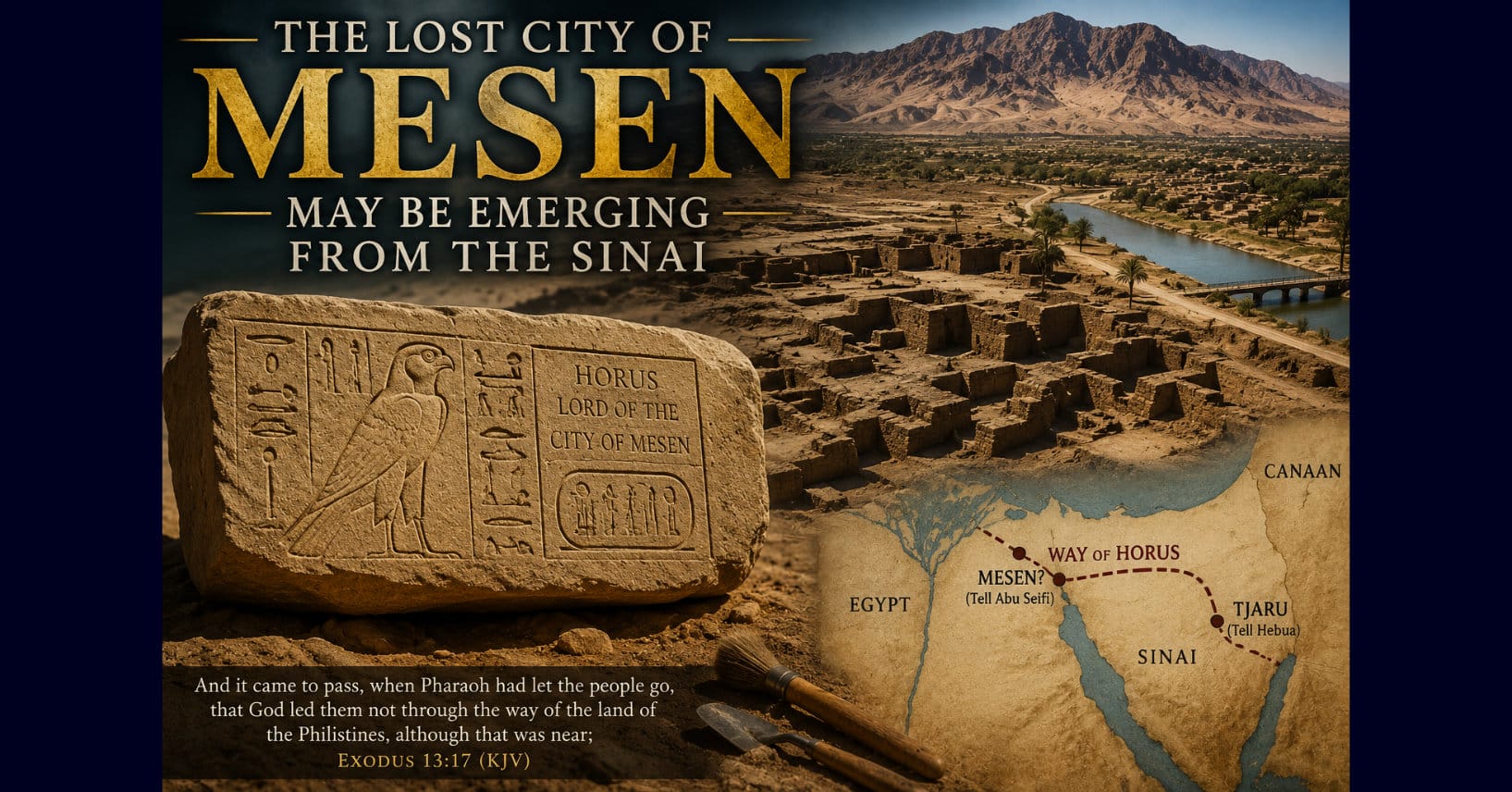
Archaeologists excavating Tell Abu Seifi near Egypt’s eastern frontier have uncovered a Ramesses II inscription referring to Horus as “Lord of the City of Mesen,” strengthening the possibility that the site is connected with the long-lost city. The Lost City of Mesen May Be Emerging From the Sinai explores the discovery, the strategic Way of Horus linking Egypt with Sinai and Canaan, and its significance for understanding the geographical world described in Exodus. The article also examines how genuine lost-city discoveries can become fuel for ancient-alien speculation and why the sophistication of Egyptian civilization requires neither extraterrestrial teachers nor technological reinterpretations of its gods.
For nearly 140 years, archaeologists have debated the location of an ancient Egyptian city called Mesen.
Now a broken piece of sandstone may be bringing that city back into view.
An Egyptian archaeological mission excavating Tell Abu Seifi, near Qantara East and the Suez Canal, has uncovered a large sandstone lintel inscribed with the royal titles of Ramesses II. More importantly, the inscription refers to restoration work on a statue of Horus and identifies the deity as “Lord of the City of Mesen.”
The discovery strengthens the possibility that Tell Abu Seifi is connected with the long-lost city known from ancient Egyptian texts.
It does not prove it.
Egyptian archaeological authorities have emphasized that additional excavation and study are necessary before the identification can be confirmed.
That uncertainty makes the discovery more interesting, not less.
Because Mesen may have occupied one of the most strategically—and biblically—significant corridors of the ancient world.
The Road Through the Sinai
Tell Abu Seifi stood near the ancient Way of Horus, the military and trade route connecting Egypt’s eastern frontier with Sinai and Canaan.
This was not simply a road.
Egypt maintained fortified settlements, supply facilities, administrative centers, and military installations along the corridor. Armies traveling toward Canaan could be provisioned and controlled through this network.
The latest excavations have revealed a substantial mudbrick enclosure wall with gateways and rooms, a temple complex, storage facilities, and paved approaches. Later civilizations continued using the site: the Ptolemies developed it, Roman forces eventually converted portions into military facilities, and still later occupants constructed lime kilns over parts of the former sanctuary.
Layer upon layer, one civilization built upon another.
But for Christians, the geography immediately raises another question.
The book of Exodus describes precisely such a route.
“And it came to pass, when Pharaoh had let the people go, that God led them not through the way of the land of the Philistines, although that was near;”
—Exodus 13:17, KJV
The biblical text describes an obvious route toward Canaan—and specifically tells us Israel did not take it.
What the Discovery Does—and Does Not—Establish
This is where archaeological restraint becomes especially important.
Finding Mesen would not prove the Exodus.
Nor would identifying Tell Abu Seifi with Mesen establish that the Israelites passed through this particular location.
What the archaeology can do is illuminate the geographical and military world described by the biblical text.
Egypt really did maintain a heavily controlled eastern route toward Canaan.
Fortifications really did guard that frontier.
Military and administrative infrastructure really did exist along the corridor.
That context helps explain why avoiding the established northern route would have mattered.
Archaeology does not need to produce a sign saying “Moses was here” to make the historical landscape of Exodus more intelligible.
The Mystery Has Been Here Since 1887
The Mesen question is not new.
Excavations at Tell Abu Seifi in 1887 uncovered Ramesside material that also referred to Horus of Mesen. That led some scholars to associate the location with the lost city.
There was a problem.
Later archaeological work did not produce the occupation evidence researchers expected from the time of Ramesses II.
Scholars therefore proposed another explanation: perhaps the Ramesside stones had been transported to Tell Abu Seifi from nearby Tell Hebua, identified with the important Egyptian frontier city of Tjaru.
Mesen might have been a separate settlement.
It might have been associated with Tjaru.
It might even have referred primarily to a temple or cult center connected with Horus.
The question remained open.
The newly discovered inscription now gives archaeologists fresh evidence to reconsider it.
That is how archaeology normally advances.
Not through one sensational discovery that suddenly overturns everything, but through accumulated evidence that gradually makes one interpretation stronger than another.
When “Lost City” Becomes Something Else
Yet the phrase lost city has acquired a second life in popular culture.
A forgotten city is rarely allowed to remain simply forgotten.
It becomes mysterious.
Then advanced.
Then suppressed.
Perhaps its inhabitants possessed forgotten technology.
Perhaps conventional archaeology has misunderstood human history.
Perhaps knowledge arrived from an older civilization.
And eventually, in ancient-astronaut narratives, someone looks toward the stars.
That progression tells us more about modern imagination than ancient archaeology.
Nothing about Mesen presently requires an advanced lost civilization.
The emerging picture is already remarkable.
Egyptians constructed military roads.
They fortified frontiers.
They built temples.
They maintained supply networks.
They organized armies across enormous distances.
They created administrative systems capable of sustaining imperial control from the Nile Delta into Canaan.
Human beings did that.
No extraterrestrial engineers are necessary.
Horus and the Technological Reinterpretation of the Gods
There is another reason Mesen belongs within the broader discussion of The Alien Deception Chronicles.
The inscription invokes Horus.
Ancient Egyptian religion has become fertile territory for ancient-alien interpretation. Gods depicted with animal characteristics, celestial associations, unusual crowns, solar imagery, and divine vehicles are frequently reinterpreted through modern technological assumptions.
Gods become extraterrestrials.
Heaven becomes outer space.
Divine manifestations become spacecraft.
Sacred knowledge becomes advanced science.
Creation becomes genetic engineering.
But notice what has happened.
The ancient religious worldview has not actually been discarded.
It has been translated into modern terminology.
The supernatural has been repackaged as technological.
That transformation is central to the alien-deception hypothesis explored throughout this series.
From a biblical perspective, pagan religion does not need extraterrestrial biology to explain its spiritual significance.
Scripture repeatedly confronts idolatry and false gods as spiritual rebellion and deception.
Putting an alien face on Horus does not make ancient Egyptian religion more scientific.
It simply changes the vocabulary.
A City Returning One Inscription at a Time
Perhaps Tell Abu Seifi will ultimately be confirmed as Mesen.
Perhaps further excavation will complicate the picture again.
That is archaeology.
The responsible response is to allow the evidence to accumulate.
What has already emerged is significant enough.
A Ramesses II inscription names Horus as Lord of Mesen.
A fortified religious and administrative complex occupied an important position near Egypt’s eastern frontier.
The site stood within the landscape of the ancient Way of Horus.
And that landscape helps us understand why the biblical description of Israel avoiding the established northern route out of Egypt makes geographical and military sense.
We should not make the discovery prove more than it can.
But neither should we overlook what it gives us.
Sometimes archaeology does not dramatically rewrite history.
Sometimes it restores a name.
A wall.
A road.
A temple.
A city thought lost.
And gradually, the world described by ancient texts becomes a little less abstract.
Mesen may be emerging from the Sinai.
If it is, its greatest significance may not be that archaeologists have found something history forgot.
It may be that another piece of the ancient biblical world has returned to the map.