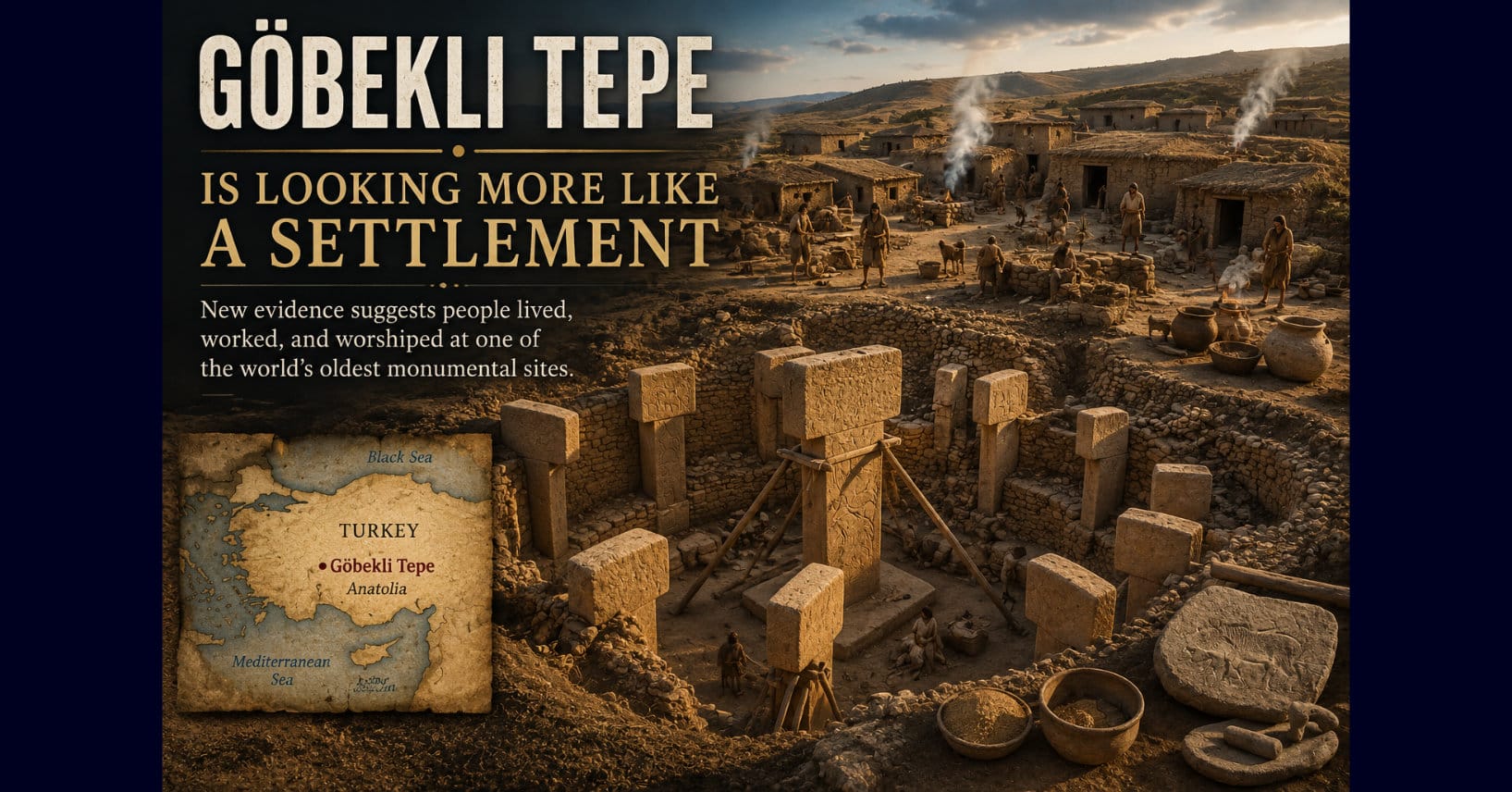
Göbekli Tepe has long been portrayed as an extraordinary ceremonial complex built by hunter-gatherers more than 11,000 years ago. But archaeological evidence increasingly complicates the familiar “world’s oldest temple” narrative. Göbekli Tepe Is Looking More Like a Settlement examines evidence of habitation and everyday activity, the wider network of related Neolithic sites such as Karahan Tepe, and what these discoveries reveal about the sophistication of early human communities. The article also challenges lost-civilization and ancient-alien interpretations that depend upon underestimating ancient people. Rather than making Göbekli Tepe less mysterious, the emerging settlement picture restores human agency to one of archaeology’s most remarkable sites.
For decades, Göbekli Tepe has been presented as one of archaeology’s great anomalies.
More than 11,000 years ago, people in southeastern Anatolia erected massive T-shaped limestone pillars, some weighing many tons. The pillars were carved with foxes, snakes, boars, birds, and other animals. Monumental circular enclosures appeared at a time traditionally associated with hunter-gatherer societies rather than cities, temples, or large-scale organized construction.
That combination produced a compelling description:
Göbekli Tepe was the world’s oldest known temple.
People supposedly traveled there for ceremonies and feasts but did not permanently live there. Religion, according to one influential interpretation, may even have helped bring people together before settled agricultural civilization fully developed.
It was an extraordinary idea.
It was also irresistible to alternative-history writers.
If hunter-gatherers could not have built Göbekli Tepe, perhaps they were not responsible.
Perhaps an advanced civilization existed before conventional history allowed.
Perhaps survivors of some forgotten catastrophe carried knowledge into the ancient world.
And inevitably:
Perhaps the teachers came from somewhere else.
But archaeology has continued.
And Göbekli Tepe is beginning to look less like an isolated sanctuary and more like something simultaneously less sensational and more consequential:
A place where people may actually have lived.
More Than a Temple
Recent archaeological interpretation has increasingly challenged the simple distinction between “ritual center” and “settlement.”
Researchers have identified evidence of domestic activity, food preparation, buildings, water management, tools, and other aspects of everyday life associated with Göbekli Tepe and the broader network of early Neolithic sites in the region.
The picture emerging is not necessarily of a temple surrounded by empty wilderness.
It is of a complex community.
People gathered there.
They built there.
They prepared food there.
They worked stone there.
They performed rituals there.
And increasingly, the evidence suggests some of them may have lived there.
That does not make the monumental enclosures less important.
It changes the question.
Instead of asking how wandering hunter-gatherers could have suddenly constructed a mysterious ceremonial complex, archaeologists can ask how increasingly settled communities organized their social, religious, economic, and architectural lives.
That is a very different problem.
The Category May Have Been Wrong
Part of the difficulty comes from imposing modern categories on prehistoric people.
We separate church from home.
Temple from workshop.
Public building from residence.
Sacred from ordinary.
Ancient communities may not have organized their lives so neatly.
A monumental enclosure could have served ceremonial purposes while existing inside a community where people lived and worked.
A building could carry religious significance without being exclusively a “temple.”
Food preparation could accompany ritual activity.
Feasting could reinforce social relationships.
Architecture could express both communal identity and religious belief.
The question therefore may not be:
Was Göbekli Tepe a temple or a settlement?
It may have been both—or something for which our modern vocabulary has no exact equivalent.
That possibility matters because much of the mystery surrounding Göbekli Tepe has depended upon the assumption that it was one extraordinary thing appearing where it should not have existed.
The Civilization Before Civilization
Göbekli Tepe became a cornerstone of lost-civilization speculation precisely because of its age.
The reasoning usually proceeds like this:
Hunter-gatherers were primitive.
Primitive people could not organize massive construction projects.
Göbekli Tepe required advanced planning.
Therefore someone more advanced must have been involved.
Candidates range from a forgotten Ice Age civilization to survivors of Atlantis to extraterrestrial visitors.
But notice the assumption doing most of the work:
Ancient people were incapable.
Archaeology is increasingly dismantling that assumption.
The communities responsible for Göbekli Tepe and related sites appear to have possessed sophisticated social organization, symbolic systems, architectural knowledge, stoneworking skills, and the ability to coordinate significant amounts of labor.
That does not require a vanished technological civilization.
It requires human beings to have been more capable than modern stereotypes assumed.
The Biblical Worldview Has No Problem With That
Christians have little theological reason to imagine early humanity as intellectually primitive.
Genesis does not describe human civilization spending hundreds of thousands of years struggling toward basic intelligence.
Its early chapters portray people farming, raising livestock, building cities, making musical instruments, and working metals.
Genesis 4 records:
“And Cain knew his wife; and she conceived, and bare Enoch: and he builded a city…”
—Genesis 4:17, KJV
Later in the chapter:
“And his brother’s name was Jubal: he was the father of all such as handle the harp and organ.”
—Genesis 4:21, KJV
And:
“Tubalcain, an instructer of every artificer in brass and iron…”
—Genesis 4:22, KJV
Whatever chronological questions Christians debate regarding the relationship between biblical and archaeological timelines, the theological portrait is clear:
Human creativity is ancient.
Complexity should not surprise us.
What the Pillars Still Tell Us
The increasingly residential interpretation does not eliminate Göbekli Tepe’s religious significance.
Quite the opposite.
The monumental pillars remain extraordinary.
Some depict arms and hands, suggesting that the T-shaped forms may represent stylized anthropomorphic beings. Animals and abstract symbols cover other surfaces.
Whatever these images meant, they mattered enough for people to quarry enormous stones, carve them, transport them, and erect them.
These communities were not concerned merely with food and shelter.
They possessed symbolic worlds.
They had beliefs.
They ritualized aspects of life.
They looked beyond immediate survival.
This is one of Göbekli Tepe’s most important lessons.
The farther archaeology pushes into the human past, the harder it becomes to separate humanity from questions of meaning, ritual, death, community, and the unseen.
That should interest Christians far more than speculative spacecraft.
Where Ancient Aliens Enter
Göbekli Tepe appears frequently in ancient-alien narratives because its carvings can be detached from their archaeological context and reinterpreted visually.
An unusual figure becomes a nonhuman being.
A symbolic object becomes technology.
A celestial interpretation becomes astronomical knowledge supposedly impossible for prehistoric people.
A monumental pillar becomes evidence of outside instruction.
Once again, the supernatural or symbolic world of ancient people is translated into technological language.
But archaeological mystery does not constitute evidence of extraterrestrial involvement.
If we do not understand a carving, then we do not understand it.
The responsible conclusion is not:
Therefore aliens.
It is:
More evidence is needed.
A Network, Not an Anomaly
Göbekli Tepe also becomes less anomalous when considered alongside other sites in southeastern Turkey.
Karahan Tepe and additional locations associated with the broader Taş Tepeler archaeological landscape demonstrate that monumental construction and sophisticated symbolic culture were not confined to one mysterious hill.
This matters enormously.
One extraordinary site can look like an historical accident.
Multiple related sites begin to look like a culture.
And cultures transmit knowledge.
People move.
Craft traditions spread.
Communities exchange ideas.
Architectural techniques develop.
Religious symbols acquire shared meaning.
Suddenly, Göbekli Tepe does not require mysterious outsiders arriving with forbidden knowledge.
It belongs to a larger human landscape that archaeologists are only beginning to reconstruct.
The Mystery Is Becoming Better
There is a peculiar tendency in popular archaeology to assume that explaining something makes it less interesting.
Göbekli Tepe demonstrates the opposite.
If people actually lived around these monumental structures, the site becomes more fascinating.
Who organized the community?
How was labor coordinated?
Who carved the pillars?
What did the animals represent?
Were different buildings associated with families, clans, rituals, or communal gatherings?
How did subsistence practices change as people became increasingly sedentary?
What relationship existed between settlement, agriculture, religion, and social hierarchy?
These questions are more productive than simply asking which advanced civilization taught prehistoric people how to stack stones.
The mystery has not disappeared.
It has matured.
The People Are Returning to Göbekli Tepe
For years, the popular story of Göbekli Tepe emphasized the monuments.
Perhaps archaeology is now returning attention to the people.
Not mysterious priests arriving at an isolated sanctuary.
Not survivors of Atlantis.
Not extraterrestrial instructors.
People.
Families.
Workers.
Stone carvers.
Hunters.
Food preparers.
Children.
Community leaders.
People who worshipped, ate, worked, gathered, built, and died.
That does not diminish Göbekli Tepe.
It restores something that sensational explanations often remove:
human agency.
The builders did not necessarily need knowledge from another civilization.
They may have been the civilization we failed to recognize.
And perhaps that is the most important development at Göbekli Tepe.
The site is not becoming less mysterious because archaeology is discovering evidence of settlement.
It is becoming more human.
The stones were extraordinary.
But the people who raised them may have been even more so.