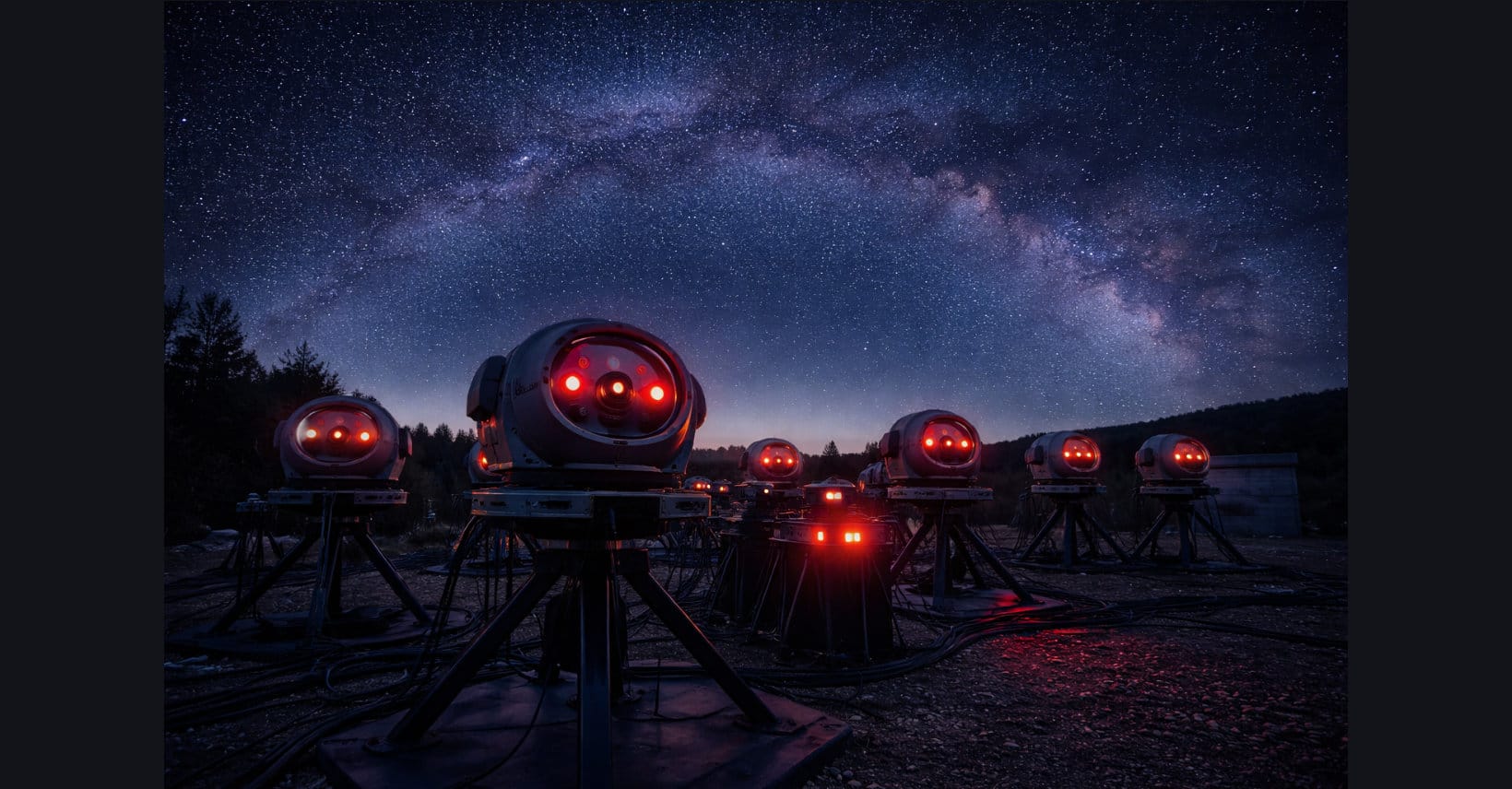
The Galileo Project has commissioned an all-sky infrared camera array nicknamed “Dalek” to search for observable technosignatures and unusual aerial objects with scientific rigor. The system has detected many airborne objects and flagged some statistical outliers after filtering out birds, satellites, aircraft, and other familiar sources.
No definitive technosignature has been confirmed, but the project represents a shift toward systematic, instrument-based study of unidentified aerial phenomena. Its open-data, quantitative approach is intended to assess anomalous motion or spectral signatures if they are found.
The search for evidence of extraterrestrial technology took a decidedly scientific turn with the commissioning of an unprecedented all‑sky infrared camera array developed under the guidance of the Galileo Project — an initiative formally established to pursue observable technosignatures with rigor. This array, affectionately nicknamed “Dalek,” represents a new generation of dedicated instruments capable of scanning the entire sky in infrared bands for anomalous objects that evade traditional classification.
During its initial months of operation, the Dalek system detected hundreds of thousands of airborne objects, with a subset statistically flagged as outliers relative to known object categories. These outliers persisted even after applying machine‑learning rejection algorithms for birds, satellites, aircraft, and other familiar objects. While no definitive technosignature has yet been confirmed, the scale and ambition of this project underscore an emerging shift: purposeful, systematic observation of potential UAP phenomena with scientific instrumentation rather than anecdotal reporting.
In the broader context of The Alien Deception Chronicles, Dalek’s work signifies a convergence of technology and theory that could challenge conventional dismissals of unusual aerial phenomena. The analytical architecture underpinning this endeavor means that any detection of truly anomalous motion patterns or spectral signatures would be immediately subject to quantitative assessment — a leap beyond the informal sightings and reports that have dominated prior discourse.
Indeed, the rigorous methodology and open‑data philosophy of the Galileo Project mark a forward‑thinking era in technosignature research. Whether the ultimate discoveries affirm extraterrestrial intelligence or reshape our understanding of atmospheric and orbital oddities, this effort stands as a pivotal development in the long arc of inquiry into anomalous aerial phenomena.