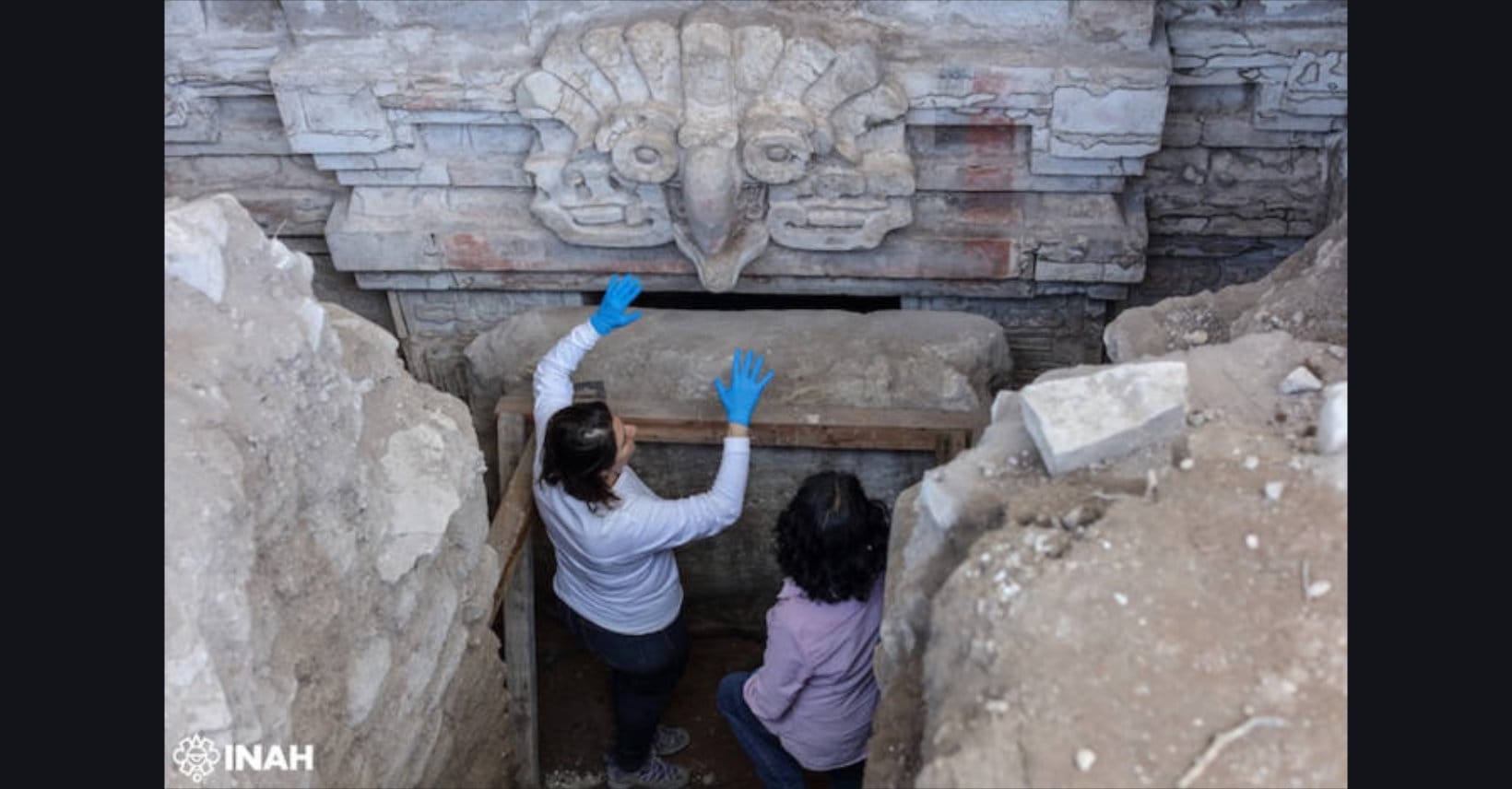
Archaeologists in San Pablo Huitzo, Oaxaca, have uncovered a roughly 1,400-year-old tomb with unusually well-preserved murals and symbolic carvings. Mexican officials have called it one of the most important archaeological finds in a decade.
The tomb features a monumental stone owl and ritual imagery, including ceremonial figures and calendrical glyphs. The site is presented as evidence of sophisticated Zapotec funerary art and cosmology, with some interpretations linking its symbols to celestial themes and hidden knowledge.
In the rolling valleys of Oaxaca, Mexico, a remarkable archaeological discovery has surfaced that promises to reshape how we interpret ancient civilizational knowledge and its possible connections to celestial themes. Recent excavations in San Pablo Huitzo have uncovered a previously lost tomb that dates back roughly 1,400 years. Known for its breathtaking preservation and symbolic richness, the site has already been described by Mexican officials as the most significant archaeological discovery in the past decade.
At the heart of this discovery is a monumental stone owl—its piercing eyes carved in profound detail, its beak poised above an engraved mural of ritual figures. In many ancient cultures, owls were not merely birds; they were emissaries between worlds, symbols of death, transition, and the unseen. The choice to guard a tomb with such a figure immediately evokes questions about what ancient people believed regarding life beyond the observable world—a theme that seamlessly aligns with the broader hypothesis that earlier societies may have encoded metaphysical or extraterrestrial associations in their sacred art.
Once inside the tomb, researchers have documented vibrant murals depicting ceremonial processions, figures bearing ceremonial incense, and a host of calendrical glyphs whose meaning remains enigmatic. These visual depictions hint at a cosmology that may have been deeply intertwined with astronomical cycles—an intellectual sophistication that goes beyond mere funerary practice and suggests a worldview of celestial correspondences and potentially lost knowledge.
Viewed through the lens of The Alien Deception Chronicles, this discovery serves as more than a window into Zapotec funerary customs. It represents a refracted mirror of how ancient intelligences approached the metaphysical unknown. Owls, stars, and serpents often punctuate ancient lore across continents; whether symbolic or literal, these motifs suggest a shared cognitive substrate that could align with narratives of advanced contact or insight. Moreover, the sophisticated handling of spatial arrangement, iconographic layering, and symbolic encoding implies that these ancient architects might have understood principles that modern science is only beginning to decrypt.
What contemporary archaeology calls myth and metaphoric language, alternative interpretations regard as encrypted references to knowledge systems that predate mainstream science. Whether this tomb proves such hypotheses or not, the sheer precision of its construction and ornamentation invites deeper investigation into a past where the boundaries between human spirituality and the cosmic unknown were far more porous than we conventionally acknowledge.