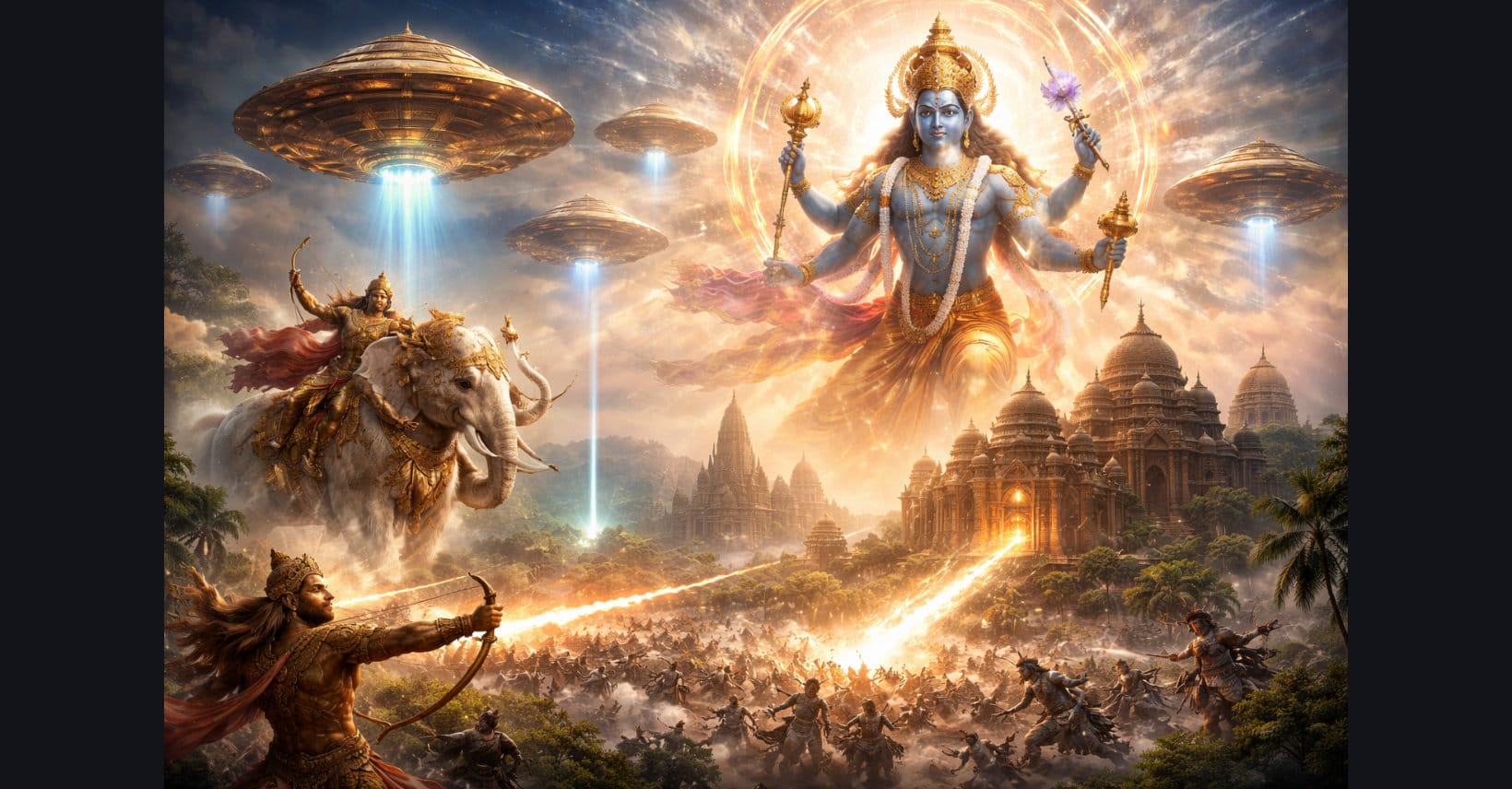
The piece examines ancient Indian texts that describe flying vehicles, powerful weapons, and celestial conflict, and considers whether these accounts reflect mythology, advanced technology, or encounters with non-human spiritual beings. It argues that ancient and modern readers often reinterpret extraordinary events through the categories available to them.
The author emphasizes discernment, suggesting that humanity repeatedly assigns meaning to unexplained power and may mistake signs and wonders for technology or divinity. The central question is not only what ancient people saw, but how they understood it.
There is something uniquely disorienting about the ancient texts of India.
Not because they are unfamiliar—but because they feel unexpectedly familiar.
Descriptions of flying craft.
Accounts of weapons with immense destructive force.
Beings descending from the heavens, engaging in conflict, and interacting directly with humanity.
To a modern reader, these do not immediately read as mythology.
They read like technology.
The Devas and the Language of Power
In the Vedic tradition, the Devas are powerful, non-human beings associated with natural forces, cosmic order, and authority. Figures such as Indra, Agni, and Vishnu appear throughout the texts, often operating with capabilities far beyond human limitation.
But what stands out is not simply their power.
It is how that power is described.
The ancient epics—particularly the Mahabharata—contain references to:
- Vimanas — airborne vehicles capable of traversing great distances
- Astras — weapons invoked with precision, capable of devastating entire regions
- Celestial warfare — battles fought not just on land, but in the skies
These are not vague symbolic references. They are detailed, structured, and often technical in tone.
And that raises an important question:
Are we reading mythology…
or are we reading ancient attempts to describe something beyond their framework of understanding?
When Technology and the Supernatural Converge
There is a principle that repeats throughout history:
Sufficiently advanced power is indistinguishable from the divine.
Ancient observers, encountering something beyond their comprehension, would naturally interpret it through the only categories available to them—gods, divine weapons, heavenly chariots.
Modern observers, reading those same descriptions, often reverse the equation:
“These were not gods. These were advanced beings with technology.”
Both interpretations attempt to solve the same problem:
How do you explain what exceeds your understanding?
But both may be missing something deeper.
The Illusion of Explanation
The modern reinterpretation of the Devas as technologically advanced entities—whether extraterrestrial or otherwise—offers a sense of clarity.
It feels grounded. Rational. Plausible.
But it may also be incomplete.
Because it assumes that power, no matter how extraordinary, must ultimately be explainable in material terms.
Scripture presents a different framework.
It affirms the existence of real, non-human intelligences—angels and fallen angels—capable of influence, manifestation, and interaction within the physical world.
Not technological.
Not mechanical.
But no less real.
And critically, no less powerful.
This introduces a possibility often overlooked in modern discussions:
What if the ancient accounts are not misidentified technology…
but misinterpreted encounters with the spiritual realm?
The Pattern of Reinterpretation
This is where the broader narrative explored throughout The Alien Deception Chronicles becomes especially relevant.
Across civilizations, humanity has consistently encountered—or at least recorded—interactions with non-human intelligences.
In the ancient world, those encounters were interpreted as divine.
In the modern world, they are increasingly interpreted as extraterrestrial.
The label changes.
The descriptions evolve.
But the structure remains remarkably consistent.
Beings from above.
Superior knowledge.
Influence over humanity.
Moments of intervention.
The Devas fit that pattern.
Not as proof of extraterrestrial origin—but as part of a much larger continuity in how humanity processes the unknown.
Signs, Wonders, and Discernment
The Bible repeatedly warns of “signs and wonders” that can persuade, convince, and even deceive.
Not crude illusions—but events with enough weight and realism to challenge discernment itself.
That warning reframes how we read accounts like those found in the Vedic texts.
Because whether one interprets vimanas as symbolic, technological, or something else entirely, the core issue is not the mechanism.
It is the effect.
The effect is this:
Humanity encounters power it cannot explain…
and then builds meaning around that encounter.
Sometimes correctly.
Sometimes not.
A Future Echo of the Past
This is where the ancient world begins to intersect with the modern one.
If humanity once interpreted extraordinary phenomena as divine…
And now interprets similar descriptions as technological…
What happens when something appears that fits both categories?
A manifestation that is:
- Structured enough to feel technological
- Powerful enough to feel divine
- Convincing enough to feel authoritative
In such a moment, interpretation becomes everything.
And interpretation is rarely formed in the moment.
It is shaped in advance—by the stories we have already accepted.
This is one of the central concerns explored throughout The Alien Deception Chronicles:
not simply what humanity encounters,
but how humanity is prepared to interpret it.
A Personal Reflection
When I read these ancient accounts, I am not trying to retrofit them into modern science fiction, nor dismiss them as primitive imagination.
I am looking at the pattern.
A recurring human response to the extraordinary.
A tendency to assign origin, authority, and meaning to what we cannot fully comprehend.
And I am reminded that the question has never simply been:
“What did they see?”
The more important question is:
“How did they interpret it?”
Because that same question is still in front of us today.
Only now, the language has changed.
The Devas have become something else.
The vimanas have new names.
The weapons have new explanations.
But the underlying challenge remains exactly the same:
To discern the difference between power…
and truth.