Ancient Egyptian religion is presented as a system that linked creation, authority, and social order. The post argues that gods such as Ra, Osiris, and Isis were understood as active forces shaping reality, and that pharaonic power derived from this divine origin story.
It compares Egyptian creation accounts with other ancient narratives and with modern reinterpretations that frame gods as advanced beings or technologies. The piece contrasts this with the biblical account of a single Creator and warns that changing beliefs about human origins can reshape authority and identity.
Ancient Egypt was not merely a civilization.
It was a system of explanation.
Every structure, every ritual, every symbol pointed back to a central question:
Where did we come from—and who determines what happens next?
The answers Egypt provided were not casual mythology. They were comprehensive, structured, and deeply integrated into daily life.
Creation was not left undefined.
It was authored.
The Architecture of Origin
In Egyptian cosmology, the universe did not emerge randomly.
It was brought into order by divine beings.
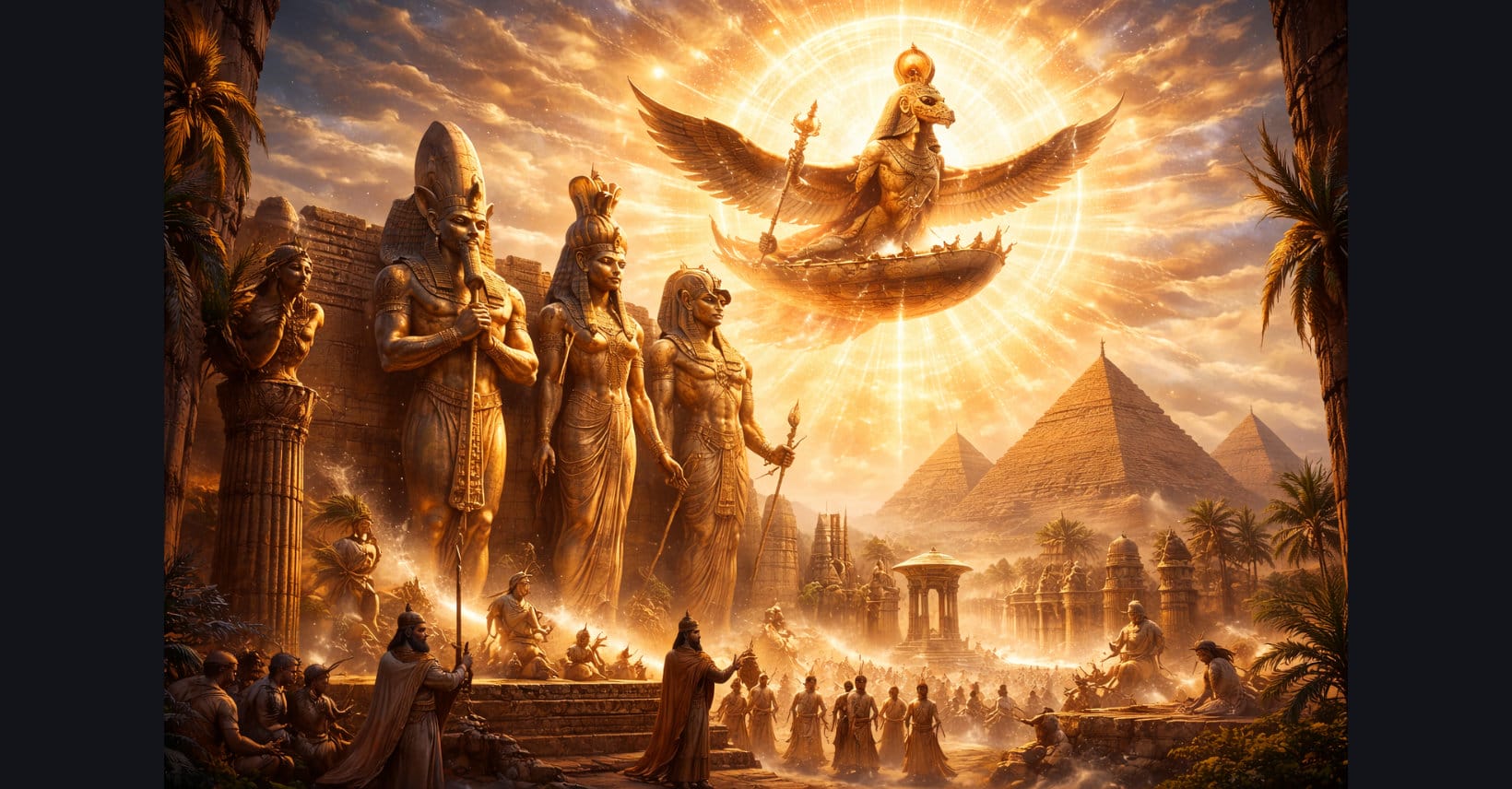
At the center of that order stood figures such as:
- Ra — the sun god, source of life and continual creation
- Osiris — ruler of the afterlife, governing judgment and resurrection
- Isis — associated with restoration, power, and hidden knowledge
These were not distant deities.
They were active participants in the structure of existence—responsible not only for creation, but for sustaining it.
The Nile, the seasons, the cycle of life and death—everything was understood as an extension of their authority.
In other words, Egypt did not just believe in gods.
It believed those gods defined reality itself.
Creation as Control
What makes the Egyptian system particularly significant is how tightly origin and authority are connected.
If the gods created humanity, then the gods—and by extension, those who represented them—held absolute authority over it.
This is where theology became governance.
The Pharaoh was not simply a political leader. He was considered a divine intermediary—sometimes even a manifestation of the gods themselves.
To question authority was to question creation.
And to question creation was to destabilize the entire system.
This linkage between origin and control is not unique to Egypt.
But Egypt refined it.
The Power of a Defined Beginning
There is a reason origin stories matter so deeply.
They answer foundational questions:
- Who made us?
- Why are we here?
- Who holds authority over us?
Once those questions are answered, everything else follows.
Ethics. Power structures. Identity.
From the perspective explored throughout The Alien Deception Chronicles, this becomes a critical point of vulnerability.
Because if humanity accepts a false origin…
it will inevitably accept false authority.
The Egyptian model demonstrates how powerful—and how stable—that structure can become once it is established.
Reinterpretation in the Modern Mind
Modern readers rarely interpret Egyptian texts as literal accounts of divine beings.
Instead, they are often viewed as symbolic, mythological, or allegorical.
But there is another growing trend.
Some reinterpret these accounts through a technological lens:
- The “gods” become advanced beings
- The “powers” become misunderstood technologies
- The “creation” becomes intervention
This mirrors what has happened with the Anunnaki narrative.
Different culture. Same reinterpretation.
And once again, the core issue is not the mechanism.
It is the conclusion.
Because whether the explanation is divine or extraterrestrial, the result is the same:
Humanity’s origin is placed outside of God.
The Consistency of the Pattern
When Egypt is viewed alongside other ancient civilizations, a pattern begins to emerge:
- Humanity is created or shaped by external beings
- Those beings possess superior knowledge and authority
- That authority is embedded into societal structure
- The system is reinforced through ritual, culture, and governance
The names change.
The symbols change.
But the structure remains consistent.
This consistency raises an important question:
Are these independent mythologies…
or variations of a recurring narrative?
Scripture and the Question of Origin
The biblical account of creation stands apart in a crucial way.
It does not present a hierarchy of competing gods.
It presents a single Creator.
“And God said, Let us make man in our image…” (Genesis 1:26, KJV)
Humanity is not an afterthought.
Not a product of experimentation.
Not a creation of lesser beings.
It is intentional.
And it is directly tied to God.
This distinction matters because it anchors identity—and authority—in truth, not interpretation.
A Future Rewriting
If the past shows us anything, it is this:
Humanity is willing to accept a wide range of explanations for its origin—provided those explanations are compelling enough.
Ancient Egypt demonstrates how deeply an origin story can shape an entire civilization.
But it also reveals how vulnerable that foundation can be to reinterpretation.
Because once the question of origin is reopened, it does not remain theoretical.
It becomes immediate.
If a future event were to present itself as evidence of humanity’s “true creators”—whether framed as returning gods or advanced beings—the Egyptian model shows how quickly that claim could take hold.
Not because it is proven.
But because it fits a pattern humanity has accepted before.
A Personal Reflection
What fascinates me about Egypt is not simply its grandeur or its mythology.
It is its confidence.
A civilization fully convinced it understood where it came from…
and who held authority because of it.
That confidence built monuments.
It shaped law.
It defined identity for generations.
But it also raises a question that still matters today:
What if the foundation was wrong?
Because if origin is misidentified…
everything built on it follows.
And in a world increasingly open to new explanations of human beginnings, that question is no longer ancient.
It is present.
And it may soon become unavoidable.