Summary
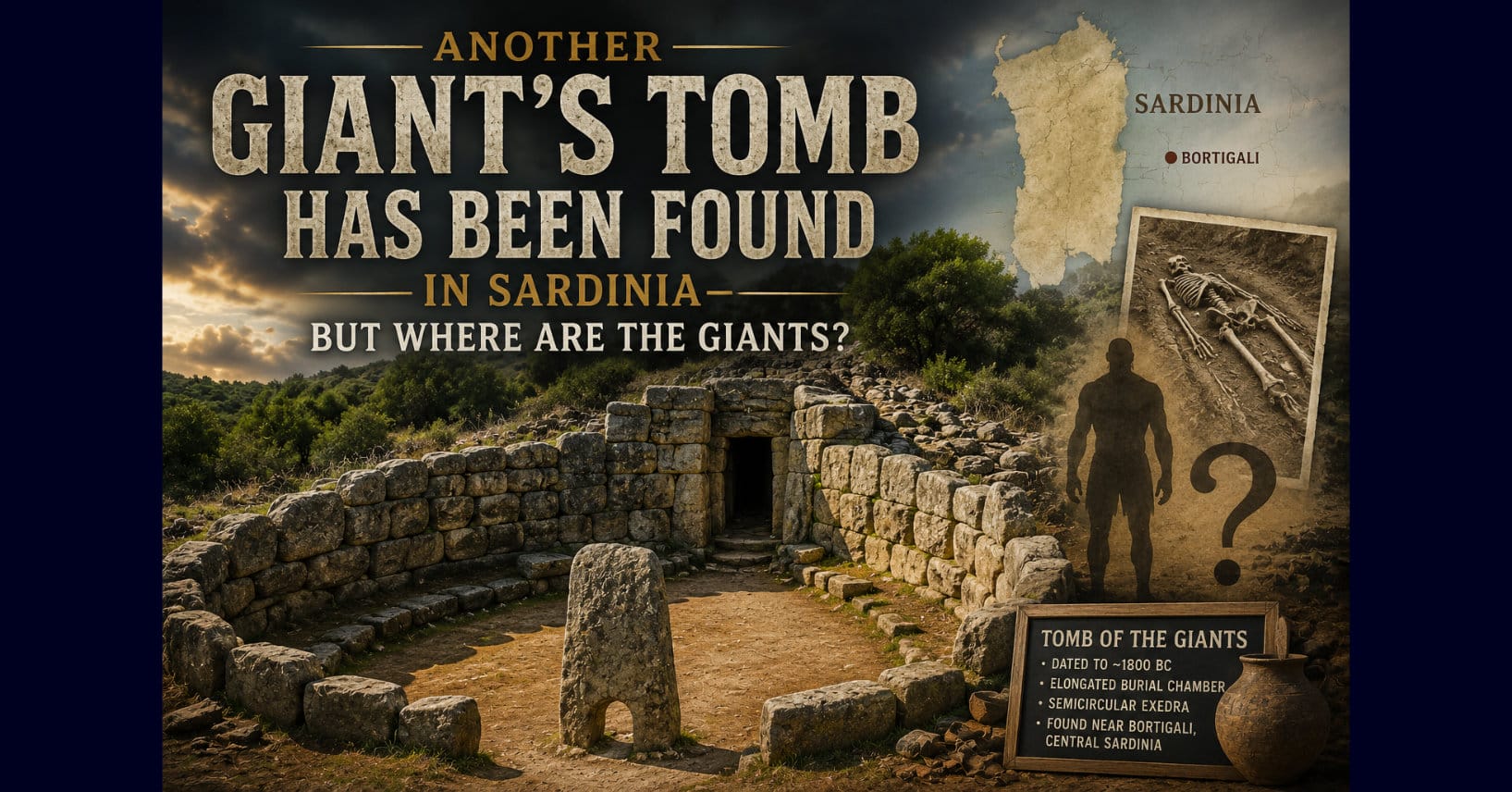
Archaeologists near Bortigali, Sardinia, have uncovered a remarkably preserved example of a Nuragic “Tomb of the Giants,” including an unusual two-level feature within its burial chamber. Despite the evocative name, these Bronze Age monuments were collective burial structures—not demonstrated graves of giant human beings.
Another Giant’s Tomb Has Been Found in Sardinia—But Where Are the Giants? separates the archaeology from centuries of folklore and modern claims involving enormous skeletons, the Nephilim, lost civilizations, and extraterrestrial intervention. The article argues that Christians can take biblical accounts of giants seriously without treating every megalithic monument or giant legend as confirmation of Genesis 6. Archaeological evidence, biblical interpretation, and speculation must remain distinguishable if we want genuine discernment.
Hidden beneath dense vegetation on a hillside in central Sardinia, archaeologists have uncovered another monument belonging to one of the Mediterranean’s most evocatively named archaeological traditions.
It is called a Tomb of the Giants.
The newly documented structure lies at Carrarzu Iddia near Bortigali, within a landscape already rich in remains of Sardinia’s Nuragic civilization. Built from large blocks of volcanic trachyte, the tomb retains its elongated burial chamber and the monumental semicircular forecourt, or exedra, characteristic of these structures. Archaeologists also found an unusual division of the chamber into two levels near its entrance—a feature rarely documented in Sardinian Giants’ Tombs.
The discovery is genuinely fascinating.
But despite the name, archaeologists did not uncover a race of giants.
And that distinction matters.
The Civilization Behind the Tomb
The Nuragic civilization flourished on Sardinia during the Bronze and early Iron Ages and takes its modern name from the nuraghi—massive stone towers scattered across the island.
The landscape around Carrarzu Iddia demonstrates how sophisticated these communities could be.
The archaeological complex includes two protonuraghi, predecessors of the better-known Nuragic towers, along with settlement remains, a probable sacred well, an extensive funerary area, and a much earlier dolmen. Archaeological evidence indicates human activity across the broader landscape from prehistory into Roman times.
The newly revealed tomb belongs to that larger cultural environment.
Giants’ Tombs began appearing around 1800 BC and functioned as collective burial places rather than graves for individual rulers. Hundreds have been identified across Sardinia.
Their architecture could be impressive.
An elongated stone chamber contained the dead. At the front, a large semicircular exedra created an open ceremonial space where the living apparently gathered for rituals associated with ancestors and communal memory.
The tomb therefore represented more than disposal of human remains.
It connected the living, the dead, the community, and the landscape.
Then Why Call Them “Giants’ Tombs”?
This is where archaeology collides with folklore.
The Sardinian name tomba dei giganti—Tomb of the Giants—does not mean archaeologists have determined that exceptionally large human beings were buried inside.
These were collective tombs.
Their enormous dimensions and monumental stone construction eventually contributed to traditions associating them with giants. When later generations encountered enormous prehistoric structures whose builders and purposes had faded from cultural memory, attributing them to beings of extraordinary stature was an understandable response.
Similar folklore appears throughout the world.
Massive stones become the work of giants.
Unusual ruins become the homes of gods.
Megalithic walls become evidence of vanished superhuman builders.
And today, increasingly, impressive ancient structures become evidence of extraterrestrials.
The explanation changes.
The human impulse does not.
But What About Giant Skeletons?
This is where the Sardinian story becomes particularly relevant to The Alien Deception Chronicles.
Search online for Sardinia’s Giants’ Tombs and it does not take long to encounter claims that enormous human skeletons have been discovered on the island.
Some versions describe eight-, ten-, or twelve-foot skeletons.
Others claim the Vatican, Italian government, Smithsonian Institution, or archaeological establishment removed or suppressed the remains.
Photographs of oversized skeletons circulate alongside stories about the Nuragic civilization, biblical giants, the Nephilim, and lost civilizations.
The problem is evidence.
The newly discovered Carrarzu Iddia tomb contains archaeological material, including ceramics associated with early phases of Nuragic civilization. The official reports describe the architecture, ritual context, landscape, and evidence of illicit excavation.
They do not report giant human remains.
That does not prove giants never existed.
It establishes something much narrower and much more important:
This discovery is not evidence that they did.
Christians Should Be Especially Careful Here
The subject of giants carries unusual weight for Christians because Scripture does describe extraordinarily formidable people and groups.
Genesis 6:4 states:
“There were giants in the earth in those days; and also after that…”
— Genesis 6:4, KJV
The KJV translates the Hebrew Nephilim as “giants.” Elsewhere Scripture describes unusually large warriors and peoples associated with the Rephaim and Anakim.
Goliath, of course, is the best-known example.
Christians therefore do not need to begin with the assumption that every historical report of unusually large human beings is impossible.
But biblical belief is not permission to lower evidentiary standards.
Quite the opposite.
If someone claims archaeologists discovered a twelve-foot skeleton in Sardinia, that claim requires evidence.
Where was it excavated?
Who excavated it?
Where are the field records?
Where are the skeletal measurements?
Where is the osteological analysis?
Where are the photographs documenting the remains in situ?
Where are the samples?
Where are the published results?
A blurry photograph accompanied by a story about government suppression is not archaeological evidence.
The Nephilim Shortcut
There is a tendency within some Christian circles to encounter almost any mysterious megalithic site and immediately invoke the Nephilim.
Massive stone blocks?
Nephilim.
Unusual skeletal remains?
Nephilim.
Advanced ancient architecture?
Nephilim.
Legends of giants?
Nephilim.
That approach may feel biblical, but it can actually undermine biblical credibility.
Scripture does not tell us that every megalithic civilization was built by giants.
It does not identify the Nuragic people as Nephilim.
It does not connect Sardinia with Genesis 6.
Those connections are modern speculation.
They can be explored as questions.
They should not be presented as biblical fact.
That distinction is particularly important for Christians interested in archaeology because weak arguments ultimately make strong biblical claims easier to dismiss.
The Ancient-Alien Version Has the Same Problem
Interestingly, ancient-alien theories frequently commit the same logical error from the opposite direction.
Instead of:
These stones are enormous, therefore Nephilim built them.
The argument becomes:
These stones are enormous, therefore extraterrestrials helped build them.
Both begin with an assumption that ancient human beings were incapable of accomplishing what archaeology shows them accomplishing.
Sardinia offers little justification for that assumption.
Nuragic society built thousands of substantial stone structures. Its people developed distinctive architecture, organized settlements, constructed sacred spaces, buried their dead communally, worked bronze, traded across the Mediterranean, and shaped landscapes that remain archaeologically visible thousands of years later.
We do not need aliens to explain that.
Nor do we need giants.
We need to understand the people who were actually there.
The Real Mystery May Be Better
The newly discovered tomb contains something genuinely unusual.
Its interior includes a division into two levels near the entrance. Archaeologists describe the feature as rare and intend to investigate it further.
What was it for?
Did it reflect changes in funerary practice?
Did different individuals or groups occupy different spaces?
Was the arrangement structural, ceremonial, chronological, or symbolic?
We do not yet know.
That is a legitimate archaeological mystery.
It does not require manufacturing another one.
And there is something almost ironic about the contrast.
The internet asks:
Where are the giant skeletons?
Archaeologists are asking:
Why did these people build their burial chamber this way?
The second question may ultimately tell us far more about the ancient world.
When Folklore Becomes Evidence
The broader lesson reaches beyond Sardinia.
Human beings frequently inherit stories about ancient places long after the original meaning of those places has disappeared.
Eventually, folklore and archaeology become intertwined.
A giant built it.
A god descended there.
A mysterious people possessed forgotten knowledge.
Visitors came from the stars.
The danger begins when the story is treated as though it were the artifact.
A legend about giants is evidence that people told stories about giants.
It is not, by itself, evidence that giants constructed the monument.
That distinction becomes increasingly important when biblical traditions, archaeological discoveries, and modern extraterrestrial mythology begin overlapping.
The Alien Deception Can Borrow From Both Sides
This is precisely where the subject becomes relevant to the larger alien-deception narrative.
Modern UFO and ancient-astronaut culture is remarkably good at absorbing older religious traditions.
Angels become extraterrestrials.
Gods become visitors from another planet.
Heaven becomes outer space.
Supernatural manifestations become advanced technology.
And giants or Nephilim become the products of extraterrestrial genetic engineering.
The result can sound simultaneously biblical, scientific, and archaeological while being none of the three.
A future deception would not necessarily need to erase humanity’s ancient traditions.
It could reinterpret them.
Imagine being told that humanity’s stories about giants were distorted memories of extraterrestrial genetic experimentation.
Genesis 6 becomes an alien hybridization program.
The “sons of God” become extraterrestrial visitors.
The Nephilim become engineered hybrids.
Ancient megaliths become remnants of their technology.
And every place called a “Giant’s Tomb” suddenly becomes another piece of supposed confirmation.
That narrative already exists in popular culture.
The archaeological evidence does not establish it.
So Where Are the Giants?
At Carrarzu Iddia, they are in the name.
What archaeologists have actually found is arguably more valuable: another remarkably preserved piece of Nuragic civilization, including an unusual architectural feature that may deepen our understanding of how Bronze Age Sardinians treated their dead and remembered their ancestors.
That should be enough to command our attention.
Christians can take biblical accounts of giants seriously without turning every ancient legend into confirmation of Genesis 6.
We can consider extraordinary possibilities without declaring them proven.
And we can appreciate monumental ancient architecture without assuming its builders needed extraterrestrial assistance.
The newest Giant’s Tomb in Sardinia gives us an excellent opportunity to practice exactly that kind of discernment.
The name is intriguing.
The archaeology is real.
The giants remain unproven.
Keeping those three statements separate is not skepticism for skepticism’s sake.
It is how we keep mystery from becoming mythology—and mythology from masquerading as evidence.