Summary
Archaeologists at Maree in County Galway, Ireland, have rediscovered a long-lost portal tomb and identified a previously unknown court tomb beside it. Researchers believe this may be the only known Irish site where these two distinct Neolithic burial traditions occur together.
Two Tombs, Two Traditions, One Neolithic Mystery explores what this unusual pairing may reveal about Ireland’s earliest farming communities, their treatment of the dead, and the spiritual significance they attached to monumental landscapes. The discovery also illustrates an important principle for interpreting ancient mysteries: increasingly sophisticated archaeology does not require lost supercivilizations or extraterrestrial teachers. Sometimes the evidence simply shows that prehistoric human communities were more socially, culturally, and spiritually complex than modern assumptions have allowed.
Nearly six thousand years ago, two communities—or perhaps two expressions of the same changing community—buried their dead beside the waters of Galway Bay.
They did not build the same kind of tomb.
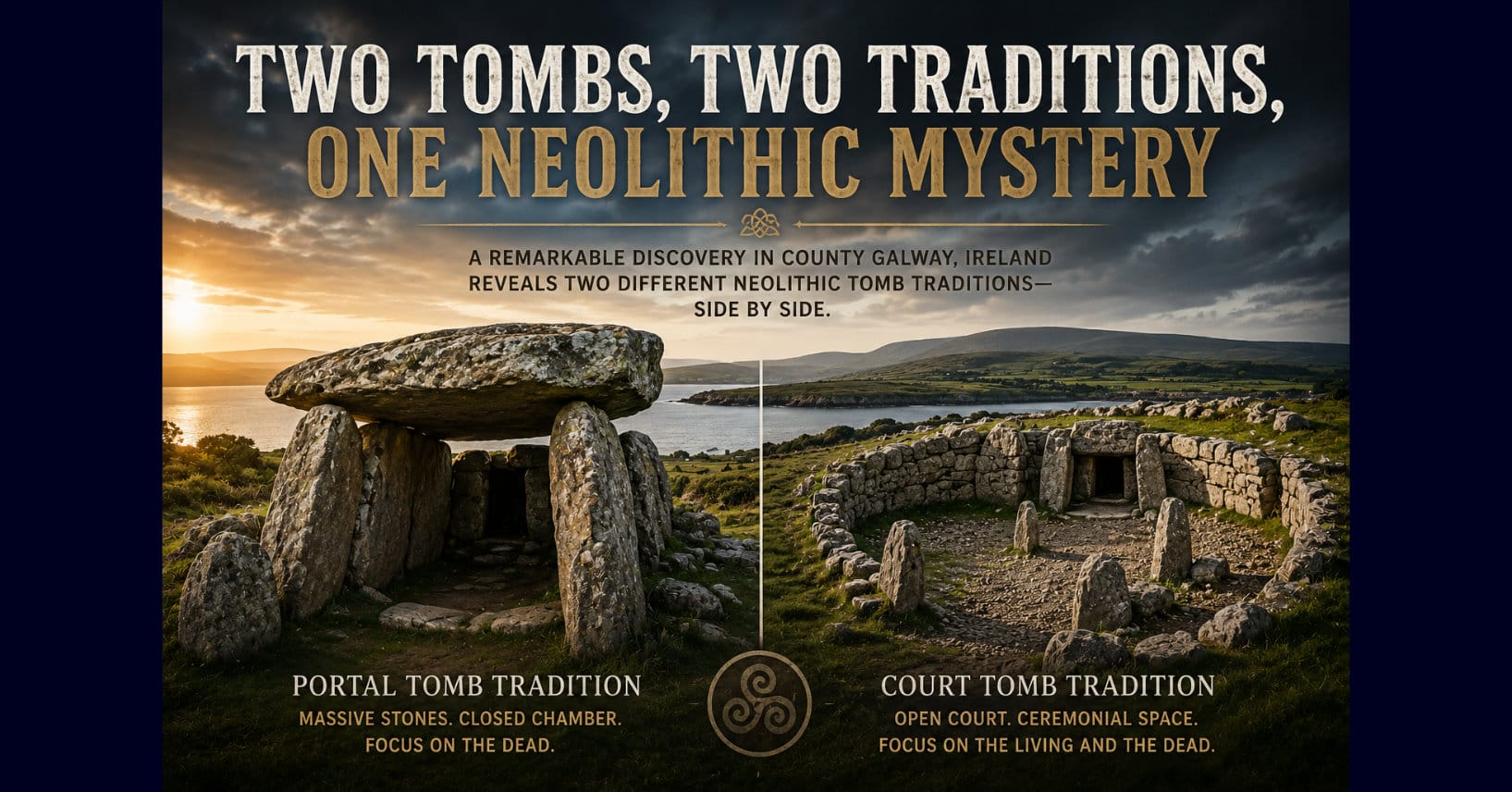
One monument belonged to Ireland’s portal-tomb tradition, characterized by massive upright stones supporting a large capstone above a burial chamber.
Beside it stood something different: a court tomb, built around an open ceremonial space leading toward burial chambers.
Either monument would be archaeologically significant.
Finding the two traditions together is something else entirely.
In July 2026, archaeologists from the University of Galway announced the rediscovery of a long-lost portal tomb at Maree, County Galway—and the identification of a previously unknown court tomb immediately beside it. Researchers believe it may be the only known location in Ireland where the two Neolithic monument traditions occur together.
The discovery raises an intriguing question.
Why did people who apparently approached death differently choose to bury their dead in the same place?
The Tomb That Disappeared
The portal tomb was not entirely unknown.
Historical records indicated that a megalithic monument once existed at Maree, but its precise location had effectively disappeared from archaeological knowledge.
Then researchers found it again.
The structure had survived sufficiently for archaeologists to recognize the distinctive architecture of a portal tomb—large upright stones defining a chamber that would originally have supported a substantial capstone.
But during the investigation, another monument emerged nearby.
This one was different.
Instead of another portal tomb, archaeologists identified the remains of a court tomb.
That changed the significance of the site.
Ireland contains hundreds of Neolithic megalithic monuments, but portal tombs and court tombs represent distinct architectural traditions. Finding them together creates an unusual opportunity to study how different communities—or different generations—used the same sacred landscape.
The stones may therefore preserve something more interesting than two burial structures.
They may preserve a relationship.
Two Ways of Approaching the Dead
Portal tombs are among Ireland’s most visually distinctive prehistoric monuments.
Their imposing entrance stones and enormous capstones sometimes create structures resembling stone doorways rising from the landscape. They are generally associated with Ireland’s early farming communities during the Neolithic period.
Court tombs followed another architectural concept.
Their characteristic feature was an open court, often positioned before chambers containing human remains. The arrangement suggests that whatever occurred there involved not merely the dead but also the living.
People gathered.
Ceremonies were performed.
Ancestors were remembered.
The architecture itself helped organize the encounter between community and burial place.
That makes the juxtaposition at Maree particularly intriguing.
Two architectural traditions.
Two approaches to monumental burial.
One location.
Were They Built at the Same Time?
We do not yet know.
That is one of the questions further archaeological investigation may help answer.
Perhaps the monuments belonged to different communities occupying the Galway Bay region.
Perhaps one tradition replaced another.
Perhaps people deliberately built beside an older tomb because the location already carried ancestral or spiritual significance.
Or perhaps the categories archaeologists use today—“portal tomb” and “court tomb”—were less rigid to the people actually constructing them.
All are possibilities.
None should yet be mistaken for conclusions.
That is what makes archaeology fascinating.
A discovery often answers one question by creating five more.
Ireland Was Not an Empty Wilderness
The tombs also remind us that Neolithic Ireland was not populated by intellectually primitive wanderers occasionally piling stones together.
The people associated with these monuments farmed.
They raised animals.
They cleared landscapes.
They constructed substantial monuments.
They moved large stones.
They maintained communities.
And they developed traditions surrounding death that required planning, labor, memory, and shared beliefs.
A megalithic tomb is therefore not simply a pile of rocks containing bones.
It represents social organization.
Someone selected the location.
Someone determined the design.
People transported materials.
Workers constructed it.
Families or communities returned to it.
And, in many cases, generations remembered what the place meant.
The architecture is evidence of an invisible world of ideas.
Archaeology Can Recover Behavior—Not Revelation
This distinction becomes especially important when interpreting ancient religious sites.
Archaeologists may be able to determine where human remains were placed.
They can analyze bones.
They can date materials.
They can reconstruct architectural sequences.
They can identify artifacts deposited with the dead.
From those things, researchers can make informed interpretations about ritual behavior.
But archaeology cannot simply recover the theology of people who left no written explanation.
We do not know precisely what the builders at Maree believed happened after death.
We do not know what words they spoke.
We do not know whom—or what—they worshipped.
We do not know what meaning they attached to the tombs.
That gap creates mystery.
And mystery creates room for speculation.
Where the Lost-Civilization Story Begins
Megalithic monuments are especially vulnerable to modern reinterpretation.
The stones are large.
Their builders are remote.
Written records are absent.
The original beliefs are mostly inaccessible.
That combination invites alternative histories.
Perhaps the builders possessed forgotten technology.
Perhaps they inherited knowledge from an advanced civilization destroyed before recorded history.
Perhaps extraterrestrial visitors taught them astronomy, engineering, or religion.
Perhaps ancient gods were actually technologically advanced beings.
The less we know about the builders, the easier it becomes to replace them with someone else.
But the Maree discovery points in another direction.
The growing complexity of Neolithic archaeology does not necessarily reveal external teachers.
It reveals increasingly complex human communities.
That pattern is becoming familiar.
We Keep Underestimating the Ancient World
Göbekli Tepe once seemed almost impossibly sophisticated for its age.
Now the broader Taş Tepeler landscape is revealing interconnected communities, domestic activity, specialized work, ritual architecture, and increasingly complex social organization.
Chleby in the Czech Republic shows that people may have incorporated solar and lunar observations into monumental architecture long before Stonehenge.
And now Maree places two distinct Irish megalithic traditions beside one another.
Again and again, archaeology is not demonstrating that ancient humanity required outside intervention.
It is demonstrating that our categories for ancient humanity were too simple.
That matters for the alien-deception discussion.
Ancient-astronaut theories often begin with an argument from presumed incapacity:
They couldn’t have done this.
Once that assumption is accepted, an outside intelligence becomes necessary.
But what happens when the assumption itself is wrong?
The Spiritual Question Is Still Real
Rejecting an extraterrestrial explanation does not mean stripping these monuments of spiritual significance.
Quite the opposite.
Burial itself confronts one of humanity’s oldest questions:
What happens when we die?
The builders at Maree appear to have invested considerable effort in places associated with their dead.
Whatever they believed, death mattered enough to shape stone.
That impulse has never disappeared.
Every civilization eventually confronts mortality.
Scripture says:
“And as it is appointed unto men once to die, but after this the judgment:”
— Hebrews 9:27, KJV
The biblical answer to death is fundamentally different from reconstructed prehistoric religion, ancient ancestor traditions, modern spiritualism, or extraterrestrial spirituality.
But the question confronting humanity is the same.
What lies beyond death?
Who are we?
Why are we here?
And does something exist beyond the world we can see?
The Modern Answer Is Moving Toward the Stars
Those questions are increasingly being answered today with extraterrestrial language.
New Age movements speak about souls originating in distant star systems.
Channelers claim communication with deceased humans, ascended masters, interdimensional beings, and extraterrestrial councils.
Some teachings describe death as a transition into higher dimensions.
Others portray Earth as a temporary incarnation environment in which starseeds undertake missions before returning to their cosmic families.
The terminology sounds futuristic.
The spiritual questions are ancient.
Humanity has always wanted to know what lies beyond the grave.
What has changed is the proposed geography.
Heaven becomes higher dimensions.
Spiritual beings become extraterrestrials.
Reincarnation becomes interplanetary incarnation.
Divine revelation becomes channeling.
And salvation becomes ascension.
The supernatural is not disappearing.
It is being renamed.
Two Tombs and a Missing Story
The people buried at Maree cannot tell us what they believed.
Their monuments survived.
Their words did not.
That is why responsible archaeology must resist the temptation to fill every silence.
Perhaps further excavation will establish which tomb came first.
Perhaps radiocarbon dating will reveal whether they were used simultaneously.
Perhaps human remains or artifacts will demonstrate relationships between the people using them.
Perhaps the site will force archaeologists to reconsider how distinct these two monument traditions really were.
Those are questions evidence may eventually answer.
But there is something deeper that archaeology probably never will.
Why did these people believe death deserved monuments of stone?
What did they think happened to those placed inside?
What ceremonies took place before the chambers?
What did parents tell children about the ancestors buried there?
Those answers disappeared thousands of years ago.
And sometimes recognizing what we cannot know is as important as discovering what we can.
The Mystery Does Not Need Aliens
Maree gives us a genuine Neolithic mystery.
Two different tomb traditions occupy the same place.
We do not yet know why.
That should be enough.
We do not need a vanished global supercivilization to make the site interesting.
We do not need extraterrestrial architects.
We do not need ancient astronauts teaching Stone Age farmers how to move rocks.
The people who built these monuments were already capable of creating complex communities, maintaining cultural traditions, organizing substantial labor, and developing beliefs powerful enough to be expressed through monumental architecture.
The mystery is not that primitive people somehow accomplished something beyond their abilities.
The mystery is that people remarkably like us stood beside Galway Bay nearly six thousand years ago, buried their dead, looked beyond death, and left behind two different stone traditions whose relationship we are only now beginning to understand.
Two tombs.
Two traditions.
One landscape.
And one mystery that becomes more interesting when we allow the people who created it to remain human.