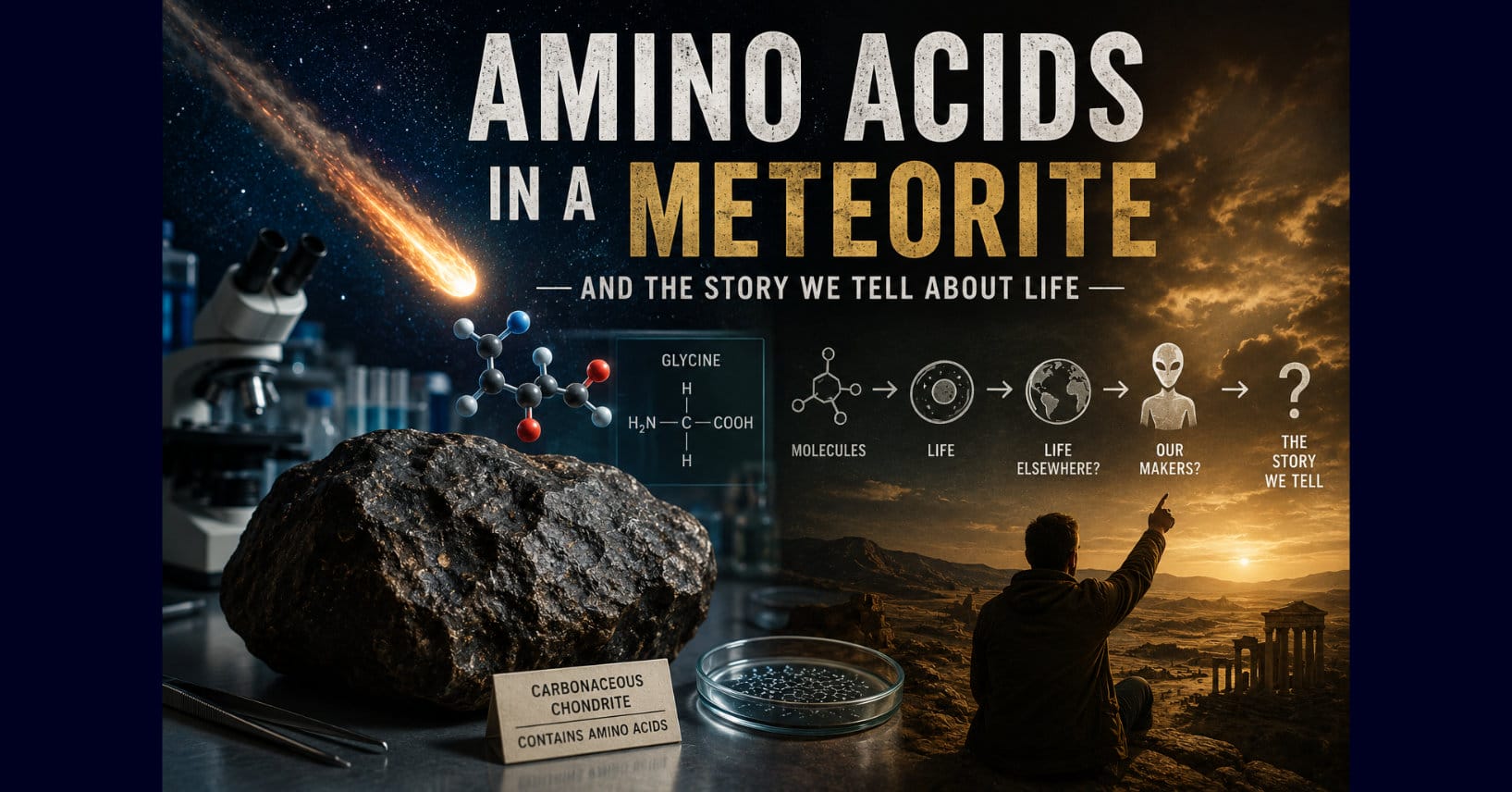
Amino acids and other organic compounds discovered in meteorites provide important evidence that complex chemistry occurs beyond Earth. Amino Acids in a Meteorite—and the Story We Tell About Life examines the crucial distinction between organic chemistry, biological life, and theories about life’s ultimate origin. The article considers panspermia, asteroid sample-return research, and the cultural leap from finding life-related molecules in space to imagining that extraterrestrial civilizations seeded Earth. For Christians, the scientific discovery presents no inherent conflict with Scripture. The deeper issue is whether evidence about chemistry is allowed to become an alternative creation story that the evidence itself does not establish.
A meteorite falls to Earth.
Scientists examine it and discover amino acids—organic compounds associated with the chemistry of life.
The discovery is scientifically fascinating.
Then something else happens.
The chemistry becomes a story.
Perhaps the building blocks of life arrived from space. Perhaps meteorites seeded the early Earth with organic material. Perhaps life itself is common throughout the universe. And from there, it is only a short cultural step to imagining an inhabited cosmos filled with civilizations whose own origins began through the same process.
But several very different propositions have quietly been joined together.
Finding organic chemistry beyond Earth is not the same as finding life beyond Earth.
And finding the ingredients associated with life is certainly not the same as explaining where life came from.
That distinction matters.
Chemistry from Space
Amino acids are organic molecules used by terrestrial organisms to construct proteins. Proteins, in turn, perform an enormous range of biological functions.
Scientists have known for decades that some meteorites contain amino acids and other organic compounds. Researchers study these extraterrestrial materials because they may help reconstruct the chemical environment of the early solar system.
That is legitimate science.
Meteorites and asteroids can preserve material billions of years old. Analyzing their chemistry can tell researchers something about the processes operating before planets reached their present forms.
The discovery of amino acids in extraterrestrial material therefore establishes something important:
Complex organic chemistry can occur outside Earth.
But notice what it does not establish.
It does not establish that the meteorite once contained life.
It does not establish that its amino acids were produced biologically.
It does not establish that life on Earth originated from material delivered from space.
And it does not establish that life inevitably emerges wherever the proper molecules exist.
Those are separate questions.
Ingredients Are Not the Recipe
Suppose you walk into a kitchen and find flour, sugar, eggs, butter, and chocolate.
You have discovered ingredients associated with a cake.
You have not discovered a cake.
More importantly, the existence of those ingredients does not explain the process by which they became a cake.
The analogy is imperfect, but the distinction is useful.
Life is not merely a collection of organic molecules sitting near one another.
Living cells contain extraordinarily organized systems involving information storage, replication, membranes, metabolism, molecular machinery, error correction, energy utilization, and tightly coordinated chemical processes.
An amino acid is important.
But an amino acid is not alive.
Finding one in a meteorite therefore tells us something about chemistry—not necessarily biology.
The Panspermia Temptation
Discoveries of extraterrestrial organic molecules frequently intersect with the idea of panspermia.
Broadly speaking, panspermia proposes that life—or material contributing to life—may have traveled between worlds through meteorites, comets, dust, or other mechanisms.
Some versions suggest only that organic compounds important to prebiotic chemistry were delivered to Earth.
More ambitious versions propose that microorganisms themselves arrived from elsewhere.
And more speculative forms imagine deliberate seeding by advanced extraterrestrial civilizations.
That last version has obvious implications for the alien-deception discussion.
If humanity can be persuaded that life began elsewhere and was intentionally brought here, the concept begins to resemble a technological creation story.
Humanity was not created.
Humanity was seeded.
Our makers were not divine.
They were advanced.
Genesis becomes mythology.
Extraterrestrial engineering becomes origins.
That is no longer merely chemistry.
It is theology wearing a laboratory coat.
Moving the Question Somewhere Else
There is another problem with using panspermia as an explanation for the origin of life.
Moving life somewhere else does not explain how life began.
Suppose microorganisms arrived on Earth inside a meteorite.
Where did those organisms originate?
Suppose an extraterrestrial civilization deliberately seeded Earth.
Where did that civilization originate?
Eventually the question returns:
How did nonliving matter become life?
Panspermia can potentially propose a mechanism for transporting life or organic material.
It cannot, by itself, solve the ultimate origin problem.
It changes the address.
It does not necessarily answer the question.
What the Meteorite Actually Says
This is where intellectual discipline becomes essential.
A meteorite containing amino acids is remarkable precisely because we do not need to make it say more than the evidence permits.
Scientists can identify compounds.
They can measure isotopic signatures.
They can investigate whether contamination occurred after the meteorite reached Earth.
They can compare extraterrestrial chemistry with terrestrial chemistry.
They can construct models describing how organic molecules may form in space.
All of that expands human knowledge.
But the meteorite does not arrive carrying a label saying:
This is how life began.
We supply that interpretation.
And interpretations must be distinguished from observations.
The Search Moves to Asteroids
Modern sample-return missions make this question even more important.
Instead of relying exclusively on meteorites that have passed through Earth’s atmosphere and rested in terrestrial environments, spacecraft can collect material directly from asteroids and return carefully controlled samples to laboratories.
Researchers can then study pristine extraterrestrial material with far less concern about Earth contamination.
If amino acids, nucleobases, or other organic compounds are found there, scientists gain stronger evidence that complex organic chemistry is widespread within the solar system.
That would be significant.
But once again:
Organic does not mean living.
Prebiotic does not mean biological.
Potential ingredient does not mean demonstrated pathway.
And chemistry does not become creation merely because it occurs in space.
Why This Matters for the Alien Narrative
For The Alien Deception Chronicles, these discoveries matter because cultural preparation does not happen only through UFO sightings.
It also happens through explanatory frameworks.
For generations, popular culture has become accustomed to several ideas:
Life probably exists throughout the universe.
The ingredients for life are everywhere.
Life may have arrived on Earth from space.
Advanced civilizations may be millions of years older than humanity.
Those civilizations may have visited ancient Earth.
Perhaps they even influenced—or created—us.
Each proposition can be introduced independently.
Eventually they can form a complete alternative account of human origins.
Then imagine a future disclosure event.
Supposed extraterrestrial beings appear and announce:
Your scientists already discovered the evidence.
The compounds that produced life came from the stars.
Your planet was seeded.
Your ancient ancestors remembered our visits as encounters with gods.
Your religions preserved distorted memories of us.
At that moment, the deception would not sound entirely new.
It would sound like the completion of a story humanity had already begun telling itself.
Scripture Tells a Different Story
The Bible places the origin of life somewhere very different.
Not in accidental chemistry.
Not in meteorites.
Not in extraterrestrial biotechnology.
But in God.
Genesis declares:
“In the beginning God created the heaven and the earth.”
—Genesis 1:1, KJV
And concerning humanity:
“And the LORD God formed man of the dust of the ground, and breathed into his nostrils the breath of life; and man became a living soul.”
—Genesis 2:7, KJV
These passages are theological claims about ultimate origin and dependence upon the Creator.
Discovering amino acids in a meteorite does not threaten them.
The meteorite, after all, is part of the created universe too.
If organic chemistry occurs naturally in asteroids, comets, molecular clouds, or other extraterrestrial environments, Christians can study it with fascination.
The question is not whether the molecules exist.
The question is what story we construct from them.
Follow the Chemistry—But Watch the Conclusions
There is no need to diminish the scientific importance of extraterrestrial amino acids.
Study them.
Determine how they formed.
Investigate how common they are.
Examine what they reveal about the early solar system.
Ask whether similar compounds occur throughout the galaxy.
Science should follow the evidence wherever it leads.
Christians should be equally willing to follow it.
But we should also recognize when the conversation crosses a boundary.
Amino acids in space are chemistry.
Life from space is a hypothesis.
Humanity created by extraterrestrials is an origins narrative.
Those are not interchangeable claims.
The meteorite may contain genuine clues about the chemistry of the early solar system.
What it does not contain is permission to skip the unanswered steps between organic molecules and living organisms.
And perhaps that is the larger lesson.
Sometimes the most consequential part of a scientific discovery is not what scientists find.
It is the story the rest of us begin telling about what they found.