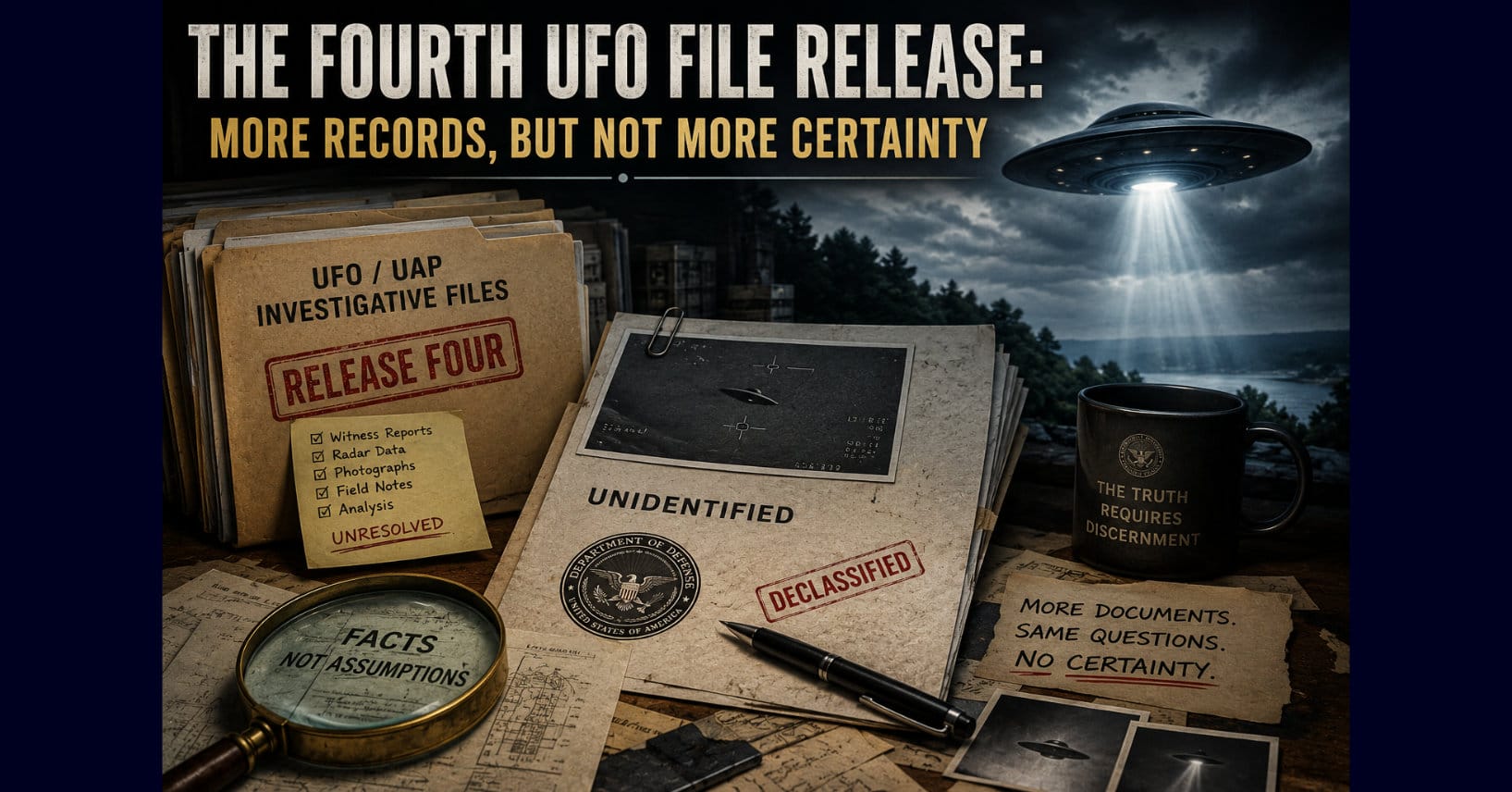
Another major release of government UFO/UAP records expands the historical evidence that military, intelligence, and government agencies have investigated unidentified aerial phenomena for decades. The Fourth UFO File Release: More Records, but Not More Certainty examines the crucial difference between documented reports and verified conclusions, how accumulating mysteries can create an expectation of extraterrestrial disclosure, and why Christians should welcome investigation while refusing to let unanswered questions become evidence for conclusions the records do not establish.
Another collection of government UFO records has entered the public domain.
More documents.
More reports.
More descriptions of objects that witnesses could not immediately identify.
And, inevitably, more headlines suggesting that disclosure is moving forward.
The fourth major release of UFO/UAP material continues a pattern that has become increasingly familiar. Government agencies release historical records or previously unavailable material. Researchers begin examining the files. Interesting cases emerge. Social media isolates the strangest passages. And the accumulated archive becomes larger.
Yet one thing has not increased at the same rate:
Certainty.
The expanding documentary record establishes beyond question that governments have investigated unidentified aerial phenomena for decades.
What it does not establish is that extraterrestrial beings are responsible for them.
That distinction becomes more important with every new file release.
What Government Records Actually Prove
There is an understandable tendency to treat an official document as validation of whatever event the document describes.
But government records do not work that way.
If an intelligence officer records a pilot’s description of an unusual object, the document establishes that the report was made.
It does not automatically establish that every detail of the observation was objectively accurate.
If investigators classify an incident as unresolved, the document establishes that investigators did not reach a satisfactory explanation with the evidence available to them.
It does not establish that the object came from another planet.
This sounds obvious.
Yet decades of UFO mythology have blurred the distinction between a documented claim and a verified conclusion.
The government can possess authentic UFO records without possessing authentic extraterrestrial spacecraft.
Both statements can be true simultaneously.
The Archive Keeps Growing
Still, the accumulating records matter.
Each release strengthens the historical case that UFOs were never merely a cultural curiosity. Military organizations, intelligence agencies, aviation authorities, and government officials have repeatedly considered unidentified aerial observations worthy of investigation.
That is historically significant.
It also creates an increasingly powerful narrative.
One release produces curiosity.
Several releases establish continuity.
Decades of files create an archive.
And eventually the archive itself can begin to feel like evidence for a conclusion it does not actually contain.
Thousands of pages discussing unidentified objects can create the impression that something extraordinary must lie behind them.
Perhaps something does.
But volume is not verification.
Ten thousand unresolved reports would still be ten thousand unresolved reports.
Adding uncertainty together does not automatically produce certainty.
The Disclosure Ratchet
There is another phenomenon worth watching.
Disclosure appears to move primarily in one direction.
Every new hearing, document release, whistleblower allegation, military video, scientific investigation, and government panel adds another piece to the cultural expectation that a larger revelation is coming.
Rarely does the public narrative reset.
A case that receives a conventional explanation may disappear from discussion, while unresolved cases remain culturally active.
The result resembles a ratchet.
Mysteries accumulate.
Explanations fall away.
Expectation increases.
Eventually, people begin assuming that the continuing existence of unanswered questions must indicate that authorities possess an extraordinary answer.
This is how uncertainty can gradually become belief.
Not through one decisive revelation, but through accumulation.
When the Question Quietly Changes
Watch what happens to the language.
Initially:
What was observed?
Then:
Was it intelligently controlled?
Then:
Who controls it?
Then:
Where are they from?
Then:
How long have they been here?
And eventually:
Why have they been visiting humanity?
Each question contains assumptions inherited from the question before it.
By the end of the progression, extraterrestrial visitation has become the premise rather than the hypothesis.
Yet the original evidence may have established only that someone observed something they could not identify.
This is one reason the fourth file release matters to The Alien Deception Chronicles.
The series is concerned not merely with whether unusual phenomena exist, but with how humanity interprets them.
The interpretation may ultimately prove more consequential than the phenomenon.
The Perfect Environment for Deception
Suppose a future global event occurs that appears undeniably nonhuman.
Craft appear publicly.
Communications are received.
Beings present themselves.
Governments acknowledge contact.
Would humanity evaluate the event without preconceptions?
Probably not.
Decades of UFO culture have already supplied the vocabulary.
Government disclosure has supplied institutional legitimacy.
Science has supplied the possibility of extraterrestrial intelligence.
Entertainment has supplied imagery.
New Age spirituality has supplied theology.
Starseed movements have supplied personal identity.
Channelers have supplied supposed messages.
Ancient-astronaut theories have supplied a rewritten human history.
By the time something arrives claiming to explain itself, much of the conceptual architecture may already exist.
The world may not ask:
What is this?
It may say:
They’re finally here.
That difference is enormous.
More Evidence Would Be Welcome
None of this is an argument against disclosure.
Quite the opposite.
Release the records.
Declassify material that no longer requires protection.
Allow scientists to examine available data.
Investigate credible witnesses.
Preserve sensor information.
Compare reports.
Follow evidence wherever it leads.
Truth benefits from scrutiny.
Christians should not need secrecy to protect their worldview.
If unusual physical phenomena exist, study them.
If previously unknown technology exists, identify it.
If evidence eventually demonstrates something truly extraordinary, acknowledge it.
But evidence must be allowed to establish the conclusion rather than being recruited to support one chosen in advance.
Scripture gives a remarkably concise principle:
“Prove all things; hold fast that which is good.”
—1 Thessalonians 5:21, KJV
That is neither skepticism nor gullibility.
It is discernment.
Suppose the Files Eventually Contain Something Extraordinary
Imagine that a future release includes material far more compelling than eyewitness testimony.
High-resolution multisensor data.
Physical samples.
Repeated observations.
Independent scientific analysis.
Perhaps even evidence of intelligently controlled technology that cannot reasonably be attributed to known human systems.
That would change the evidentiary landscape dramatically.
But Christians should notice what would still remain unresolved.
Who created it?
Where did it originate?
Why is it here?
What does its intelligence know?
Is it truthful?
What does it want?
Technology cannot answer those questions merely by existing.
And extraordinary capability cannot establish spiritual authority.
That distinction runs throughout The Alien Deception Chronicles because it could become the central question of any genuine future disclosure.
The Most Important File Has Not Arrived
The fourth UFO file release adds another layer to the historical record.
That is valuable.
Researchers now have more material to examine. Historians have more documentation of government interest. Investigators have additional cases to compare against earlier reports.
But the central question remains where it was before the files appeared.
Do we possess publicly verifiable evidence demonstrating that extraterrestrial intelligence is responsible for UFO/UAP phenomena?
The new records may deepen the mystery.
They do not automatically resolve it.
And perhaps that is the most important lesson of these continuing releases.
Disclosure is not measured by the number of documents published.
It is measured by what the evidence can actually establish.
Until that changes, Christians—and everyone else—should remain comfortable with an answer that increasingly seems unsatisfying in an age hungry for revelation:
There are things in these records we cannot explain.
That is interesting.
It may even be important.
But more records do not necessarily mean more certainty.
And until the evidence takes us further, neither should our conclusions.