Underwater archaeologists investigating three overlapping thirteenth-century shipwrecks at Cala en Busquets, Menorca, recovered an encolpium, a small Christian reliquary once worn around the neck. Its contents remain unknown while conservation continues. The Sacred Relic Beneath Menorca’s “Cove of Mysteries” examines how genuine archaeological uncertainty can quickly attract sensational interpretations, why an ancient artifact should not become a source of spiritual authority, and how the same reasoning applies to claims about mysterious objects of supposedly extraterrestrial origin.
Beneath the quiet waters off Menorca lies a place where three medieval ships appear to have met the same fate.
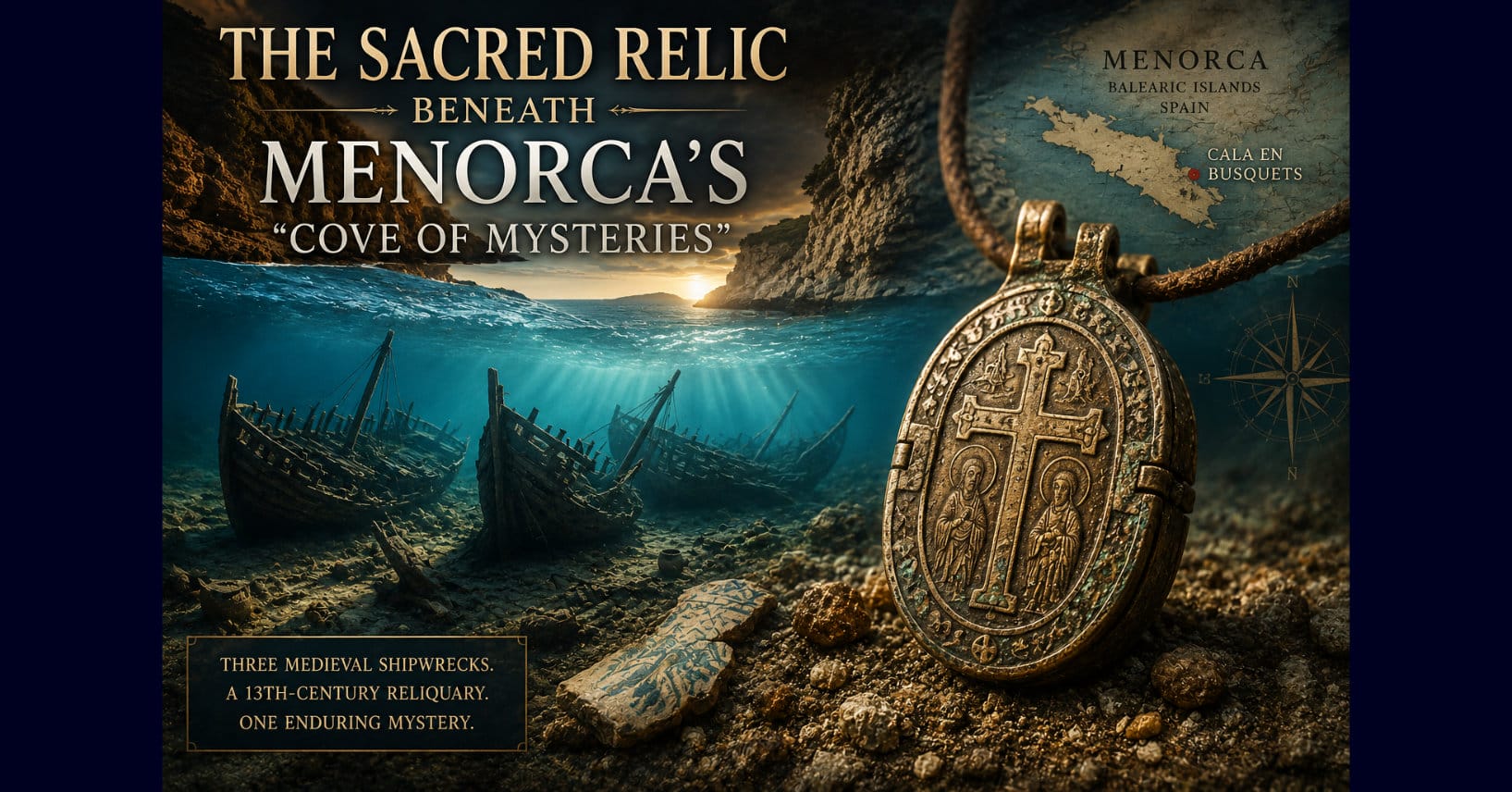
Cala en Busquets, a sheltered cove near Ciutadella, has become an unusually rich underwater archaeological site. Researchers have identified three overlapping thirteenth-century shipwrecks—Busquets I, II, and III—preserved beneath layers of sediment.
The wrecks themselves are remarkable.
But one small object recovered from the seabed has introduced another kind of mystery.
Archaeologists discovered an encolpium: a small Christian reliquary designed to be worn around the neck, typically by a member of the clergy or someone of significant religious standing.
And researchers do not yet know what is inside.
That unanswered question is precisely what makes the discovery so interesting—and so vulnerable to speculation.
Three Ships Beneath the Water
The wrecks at Cala en Busquets date to a turbulent period in Mediterranean history.
Carbon dating places them in the thirteenth century, with evidence suggesting that the vessels may have sunk around the same general period. The waters surrounding Menorca connected Christian and Muslim territories through trade, warfare, migration, and political competition.
The artifacts recovered from the wrecks reflect that complicated world.
Archaeologists have found evidence associated with both Christian and Islamic cultures, providing a material snapshot of Mediterranean life during a period when political and religious boundaries were shifting.
There may also be a natural explanation for why several ships ended up in the same location.
Cala en Busquets can experience rissagas—sudden oscillations in sea level produced by atmospheric conditions. Sometimes described as meteorological tsunamis, these events can cause rapid and dangerous movements of water inside harbors and coves.
A severe event could potentially have overwhelmed vessels seeking shelter.
What appears mysterious at first may therefore have a perfectly natural explanation.
But the reliquary presents a different question.
What Is Inside?
An encolpium was not merely jewelry.
Such objects could contain something regarded as sacred: perhaps a fragment associated with a saint, a small piece of parchment, a devotional object, or another material connected with Christian religious practice.
The Menorca artifact is undergoing conservation, including the slow desalination required for objects recovered from seawater.
Until specialists can safely examine its contents, whatever remains inside is unknown.
And that single word—unknown—has tremendous cultural power.
Imagine the headlines if something survives within it.
A fragment of bone.
A piece of fabric.
Writing.
An unidentified substance.
Immediately, questions would multiply.
Whose relic was it?
Where did it originate?
Why was it being transported?
Was it associated with an important medieval church?
Could it contain something previously unknown?
The questions would be legitimate.
The conclusions might not be.
When an Artifact Becomes Revelation
This is where discoveries such as the Menorca reliquary become relevant to The Alien Deception Chronicles.
Modern culture has an enduring fascination with hidden objects that supposedly contain hidden truth.
Secret manuscripts.
Forbidden gospels.
Lost relics.
Ancient technologies.
Mysterious artifacts.
Objects concealed by governments, churches, archaeologists, or forgotten civilizations.
The pattern is familiar.
First comes the artifact.
Then comes the mystery.
Then comes the suggestion that what we already believe about history may be wrong.
Eventually, the object is transformed from archaeological evidence into a source of revelation.
That transition deserves scrutiny.
An ancient object can tell us something about the people who made, carried, used, or revered it.
It cannot automatically tell us whether their beliefs were true.
Relics and Biblical Authority
Christians should make another distinction here.
The discovery of an ancient Christian relic does not authenticate every tradition associated with relics.
An object may genuinely have been revered by medieval Christians while the claims surrounding it remain historically uncertain.
Age does not establish spiritual authority.
Sincerity does not establish spiritual authority.
Tradition does not establish spiritual authority.
And mystery certainly does not establish spiritual authority.
Scripture provides the standard.
Paul wrote:
“Prove all things; hold fast that which is good.”
—1 Thessalonians 5:21, KJV
That principle applies even when the object in question carries a cross.
Christian discernment does not require rejecting archaeology. It requires refusing to allow archaeology to become a substitute for revelation.
The Extraterrestrial Parallel
There is an important parallel with UFO disclosure.
Imagine that investigators someday recover an object of genuinely unknown manufacture.
Perhaps its material composition is unusual.
Perhaps no known industrial process immediately explains it.
Perhaps scientists cannot determine its origin.
What has been established?
An unusual object has been discovered.
But the cultural temptation would be enormous:
Unknown material becomes nonhuman material.
Nonhuman becomes extraterrestrial.
Extraterrestrial becomes advanced intelligence.
Advanced intelligence becomes ancient visitor.
Ancient visitor becomes humanity’s teacher.
Eventually, a physical artifact becomes the foundation for an entirely new account of human origins.
The Menorca reliquary demonstrates the same epistemological problem on a smaller scale.
What we do not know about an object cannot legitimately become evidence for whatever story we prefer.
Mystery is not proof.
Something Sacred to Someone
There is still something deeply human about the artifact.
Someone carried it.
Perhaps a priest wore it around his neck.
Perhaps the object inside had enormous personal significance.
Perhaps he believed it connected him to a saint, a holy place, or an important event.
Then the ship sank.
The owner disappeared.
The reliquary settled into the sediment.
Centuries passed.
Whatever story surrounded it was lost.
Now archaeologists have recovered the object while much of its meaning remains beneath another layer of history.
That is what makes archaeology compelling.
We recover things more easily than we recover the worlds that gave those things meaning.
Let the Reliquary Speak for Itself
Eventually, conservation may reveal what lies inside the Menorca encolpium.
Perhaps it will contain a fragment of bone.
Perhaps parchment.
Perhaps nothing recognizable survives.
Whatever researchers find should be studied carefully and reported proportionately.
Christians have no reason to fear the result.
If the object illuminates medieval Christian practice, it adds another piece to our understanding of history.
If it contains something unexpected, investigate it.
But do not allow an artifact to become an oracle.
The seabed has preserved a mystery.
Archaeology may eventually solve part of it.
Until then, the most responsible response is also the simplest:
We do not know what is inside.
And we should resist the increasingly common temptation to treat what we do not know as permission to believe anything.
The sacred relic beneath Menorca’s “Cove of Mysteries” may eventually tell us something fascinating about the medieval world.
But whatever lies inside, truth will not depend upon what archaeologists find when they finally open it.