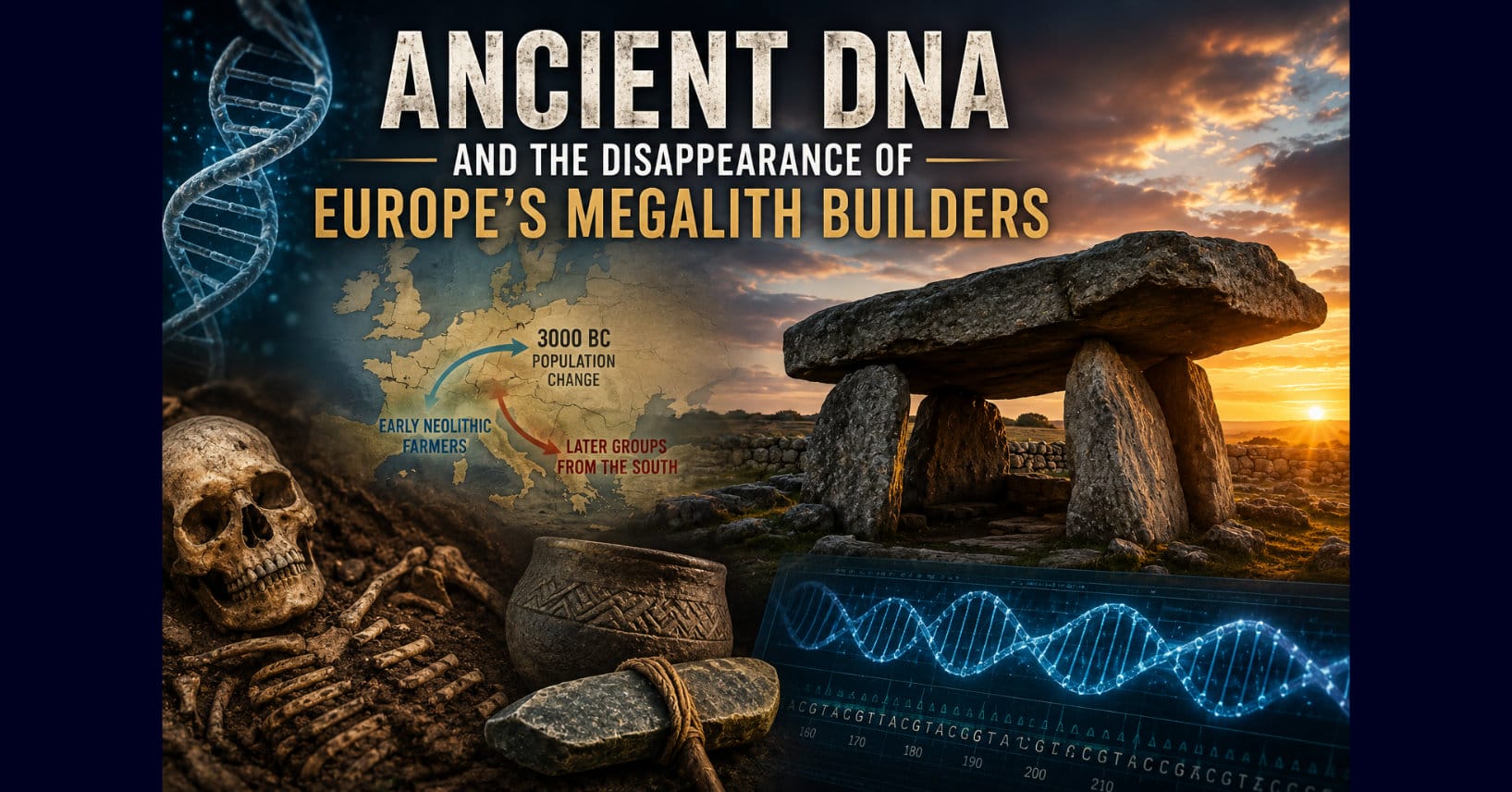
Ancient DNA recovered from a megalithic burial site near Paris is providing new insight into the communities associated with Europe’s prehistoric monuments. Researchers identified distinct burial populations, evidence of serious disease, high mortality, and demographic change around 3000 BC. Ancient DNA and the Disappearance of Europe’s Megalith Buildersexamines how genetics is restoring the human story behind the stones, why disappearing populations so easily inspire lost-civilization and ancient-alien theories, and why archaeological mystery should not be mistaken for evidence of extraterrestrial intervention.
For thousands of years, enormous stone monuments have stood across the European landscape.
Dolmens. Passage graves. Long barrows. Stone chambers. Megalithic tombs constructed from blocks weighing many tons.
Their builders possessed no cranes, diesel engines, or modern surveying equipment. Yet communities across prehistoric Europe quarried stone, transported it considerable distances, organized large workforces, and created monuments substantial enough to survive into the modern world.
Then something changed.
Recent ancient-DNA research from a megalithic burial site near Paris is providing a remarkable glimpse into what happened to at least one population associated with this world.
The evidence suggests something more complicated—and more human—than the lost-civilization stories often attached to Europe’s megaliths.
The monuments remained.
But the people changed.
Two Populations in One Tomb
Researchers examined ancient DNA from individuals buried in a large megalithic tomb at Bury, roughly 50 kilometers north of Paris.
The tomb was not used continuously by a single community.
Instead, genetic evidence indicates two distinct periods of burial separated by a significant demographic change around 3000 BC.
The earlier individuals were genetically similar to Neolithic farming populations associated with northern France and neighboring parts of Europe. Later individuals showed stronger ancestry connections toward populations of southern France and the Iberian Peninsula.
In other words, the same monument appears to have served communities that were not simply successive generations of the same extended population.
Something happened.
The people associated with the earlier phase diminished or disappeared, and another population eventually used the site.
That finding is important because archaeology often gives us buildings without biographies.
Ancient DNA is beginning to restore the biographies.
Disease, Mortality, and Disruption
The genetic evidence also reveals that these communities were not living in an idyllic prehistoric world.
Researchers detected pathogens associated with serious disease, including Yersinia pestis, the bacterium responsible for plague, and Borrelia recurrentis, which causes louse-borne relapsing fever.
Disease alone may not explain the demographic transformation.
Environmental pressures, migration, social disruption, resource scarcity, conflict, changing trade networks, and other factors may have contributed.
But the burial population contains another sobering clue: unusually high mortality among children and younger people.
Behind the monumental stones were vulnerable human communities.
They became sick.
Children died.
Families buried their dead.
Populations moved.
Social structures changed.
Eventually, people who had once occupied a landscape could disappear from it.
That reality matters when we talk about “lost civilizations.”
The Monument Outlived Its Meaning
Imagine encountering one of these megalithic structures centuries after its original builders had disappeared.
The stones would still be there.
But perhaps no one remembered who raised them.
No one knew exactly why they were positioned as they were.
Stories might develop.
Ancestors built them.
Giants built them.
Gods built them.
Supernatural beings taught people how.
This is one of archaeology’s recurring problems.
Material culture can survive cultural memory.
And when memory disappears, mythology often moves in.
The same thing happens today.
We encounter an enormous ancient monument and ask:
Who could have built this?
How did they move those stones?
What did the monument mean?
Where did the builders go?
Those are legitimate questions.
But unanswered questions create fertile ground for extraordinary explanations.
Enter the Ancient Astronauts
Megalithic monuments have become central exhibits in the modern ancient-alien narrative.
Their size is treated as evidence.
Their astronomical orientations are treated as evidence.
Their geographic distribution is treated as evidence.
Their mysterious builders are treated as evidence.
And when the civilization responsible for a monument disappears, disappearance itself can become evidence.
Perhaps, the story suggests, ancient humanity received knowledge from extraterrestrial visitors.
Perhaps those visitors taught people mathematics, astronomy, engineering, or religion.
Perhaps an advanced civilization existed before conventional archaeology recognizes it.
Perhaps its survivors spread knowledge across the ancient world.
The problem is not asking whether something extraordinary happened.
The problem is using mystery as evidence for the answer we prefer.
The ancient DNA from Bury points in another direction.
The builders and users of Europe’s megalithic landscapes were human communities experiencing the same forces that have shaped human history ever since: migration, disease, family, mortality, cultural change, and population replacement.
The mystery becomes more understandable as evidence accumulates.
Not less remarkable.
More human.
Ancient People Were Not Primitive Fools
Ancient-alien theories often contain an assumption that deserves greater scrutiny:
Ancient people could not have accomplished extraordinary things without help.
That assumption is strangely dismissive of the civilizations the theories supposedly celebrate.
Human beings do not require extraterrestrial instruction to observe the heavens.
They do not require aliens to develop geometry.
They do not require visitors from another planet to organize labor.
They do not require advanced spacecraft to learn how leverage, rollers, ropes, ramps, timber, earthworks, and coordinated manpower can move enormous objects.
The biblical worldview gives Christians even less reason to underestimate early humanity.
Genesis portrays people developing agriculture, animal husbandry, metallurgy, music, cities, and social organization very early in human history.
Human creativity is not an accident.
It reflects our creation in the image of God.
“So God created man in his own image, in the image of God created he him;”
—Genesis 1:27, KJV
The stones do not prove that extraterrestrials visited ancient Europe.
They demonstrate what human beings can accomplish.
When Populations Disappear
There is another lesson in the Bury research.
Civilizations do not have to vanish mysteriously.
Sometimes populations simply cease to exist as distinct communities.
Disease reduces them.
Migration absorbs them.
Other populations arrive.
Marriage changes genetic ancestry.
Political structures collapse.
Religious traditions disappear.
Languages die.
Within several generations, a community that once considered itself permanent can become archaeologically invisible except for bones, artifacts, and buildings.
Ancient DNA allows researchers to detect those transitions in ways previous generations of archaeologists could not.
That makes the disappearance of Europe’s megalithic populations scientifically fascinating.
It does not make their disappearance extraterrestrial.
The Deeper Spiritual Question
There is still a spiritual dimension to these ancient monuments.
People buried their dead deliberately.
They constructed places that required enormous communal effort.
They oriented monuments within landscapes that carried meaning.
They practiced rituals.
They looked toward the heavens.
They confronted death.
Those behaviors reveal something enduring about humanity.
We have always asked questions larger than survival.
Who are we?
Where did we come from?
What happens when we die?
Is there something beyond what we can see?
The ancient-alien worldview takes those deeply human questions and redirects them toward technologically superior creatures.
The biblical worldview directs them toward the Creator.
That distinction is central to The Alien Deception Chronicles.
The danger is not archaeology.
The danger is allowing archaeological mystery to become an alternative creation story.
The Stones Remain
Perhaps the most haunting aspect of the Bury discovery is also the simplest.
The people disappeared.
The monument remained.
Thousands of years later, scientists can recover DNA from bones and reconstruct fragments of lives that no written history preserved.
We can identify ancestry.
We can detect disease.
We can observe demographic change.
But we still cannot hear their conversations, recover every belief, or know precisely what they thought when they gathered around those stones.
Some mystery remains.
And that is acceptable.
Not every unanswered question requires an extraterrestrial answer.
Ancient DNA is giving Europe’s megalithic builders back something that mythology often takes away from them:
their humanity.
They were not mysterious placeholders waiting for aliens to explain them.
They were people.
They built.
They worshipped.
They suffered.
They buried their children.
They migrated.
They died.
And eventually their descendants or successors forgot enough that later generations were left staring at enormous stones and wondering who could possibly have put them there.
The answer may be less sensational than visitors from another world.
But it is no less extraordinary.
Human beings did.
The stones survived them.
And now their bones are beginning to tell us who they were.