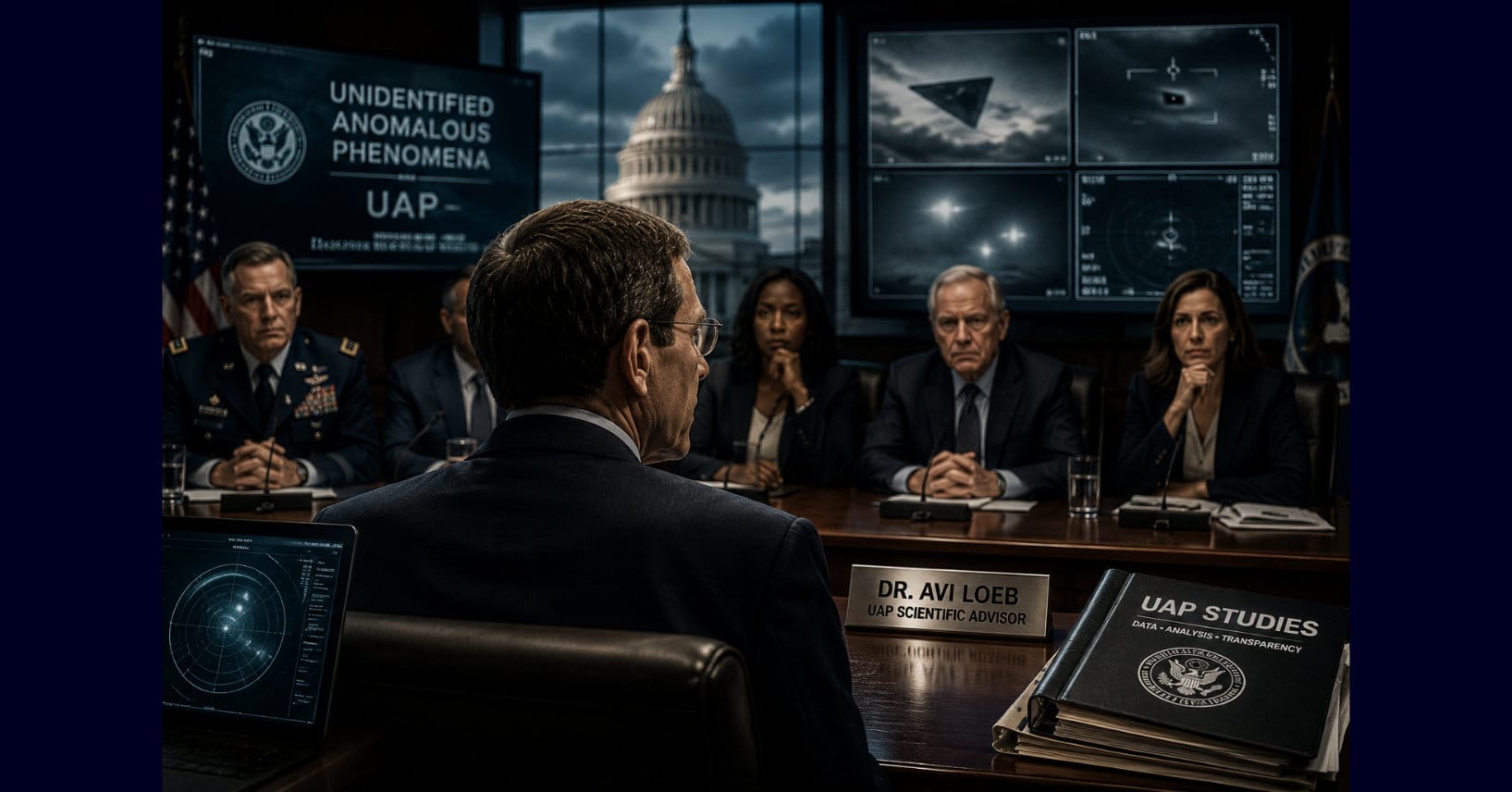
Harvard astrophysicist Avi Loeb has become one of the most recognizable scientific voices arguing that extraterrestrial technology deserves serious investigation. His selection to lead a scientific advisory council connected with UAP investigation represents a significant cultural shift. When the Alien Hunter Gets a Government Seat examines how UFOs moved from fringe speculation into government institutions, why investigation must not be confused with confirmation, and how years of hearings, scientific panels, declassified records, and unexplained sightings could create an architecture of expectation for future disclosure.
For decades, the search for extraterrestrial intelligence occupied an unusual position in science.
Listening for radio signals from distant civilizations was considered legitimate scientific inquiry. Claiming that extraterrestrial technology might already have reached Earth was another matter entirely.
Harvard astrophysicist Avi Loeb has spent years challenging that boundary.
Loeb attracted international attention after arguing that the unusual interstellar object ʻOumuamua, which passed through our solar system in 2017, deserved consideration as potentially artificial rather than automatically being classified as a natural object. He later founded the Galileo Project, an effort to bring scientific instruments and systematic observation to the study of unidentified anomalous phenomena and possible extraterrestrial technological artifacts.
His arguments have generated substantial criticism within the scientific community. Many astronomers favor natural explanations for ʻOumuamua, and none of Loeb’s investigations has established that extraterrestrial technology has been discovered.
That distinction remains essential.
But something else has changed.
Loeb has now been selected to lead a scientific advisory council associated with a broader effort addressing unidentified anomalous phenomena. A scientist whose name has become closely associated with the possibility of extraterrestrial technology is no longer merely commenting from outside the institutional UAP conversation.
He has been given a seat at the table.
That does not mean the government has endorsed his conclusions.
It does mean the cultural boundary surrounding the subject continues to move.
From Fringe Question to Institutional Question
The most important development in the modern UAP story may not be any particular video, whistleblower, congressional hearing, or unexplained object.
It may be institutionalization.
Governments now maintain reporting mechanisms for UAP encounters. Military personnel are encouraged to document unusual observations. Congressional committees hold hearings. Scientists participate in advisory structures. Intelligence agencies review historical records. Previously classified material is being released publicly.
The vocabulary itself has changed.
“Flying saucers” became UFOs.
UFOs became UAPs.
And UAPs became a legitimate subject of national-security governance.
None of those changes proves extraterrestrial visitation.
But they change how society thinks about the possibility.
When a subject receives committees, procedures, reporting systems, scientific advisers, and official terminology, it acquires institutional credibility even when the underlying evidence remains unresolved.
That is an important distinction for Christians to recognize.
Official attention is not official confirmation.
The Architecture of Expectation
Imagine the psychological difference between two announcements.
The first occurs in a culture where extraterrestrial visitation is considered ridiculous. Government officials suddenly announce that nonhuman intelligence exists.
The claim would encounter enormous resistance.
Now imagine the same announcement after years of congressional hearings, military videos, declassified documents, scientific panels, government databases, whistleblower allegations, unexplained sightings, and respected scientists discussing extraterrestrial possibilities.
The announcement would arrive in prepared soil.
People might respond not with disbelief but with relief:
We knew something was happening.
That does not mean anyone is deliberately constructing such a process. Government agencies have legitimate reasons to investigate unidentified objects near military installations and controlled airspace. Scientists have legitimate reasons to examine anomalous observations.
But the cultural effect exists regardless of intent.
Expectation is being normalized.
And normalization matters.
The Alien Deception Does Not Require Fake UFOs
Within the speculative framework of The Alien Deception Chronicles, this distinction is particularly important.
A future deception would not require every UFO sighting to be supernatural.
Most could be completely ordinary.
Some might be drones.
Others might be balloons, aircraft, satellites, atmospheric phenomena, sensor artifacts, classified systems, foreign surveillance platforms, or simple misidentifications.
A small percentage might remain genuinely unexplained.
The deception would not depend upon the objects themselves.
It would depend upon the interpretation eventually imposed upon them.
That is how powerful narratives work.
Individual events accumulate until they appear to form a pattern. The pattern produces expectation. Expectation creates readiness for an explanation.
Then, when an authoritative explanation finally arrives, it does not feel new.
It feels like confirmation.
What Would We Actually Know?
Suppose tomorrow scientists produced indisputable evidence that an intelligently controlled object of unknown origin had entered Earth’s atmosphere.
What would that establish?
It would establish that an intelligently controlled object of unknown origin had entered Earth’s atmosphere.
It would not establish who controlled it.
It would not establish where they came from.
It would not establish that they created humanity.
It would not establish that they guided ancient civilizations.
It would not establish that their religious claims were true.
And it certainly would not establish that they deserved humanity’s trust.
Those would be additional claims requiring additional evidence.
Yet popular extraterrestrial spirituality routinely collapses all of those questions together. Advanced technology becomes advanced morality. Greater knowledge becomes spiritual authority. Superior capability becomes evidence of superior truth.
Scripture gives Christians no reason to make those assumptions.
The Bible repeatedly warns that extraordinary manifestations can accompany deception.
Paul writes:
“And no marvel; for Satan himself is transformed into an angel of light.”
—2 Corinthians 11:14, KJV
The warning is not that everything unusual is demonic.
The warning is that appearance and authority are not the same thing as truth.
Discernment at the Government Table
Avi Loeb’s participation in UAP advisory work should therefore neither frighten Christians nor convince them that extraterrestrial disclosure has begun.
Science should investigate unusual phenomena.
Governments should investigate unknown objects operating near military assets.
Witnesses should be taken seriously enough for their claims to be examined.
But Christians should maintain a category that modern culture increasingly struggles to tolerate:
We do not yet know.
That is not ignorance.
It is intellectual discipline.
An unexplained observation should remain unexplained until evidence justifies something more.
An advisory council should remain an advisory council.
A scientist interested in extraterrestrial technology should remain a scientist investigating a hypothesis.
And a government seat should never be mistaken for proof that the hypothesis has been confirmed.
Still, something important has happened.
The alien question has moved another step inward—from popular culture, documentaries, and speculation toward formal institutions entrusted with scientific and governmental authority.
The alien hunter now has a seat at the table.
The question Christians should be asking is not whether that proves aliens exist.
It does not.
The better question is whether the world is becoming increasingly prepared to believe them when someone eventually says they do.