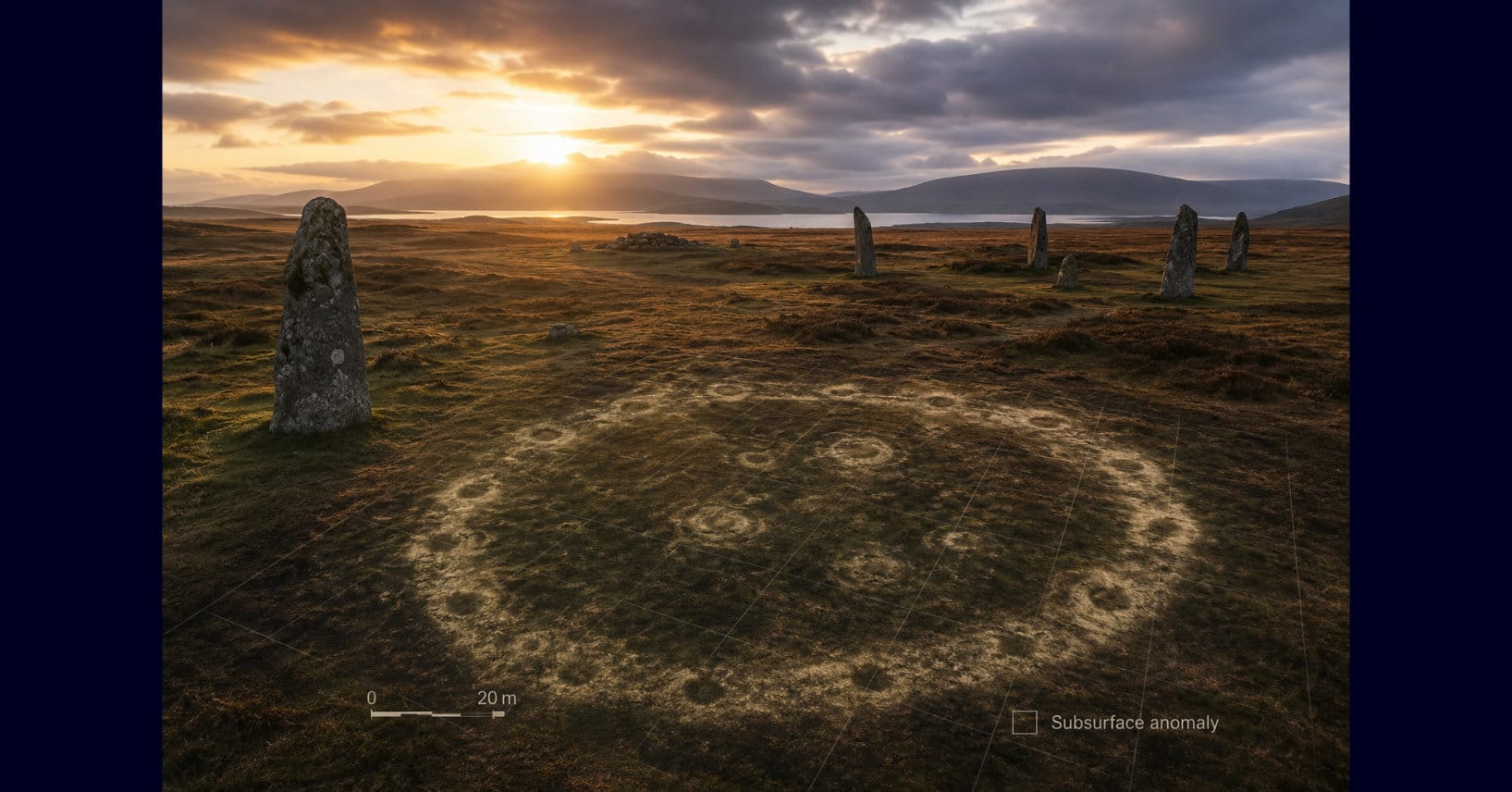
Geophysical surveys at Machrie Moor on Scotland’s Isle of Arran have revealed what may be another prehistoric circular monument hidden beneath the landscape. The discovery expands an already complex collection of standing stones, burial cairns, and ceremonial sites. Another Circle Beneath the Moor examines what the finding tells us about ancient human ingenuity, why archaeological uncertainty so easily attracts ancient-alien theories, and how a biblical worldview provides a more compelling understanding of humanity’s intellectual and spiritual capacities.
The landscape of Machrie Moor on Scotland’s Isle of Arran already looks like a place designed to provoke questions.
Across the open moor stand ancient stones, burial cairns, and the remains of prehistoric ceremonial monuments dating back thousands of years. Some of the standing stones rise dramatically from the landscape, silent remnants of communities whose beliefs, rituals, and understanding of the heavens can now be reconstructed only imperfectly.
Now archaeologists may have discovered that even more of this ancient landscape remains hidden beneath the ground.
A geophysical survey at Machrie Moor has detected what appears to be another prehistoric circular monument. Unlike the standing stones visible today, this structure survives primarily as a pattern beneath the surface. Researchers identified circularly arranged anomalies consistent with pits that may once have supported large timber posts or stones.
If confirmed, the discovery would add another monument to an already remarkable concentration of prehistoric structures on Arran.
And that matters.
Archaeologists increasingly understand sites such as Machrie Moor not as isolated monuments but as parts of larger ritual landscapes. Generations of people returned to the same locations, modifying them, burying their dead nearby, raising stones, constructing circles, and giving particular places significance that could endure for centuries.
We may never know precisely what every circle meant.
Some may have marked burial grounds. Others may have been gathering places. Certain monuments may have reflected seasonal or astronomical observations. Religious practices almost certainly played some role.
That uncertainty is legitimate.
But uncertainty also creates an opening for something else: speculation.
Whenever archaeology reveals another ancient monument aligned with the landscape or heavens, a familiar collection of theories follows close behind. Ancient people are portrayed as recipients of lost knowledge. Sophisticated astronomical observation becomes evidence of advanced technology. Monumental construction becomes proof of forgotten civilizations. And eventually someone asks whether visitors from somewhere beyond Earth supplied the knowledge.
The argument usually begins with amazement.
How could ancient people have known this?
That is a reasonable question.
The problem comes when the question quietly becomes an assumption:
Ancient people could not have known this.
Once that premise is accepted, extraterrestrial teachers become increasingly attractive.
But the archaeological record tells a different story.
Ancient human beings were careful observers. They watched the movement of the sun, moon, and stars because those movements mattered. Seasonal cycles affected planting, harvesting, hunting, migration, weather, navigation, and survival. Knowledge accumulated across generations. Communities could preserve observations long before written language recorded them.
They could also organize.
Moving stones, digging pits, raising timber posts, constructing burial monuments, and maintaining ceremonial sites required cooperation and planning, but none of those abilities requires technology from another world.
From a biblical perspective, that should hardly surprise us.
Scripture does not describe early humanity as intellectually primitive creatures waiting for civilization to arrive from the stars. Human beings were created in the image of God with capacities for reason, creativity, language, craftsmanship, social organization, and spiritual awareness.
Genesis describes people building cities, working metals, raising livestock, making musical instruments, and organizing societies very early in the biblical account.
Human ingenuity is not a modern invention.
Neither is false worship.
That distinction is particularly important when considering ancient ceremonial landscapes.
The fact that prehistoric people looked toward the heavens does not mean heavenly beings taught them astronomy. Nor does evidence of sophisticated ritual prove that their spiritual beliefs were true.
Romans 1 describes humanity recognizing something of the Creator through creation yet turning instead toward created things. Paul writes that they “worshipped and served the creature more than the Creator” (Romans 1:25, KJV).
That pattern is ancient.
And it remains remarkably current.
Modern ancient-alien mythology often repeats the same inversion. The heavens inspire wonder, but instead of that wonder pointing beyond creation toward God, it is redirected toward supposed beings within creation. Extraterrestrials become humanity’s teachers, genetic engineers, civilizers, or even creators.
The terminology sounds technological rather than religious.
The function is theological.
That is why discoveries such as the possible new circle beneath Machrie Moor deserve both excitement and discernment.
Christians have no reason to fear archaeology. Quite the opposite. Every excavation gives us another opportunity to understand the remarkable complexity of human history.
But we should resist the temptation to turn unanswered questions into evidence for whatever explanation happens to fascinate the culture.
A buried circle is evidence that people built a circle.
Its purpose must be investigated.
Its age must be established.
Its relationship to neighboring monuments must be studied.
Anything beyond that must remain proportional to the evidence.
Machrie Moor reminds us that the ancient world still holds enormous mysteries beneath our feet.
Those mysteries deserve investigation.
They do not require visitors from the stars.
Sometimes what archaeology uncovers is not evidence that ancient humanity needed outside teachers.
It is evidence that we have underestimated ancient humanity.