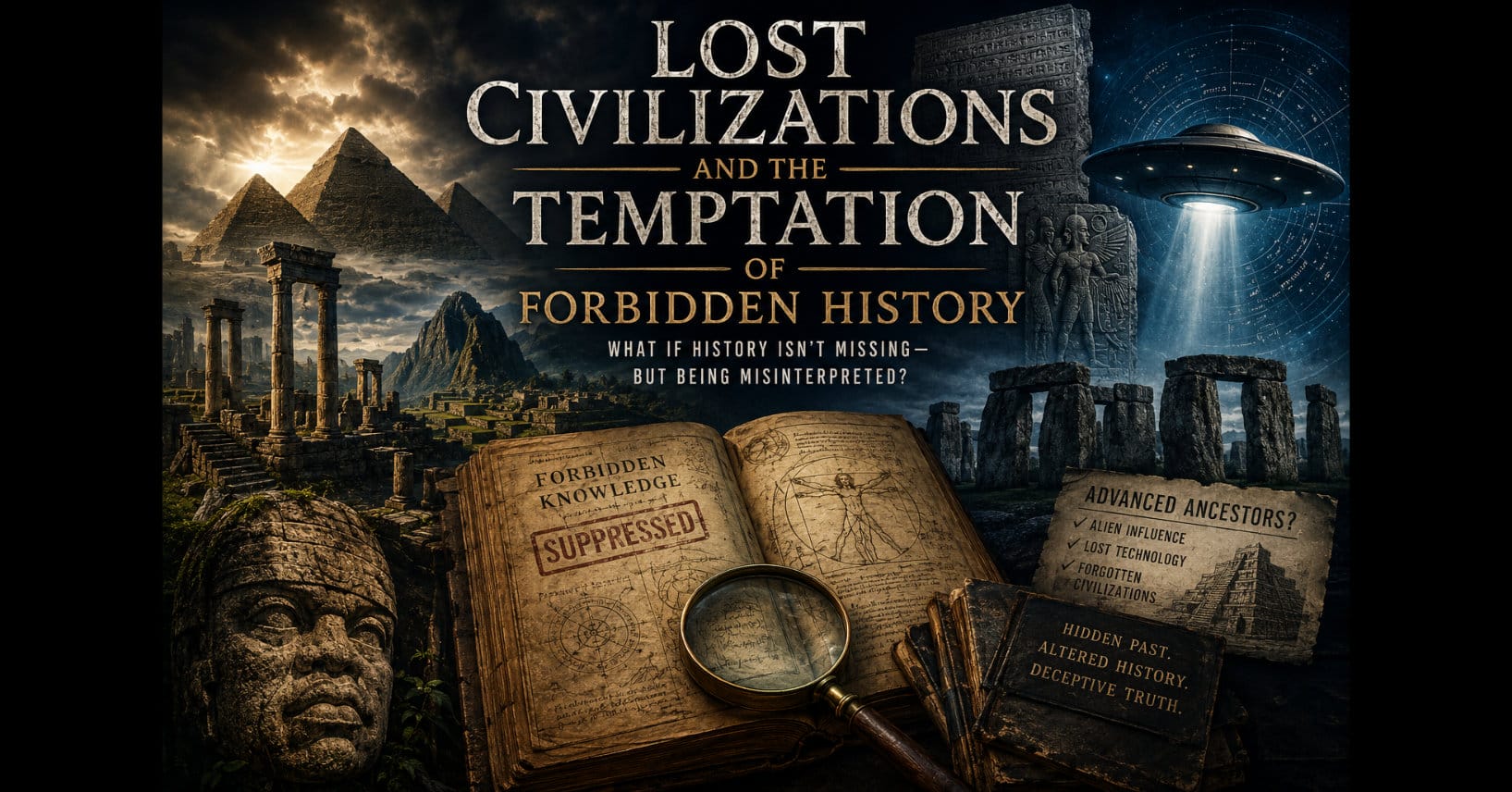
Ancient discoveries often inspire speculation about lost knowledge, alien influence, and hidden histories. The piece argues that real archaeological finds are frequently followed by extraordinary claims that go beyond the evidence.
It contrasts these ideas with a biblical view of ancient human achievement and warns that mysteries can be used to promote deceptive alternative origin stories. Readers are encouraged to approach archaeology with curiosity and discernment.
Few discoveries capture the public imagination like a lost civilization.
The moment archaeologists uncover an ancient city, a forgotten temple complex, or evidence of a previously unknown culture, speculation begins almost immediately. News headlines celebrate the discovery. Researchers work to understand its historical significance. Then, inevitably, another narrative emerges.
Maybe the builders were not entirely human.
Maybe advanced knowledge was inherited from mysterious visitors.
Maybe an ancient global civilization once possessed technology beyond modern understanding.
Maybe history is hiding a secret.
The fascination is understandable. Human beings are naturally drawn to mysteries. We want to know who came before us, how they lived, and what knowledge they possessed. Archaeology provides a window into those questions, and every new discovery reminds us that history is often more complex than we imagined.
Yet there is a subtle danger hidden within that fascination.
The less we know about an ancient culture, the easier it becomes to project modern myths onto it.
Consider how quickly extraordinary claims often follow legitimate discoveries. Massive stone structures become evidence of alien engineering. Ancient astronomical knowledge becomes proof of extraterrestrial instruction. Lost cities become remnants of forgotten super-civilizations that supposedly rivaled or exceeded modern technological achievements.
The discovery itself may be real.
The interpretation often is not.
This pattern appears repeatedly across popular culture. Sites such as the pyramids of Egypt, the megaliths of Peru, Göbekli Tepe, and countless other ancient locations have become canvases upon which modern imaginations paint stories of alien intervention and hidden knowledge.
What makes these theories appealing is not merely their mystery. It is their promise.
They suggest humanity possesses a hidden heritage. They imply that secret knowledge once existed and can be recovered. They offer an alternative origin story—one that replaces divine creation and biblical history with advanced beings, forgotten masters, or cosmic teachers.
In many ways, this is not a new idea at all.
Ancient pagan religions frequently claimed that secret wisdom had been passed down from divine or semi-divine beings. Mystery cults promised hidden truths unavailable to ordinary people. Gnostic movements taught that salvation came through special knowledge reserved for the enlightened.
The modern language has changed.
The underlying concept has not.
Instead of gods descending from heaven, we hear of extraterrestrials. Instead of secret initiations, we hear of suppressed history. Instead of forbidden wisdom, we hear of advanced lost technologies.
The temptation remains remarkably familiar.
Scripture presents a very different view of humanity’s past.
The Bible describes human beings as capable, intelligent, and creative because they were created in the image of God. It records sophisticated civilizations long before many modern historians once believed possible. The descendants of Noah built cities, developed technologies, established kingdoms, and attempted monumental projects such as the Tower of Babel.
Human achievement does not require alien architects.
Human ambition does not require extraterrestrial instruction.
The biblical narrative already provides a framework for understanding both the brilliance and the rebellion of ancient civilizations.
This does not mean archaeology should be feared. Quite the opposite. Archaeological discoveries often illuminate biblical contexts and deepen our understanding of the ancient world.
The danger arises when mysteries become invitations to abandon revelation in favor of speculation.
The Alien Deception Chronicles repeatedly explores the possibility that future deceptions may leverage humanity’s fascination with hidden history. Lost civilizations, ancient technologies, and mysterious artifacts create fertile ground for alternative narratives about who we are and where we came from.
The question is not whether history contains mysteries.
It certainly does.
The question is whether those mysteries point us toward truth—or toward a more sophisticated version of an ancient lie.
The most effective deception is rarely built upon complete fiction.
It is built upon genuine discoveries wrapped in extraordinary explanations.
As new archaeological discoveries continue to emerge, believers should approach them with both curiosity and discernment.
History is worth exploring.
But not every mystery requires a cosmic answer.