The passage argues that major deceptions succeed not because they seem absurd, but because they appear rational, compassionate, and useful. It connects this idea to Scripture’s warnings about end-times false prophets and urges believers to rely on discernment rather than confidence in human authority.
It emphasizes testing claims against Scripture, asking who benefits, and recognizing personal vulnerability to error. The piece concludes that future deception may be especially persuasive because it will offer a convincing explanation for extraordinary events.
One of the most common misconceptions about deception is that it will be obvious.
Many Christians imagine that if a great deception were ever to sweep across the world, it would be so absurd that only the spiritually blind could accept it. Surely the truth would be easy to recognize. Surely the lie would be transparent.
Scripture suggests otherwise.
The most successful deceptions in history have rarely appeared unreasonable.
They appeared rational.
They appeared compassionate.
They appeared beneficial.
Most importantly, they appeared believable.
That is precisely why they succeeded.
Throughout this Discernment Framework series, we have examined several important principles.
Deception is not primarily an intelligence problem. It is a discernment problem.
Information alone does not produce wisdom.
Truth and error often travel together.
Believers are commanded to test the spirits rather than blindly accepting every claim.
These principles become increasingly important when we consider what Scripture teaches about the future.
Jesus warned repeatedly that deception would characterize the last days.
“And many false prophets shall rise, and shall deceive many.” (Matthew 24:11, KJV)
Later in the same chapter, He warned again:
“For there shall arise false Christs, and false prophets, and shall shew great signs and wonders…” (Matthew 24:24, KJV)
Notice what Jesus emphasized.
He did not focus primarily on force.
He focused on persuasion.
The deception succeeds because people believe it.
That distinction matters.
History demonstrates that populations rarely embrace falsehood because they are compelled to do so. More often, they embrace it because it appears to solve a problem.
A believable lie provides answers.
It explains confusion.
It offers certainty during uncertainty.
It gives meaning to events that otherwise seem impossible to understand.
Human beings naturally seek explanations.
When extraordinary events occur, people look for narratives that make sense of them.
The greater the event, the greater the demand for explanation.
This tendency is neither surprising nor sinful.
It is part of how God created us.
The danger arises when the explanation offered is false.
Consider the first deception in Eden.
The serpent did not simply deny God’s warning.
He offered an alternative interpretation.
God said one thing.
The serpent offered another explanation.
Eve was forced to decide which voice she would trust.
Every deception since then has followed a similar pattern.
Competing explanations are presented.
One aligns with truth.
The other aligns with something else.
The challenge is determining the difference.
Modern society may be uniquely vulnerable to this dynamic.
We live in a culture that places enormous confidence in experts, institutions, technology, and scientific authority. These can serve valuable roles. Expertise matters. Research matters. Technology matters.
But none of these are infallible.
More importantly, none of them eliminate humanity’s need for discernment.
The danger arises when people begin treating human authority as the final authority.
At that point, questions are no longer evaluated according to truth.
They are evaluated according to consensus.
History provides countless examples of intelligent societies embracing flawed assumptions because respected authorities assured them those assumptions were correct.
The future will likely present similar challenges.
The Bible describes a world increasingly receptive to deception, signs, wonders, false authority, and counterfeit spirituality.
That deception will not succeed because it appears ridiculous.
It will succeed because it appears reasonable.
Imagine an explanation so comprehensive that it answers millions of questions simultaneously.
An explanation endorsed by governments.
Supported by experts.
Amplified by media.
Repeated by educators.
Accepted by cultural leaders.
Confirmed by technological systems.
Presented as the only logical conclusion.
How many people would question it?
How many would feel comfortable standing apart from the consensus?
How many would be willing to challenge a narrative that appears compassionate, scientific, and necessary?
Those questions reveal why discernment matters.
The greatest deceptions rarely demand blind belief.
They offer persuasive alternatives.
That reality should encourage humility.
Many people assume they would never be deceived.
Scripture encourages a different attitude.
“Wherefore let him that thinketh he standeth take heed lest he fall.” (1 Corinthians 10:12, KJV)
The antidote to deception is not self-confidence.
It is dependence upon God.
Discernment begins with recognizing our own vulnerability.
It grows as we become familiar with Scripture.
It strengthens as we learn to test claims rather than simply accept them.
And it matures as we develop the habit of asking difficult questions.
Who benefits from this narrative?
What assumptions are being made?
What evidence supports it?
Does it align with Scripture?
What worldview does it promote?
Where does it ultimately lead?
These questions do not eliminate deception entirely.
But they help expose the cracks that often appear beneath persuasive stories.
As Christians, we should not fear the future.
Neither should we fear questions.
Truth can withstand examination.
The challenge is remembering that not every explanation deserves equal trust.
Not every authority deserves unquestioned acceptance.
Not every narrative reflects reality.
The Bible teaches that a time is coming when many will embrace a lie because it appears convincing.
That warning was not given to inspire fear.
It was given to inspire vigilance.
Discernment is not merely a tool for evaluating the past.
It is preparation for the future.
The believer who learns to recognize deception in small matters today will be better prepared to recognize it in larger matters tomorrow.
The one who develops the habit of testing claims now will be less likely to accept a counterfeit later.
That is why discernment matters.
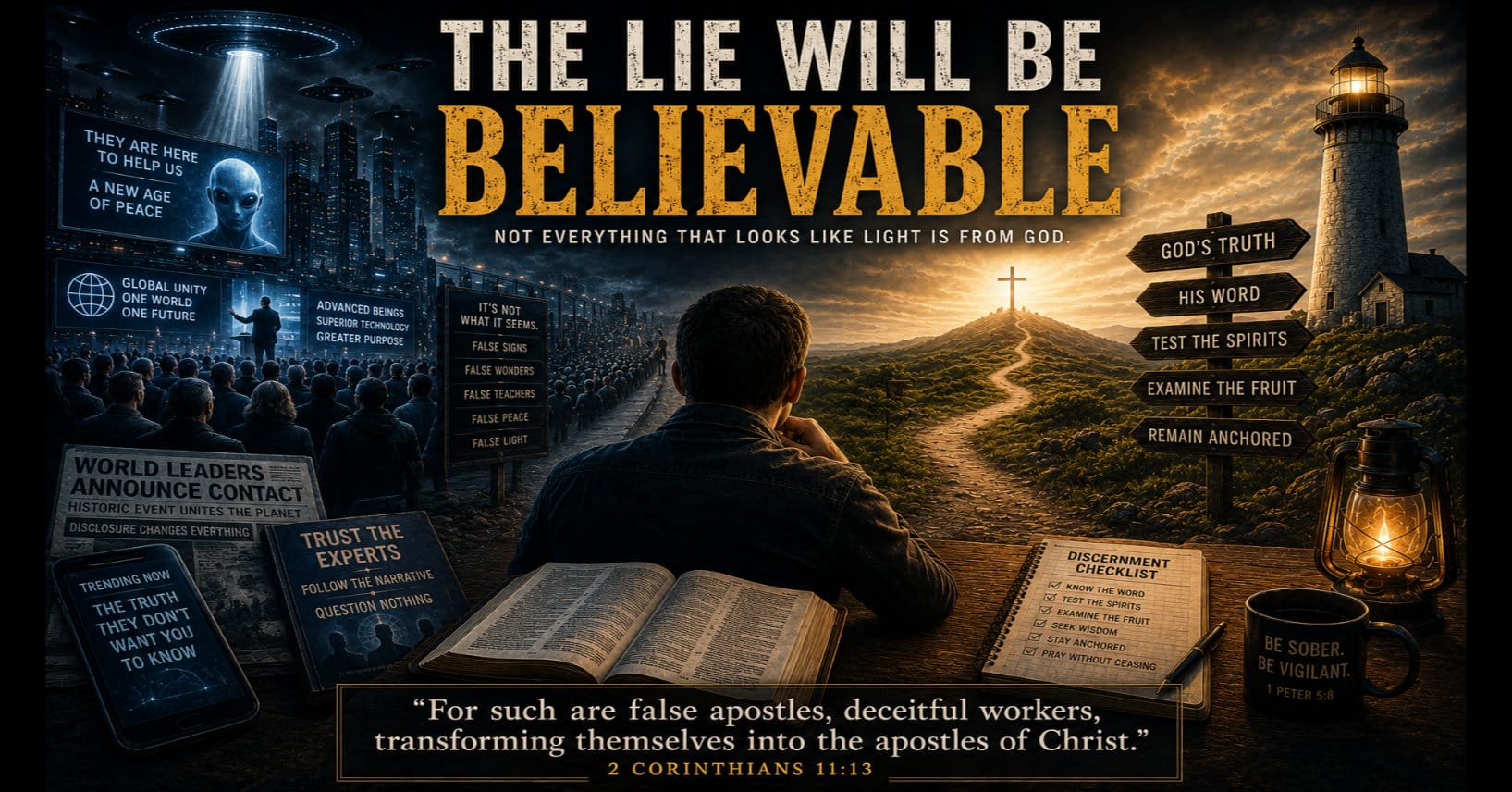
Not because the lie will be obvious.
But because the lie will be believable.
And when the world desperately seeks an explanation for the unexplainable, the ability to distinguish truth from a convincing counterfeit may become more important than ever.
In the next chapter of The Alien Deception Chronicles, humanity is confronted with exactly such a moment.
An event beyond comprehension.
A world demanding answers.
And a lie that many will find impossible to resist.