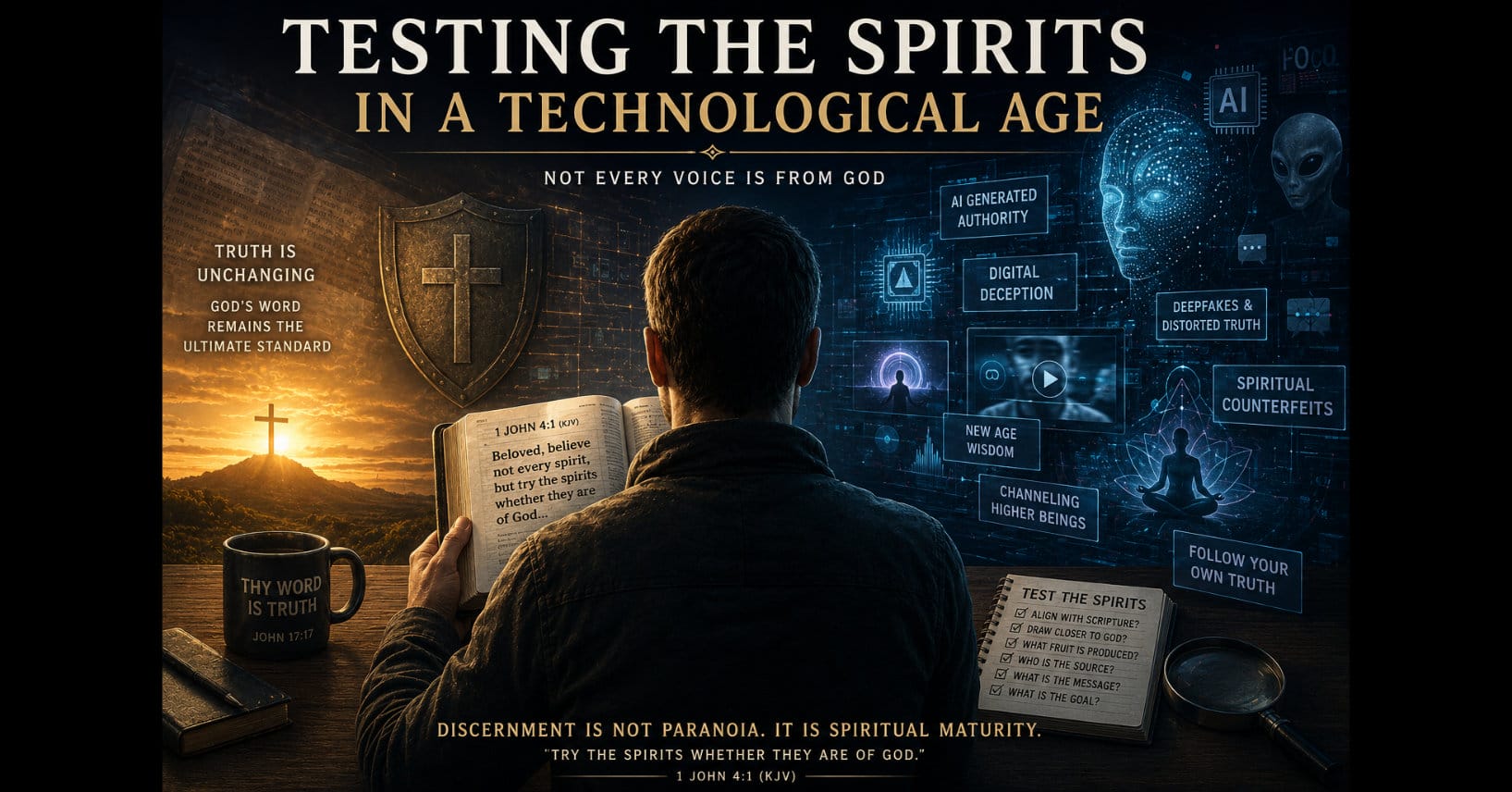
The piece argues that John’s command to test the spirits is especially relevant in a time of artificial intelligence, digital media, and immersive virtual experiences. It warns that technology can amplify deception when people grant it authority or use it to seek meaning apart from God.
It emphasizes evaluating claims by Scripture, their view of truth and humanity, and the fruit they produce. Discernment is presented as a learned practice that helps Christians distinguish what comes from God from convincing counterfeits.
One of the most remarkable verses in the New Testament may also be one of the most neglected.
“Beloved, believe not every spirit, but try the spirits whether they are of God…” (1 John 4:1, KJV)
For many Christians, this instruction seems tied to the ancient world. We imagine false prophets traveling dusty roads, pagan temples filled with idols, and early churches struggling to identify counterfeit teachers.
Yet the Apostle John’s warning may be more relevant today than at any point in history.
The technologies surrounding us have changed dramatically.
Human nature has not.
Neither has the reality of spiritual deception.
Throughout this Discernment Framework series, we have examined how deception often succeeds. It is not primarily an intelligence problem. It is a discernment problem. The most effective lies contain enough truth to appear credible. Truth and error frequently travel together.
That reality creates an important question.
How should Christians evaluate extraordinary claims in an age of artificial intelligence, digital media, virtual experiences, and rapidly advancing technology?
The answer begins where it has always begun.
Test the spirits.
Notice what John did not say.
He did not say reject everything.
He did not say accept everything.
He did not say trust your feelings.
He did not say follow the majority.
He said test.
Testing implies examination.
It requires investigation.
It demands discernment.
The command assumes that not every spiritual claim originates from God.
That assumption stands in direct opposition to much of modern culture.
Today, many people assume that any sincere spiritual experience must be valid. If an experience feels profound, transformative, or meaningful, it is often treated as evidence of truth.
Yet Scripture consistently warns otherwise.
The Bible never teaches that spiritual experiences authenticate themselves.
Experiences must be evaluated.
Claims must be examined.
Spirits must be tested.
This becomes increasingly important as technology blurs traditional distinctions between reality and illusion.
Artificial intelligence can now generate conversations that appear intelligent.
Digital avatars can simulate human interaction.
Deepfake videos can fabricate convincing events.
Virtual environments can create immersive experiences that feel real even when they are not.
These developments raise important questions.
What happens when technology becomes capable of producing experiences that appear spiritual?
What happens when digital systems begin functioning as authorities people trust more than Scripture?
What happens when human beings increasingly seek guidance from machines rather than God?
These are not merely technological questions.
They are discernment questions.
Technology itself is not the problem.
Like every tool, technology can be used for good or evil.
The issue is not the existence of technology.
The issue is the authority we grant it.
Throughout history, humanity has repeatedly looked for sources of knowledge apart from God.
In Eden, the serpent offered hidden wisdom.
Ancient pagan religions sought secret knowledge from spiritual entities.
Mystery religions promised enlightenment.
Occult practices claimed access to unseen realities.
Today, many pursue similar goals through different means.
The packaging has changed.
The temptation remains.
We continue to seek knowledge, power, certainty, and transcendence.
The question is where we seek them.
This is one reason biblical discernment becomes increasingly important in a technological age.
Many modern deceptions do not present themselves as spiritual at all.
They arrive disguised as innovation.
They appear as progress.
They promise convenience, connection, understanding, and empowerment.
Yet beneath the surface, deeper questions often emerge.
What worldview is being promoted?
What assumptions about humanity are being made?
What vision of truth is being presented?
What role does God occupy within that vision?
Those questions often reveal more than the technology itself.
Consider how frequently modern culture treats human autonomy as the highest good.
Many systems encourage individuals to define their own truth, create their own meaning, and establish their own moral standards.
That message appears in entertainment, education, social media, self-help philosophies, and increasingly within digital technologies themselves.
Yet the message is not new.
Its roots reach back to Genesis 3.
The serpent’s temptation was ultimately about authority.
Who determines truth?
Who defines good and evil?
Who decides what is right?
God had already provided the answer.
The serpent invited Eve to seek another.
Every generation faces the same choice.
The technologies may differ.
The spiritual question remains unchanged.
Whose voice will we trust?
This is why Christians must develop the habit of testing every claim rather than merely reacting to it.
When encountering a new teaching, movement, experience, or technology, several questions become helpful:
Does this align with Scripture?
Does it draw people toward God or away from Him?
Does it encourage dependence upon Christ or dependence upon something else?
What view of humanity does it promote?
What view of truth does it assume?
What fruit does it produce?
These questions are not designed to create fear.
They are designed to cultivate wisdom.
Discernment is not paranoia.
Discernment is spiritual maturity.
The goal is not to become suspicious of everything.
The goal is to become skilled at recognizing the difference between what originates from God and what does not.
The writer of Hebrews described mature believers as those “who by reason of use have their senses exercised to discern both good and evil.” (Hebrews 5:14, KJV)
Notice the phrase “by reason of use.”
Discernment develops through practice.
The more consistently we compare claims against Scripture, the more readily we recognize error.
The more familiar we become with truth, the easier it becomes to identify counterfeits.
That principle has never been more important.
The modern world offers an endless stream of information, experiences, voices, and authorities competing for our attention.
Some deserve to be trusted.
Others do not.
The challenge is learning the difference.
Technology will continue to evolve.
Artificial intelligence will become more capable.
Digital experiences will become more immersive.
The volume of information will continue to grow.
But regardless of how advanced our tools become, the biblical instruction remains unchanged.
“Beloved, believe not every spirit, but try the spirits whether they are of God.”
That command was relevant in the first century.
It remains relevant in the twenty-first.
And in a technological age increasingly filled with convincing counterfeits, it may be one of the most important commands Christians can remember.