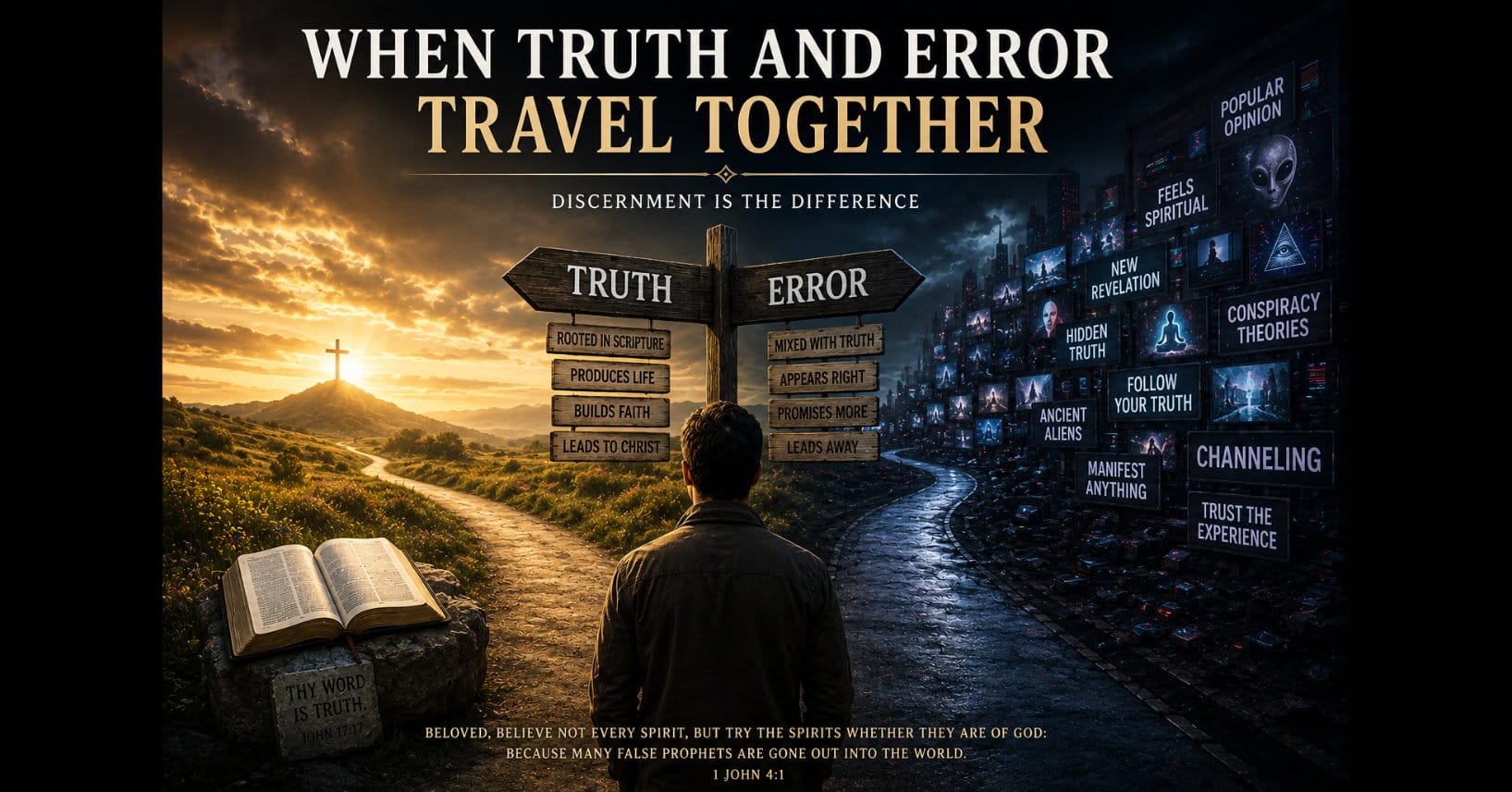
The piece argues that deception is most effective when it combines truth with falsehood rather than presenting obvious lies. Using the Eden account, counterfeit currency, and modern spiritual movements as examples, it says discernment requires identifying subtle error, not just obvious false teaching.
It emphasizes that feelings, popularity, sincerity, and signs are not reliable tests of truth. Instead, Christians should measure claims against Scripture, following the Bereans’ example of examining teachings carefully before accepting them.
Most people assume deception works by presenting obvious falsehoods.
If that were true, deception would be easy to recognize.
Very few people willingly embrace ideas they know to be false. Most deceptions succeed because they contain enough truth to appear credible. The most effective lies are rarely complete fabrications. Instead, they combine truth and error in ways that make the error difficult to detect.
This pattern appears in the very first deception recorded in Scripture.
When the serpent approached Eve in the Garden of Eden, he did not begin with a blatant denial of God’s authority. He began with a question.
“Yea, hath God said…” (Genesis 3:1, KJV)
Notice what happened next.
The serpent mixed truth with falsehood.
He correctly identified the existence of the forbidden tree. He correctly suggested that eating the fruit would produce a new experience. He correctly implied that something significant would change.
Yet woven into those truths was a deadly lie.
“Ye shall not surely die.” (Genesis 3:4, KJV)
The deception succeeded because the lie was attached to elements that were true.
Satan did not need to eliminate truth.
He only needed to distort it.
That strategy has remained remarkably consistent throughout history.
In fact, one of the greatest mistakes Christians can make is assuming that error always arrives wearing a name tag that says “False Teaching.”
More often, error arrives dressed as truth.
This is why discernment requires more than identifying what is correct. It requires recognizing what is subtly wrong.
Consider counterfeit currency.
The most dangerous counterfeit bills are not the ones that look obviously fake. Those are quickly discarded. The most dangerous counterfeits are the ones that closely resemble the genuine article.
The closer a counterfeit comes to the original, the more effective it becomes.
The same principle applies to spiritual deception.
A teaching that contains no truth at all is easy to dismiss.
A teaching that contains ninety percent truth and ten percent error can be far more dangerous.
This explains why so many modern deceptions gain traction.
Many New Age teachings emphasize personal responsibility, self-discipline, gratitude, and mindfulness. Those concepts may contain elements that sound beneficial. Yet they are often connected to ideas that place the self at the center of spiritual authority.
Manifestation teachings may encourage positive thinking while quietly promoting the belief that human desire can replace dependence on God.
Channeling often speaks of love, peace, unity, and enlightenment while encouraging communication with spiritual entities Scripture warns against.
Certain theories about extraterrestrial intelligence may ask legitimate questions about the universe while simultaneously offering explanations that undermine biblical truth.
In each case, truth and error travel together.
The challenge is determining where one ends and the other begins.
This is precisely why discernment cannot be reduced to emotional reactions.
Many people evaluate truth based on how something feels.
If a message is inspiring, it is assumed to be trustworthy.
If an experience feels spiritual, it is assumed to be authentic.
If a teaching promotes compassion, it is assumed to be harmless.
Scripture repeatedly warns against this approach.
“There is a way which seemeth right unto a man, but the end thereof are the ways of death.” (Proverbs 14:12, KJV)
The issue is not whether something seems right.
The issue is whether it is right.
Those are not always the same thing.
Jesus Himself warned that deception would become increasingly sophisticated.
“For there shall arise false Christs, and false prophets, and shall shew great signs and wonders; insomuch that, if it were possible, they shall deceive the very elect.” (Matthew 24:24, KJV)
Notice that Jesus did not describe ineffective deception.
He described deception so convincing that it would appear credible even to those familiar with the truth.
Signs and wonders alone are not proof of divine authority.
Popularity is not proof.
Sincerity is not proof.
Even spiritual experiences are not proof.
Everything must ultimately be measured against God’s Word.
This principle helps explain why modern society may be more vulnerable to deception despite having greater access to information than any previous generation.
Information can reveal facts.
Information can spread ideas.
Information can expose competing viewpoints.
But information alone cannot distinguish truth from error.
In fact, the internet often accelerates the mixing process.
A person can encounter biblical truth, conspiracy theories, sound teaching, false doctrine, historical facts, speculation, expert analysis, fabricated evidence, and artificial intelligence-generated content within a single hour.
Some of it will be true.
Some of it will be false.
Much of it will be a mixture of both.
The challenge is not finding information.
The challenge is evaluating it.
That requires discernment.
The Bereans provide a powerful example of this mindset.
When they heard Paul’s teaching, they neither accepted nor rejected it immediately.
Instead, they compared it against Scripture.
“These were more noble than those in Thessalonica, in that they received the word with all readiness of mind, and searched the scriptures daily, whether those things were so.” (Acts 17:11, KJV)
Their confidence was not placed in personalities, experiences, or popular opinion.
Their confidence was placed in God’s Word.
That remains the standard today.
When evaluating any claim, teaching, movement, experience, or worldview, Christians should ask:
What is true here?
What is false here?
What assumptions are being made?
Does this align with Scripture?
Where does this path ultimately lead?
Those questions often reveal what casual observation misses.
The reality is that deception rarely succeeds by replacing truth entirely.
It succeeds by attaching falsehood to truth and encouraging people to embrace both without examination.
That was the strategy in Eden.
It remains the strategy today.
For this reason, discernment is not merely the ability to recognize lies.
It is the ability to recognize lies hiding inside the truth.
And in a world where truth and error increasingly travel together, that ability may be more important than ever.