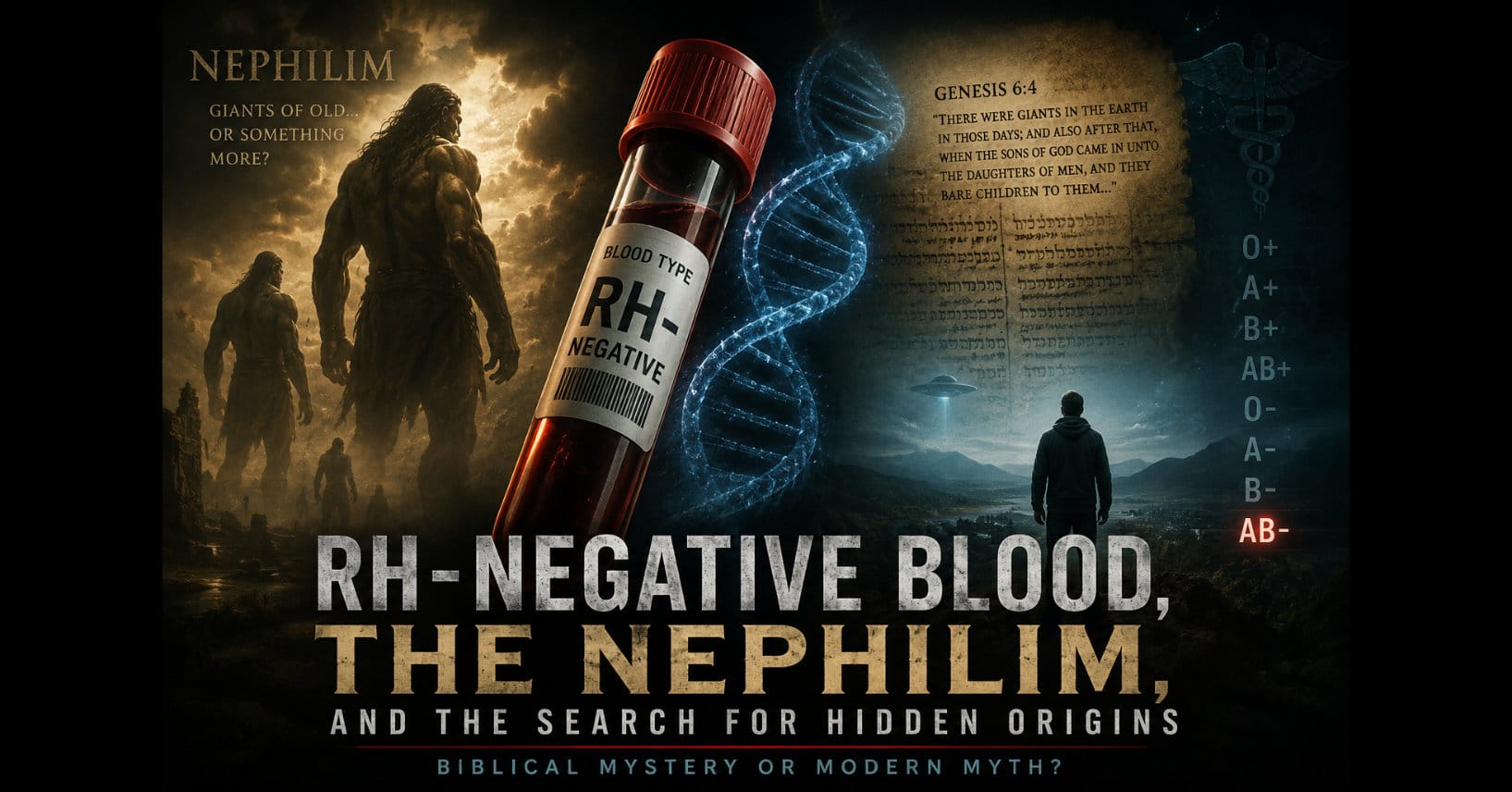
The post examines the claim that Rh-negative blood marks descendants of the Nephilim, noting how the theory circulates in conspiracy, UFO, New Age, and some Christian communities. It explains the Rh factor as a normal inherited blood trait and says genetics provides no evidence of non-human ancestry.
It traces the idea to interpretations of Genesis 6 and to later blends of biblical, ancient astronaut, and bloodline speculation. The post argues that the Bible does not connect the Nephilim to blood types and that the theory persists because mysterious explanations are often more appealing than ordinary ones.
For decades, a persistent theory has circulated through conspiracy circles, UFO communities, New Age groups, and even some Christian forums: people with Rh-negative blood may be descendants of the Nephilim.
The claim appears frequently in documentaries, podcasts, social media discussions, and online articles. Some versions suggest Rh-negative individuals carry traces of non-human DNA. Others claim ancient royal bloodlines preserved Nephilim genetics after the Flood. Still others blend the theory with extraterrestrial narratives, proposing that Rh-negative blood is evidence of alien ancestry.
The idea is certainly intriguing. It combines biblical mystery, genetics, ancient history, and the enduring human desire to discover hidden knowledge.
But does the theory withstand scrutiny?
Understanding the Rh Factor
The Rh factor is a protein found on the surface of red blood cells.
Individuals who possess the protein are classified as Rh-positive. Those who do not are classified as Rh-negative.
This distinction has practical medical implications, particularly during pregnancy. If an Rh-negative mother carries an Rh-positive child, her immune system may produce antibodies against the baby’s blood cells. Modern medicine addresses this issue through preventive treatments, making complications relatively uncommon.
The important point is that scientists fully understand the genetic mechanisms responsible for the Rh factor. It is an inherited trait passed from parents to children through ordinary genetic processes.
Nothing about Rh-negative blood requires a supernatural or extraterrestrial explanation.
Where the Theory Begins
The Nephilim first appear in Genesis 6:
“There were giants in the earth in those days; and also after that, when the sons of God came in unto the daughters of men, and they bare children to them…” (Genesis 6:4)
Interpretations vary considerably.
Some scholars view the “sons of God” as fallen angels. Others understand them as the godly descendants of Seth intermarrying with the ungodly descendants of Cain. Still others see the passage as describing ancient rulers who claimed divine status.
Those who embrace the fallen angel interpretation often conclude that the Nephilim represented a hybrid corruption of humanity before the Flood.
From there, some theorists make a leap: if the Nephilim were biologically distinct, perhaps traces of their lineage remain today.
Rh-negative blood becomes the proposed marker.
The Logic Behind the Claim
Advocates typically point to several observations.
First, Rh-negative blood is relatively uncommon, particularly outside certain European populations.
Second, they note the potential incompatibility between Rh-negative mothers and Rh-positive children.
Third, they claim that certain ancient populations—particularly the Basques of Spain and France—possess unusually high percentages of Rh-negative individuals.
Finally, they connect these observations to biblical accounts of giants, ancient royal bloodlines, and legends of divine beings interacting with humanity.
The conclusion is then drawn that Rh-negative blood may represent a surviving remnant of Nephilim ancestry.
The problem is that each step in the argument requires assumptions that lack evidence.
What Genetics Actually Reveals
Modern genetics provides a far simpler explanation.
Human populations naturally develop genetic variations over time. Some traits become concentrated in isolated populations through migration patterns, geographic separation, and genetic drift.
The Rh-negative trait is one such variation.
Researchers have identified the specific genes involved and can trace their inheritance patterns across populations. No genetic studies have discovered evidence that Rh-negative individuals possess non-human DNA or ancestry.
Every genetic marker examined thus far places Rh-negative individuals firmly within the normal spectrum of human variation.
In other words, the trait is unusual, but it is not mysterious.
When Mystery Meets Mythology
The Rh-negative theory gained significant traction during the rise of the ancient astronaut movement in the 1960s and 1970s.
As popular culture increasingly embraced extraterrestrial explanations for ancient mysteries, some writers merged UFO narratives with biblical accounts of the Nephilim.
The result was a hybrid mythology:
- The Nephilim became extraterrestrials.
- Fallen angels became advanced alien beings.
- Ancient bloodlines became repositories of hidden genetic knowledge.
- Rh-negative blood became evidence of alien heritage.
Over time, the theory spread through books, documentaries, online forums, and social media until many began treating speculation as established fact.
Yet the underlying evidence never improved.
A Biblical Perspective
There is another issue often overlooked.
The Bible never associates the Nephilim with blood type.
Scripture discusses their presence, their influence, and the corruption that characterized the pre-Flood world. It does not provide biological markers by which future generations might identify descendants.
Even among scholars who believe the Nephilim were literal offspring of fallen angels, few argue that modern blood types can be used to trace their lineage.
The biblical concern is not genetics but spiritual rebellion.
The emphasis of Genesis 6 is humanity’s corruption before judgment—not the preservation of hidden bloodlines after it.
Why These Theories Persist
The popularity of the Rh-negative theory reveals something about human nature.
People are drawn to mysteries.
We often prefer hidden explanations to ordinary ones. The idea that a rare blood type might connect someone to ancient giants, extraterrestrials, or secret lineages is far more exciting than population genetics.
But excitement is not evidence.
Throughout history, myths have frequently attached themselves to genuine mysteries. A small unknown becomes the foundation for an elaborate narrative that eventually takes on a life of its own.
The Rh-negative theory is a modern example of that process.
The Real Lesson
For students of prophecy and biblical discernment, the Rh-negative discussion offers an important reminder.
Not every mystery conceals a secret truth.
Sometimes a mystery remains a mystery because information is limited. Other times the mystery has already been solved, but speculative explanations prove more appealing than ordinary answers.
The danger arises when fascination with hidden knowledge begins to overshadow what Scripture actually says.
The Bible contains enough genuine mysteries to occupy a lifetime of study. We do not need to manufacture additional ones.
The connection between Rh-negative blood and the Nephilim remains an intriguing modern legend—but a legend nonetheless.
And in an age increasingly captivated by secret origins, ancient aliens, and hidden bloodlines, discernment remains more important than ever.