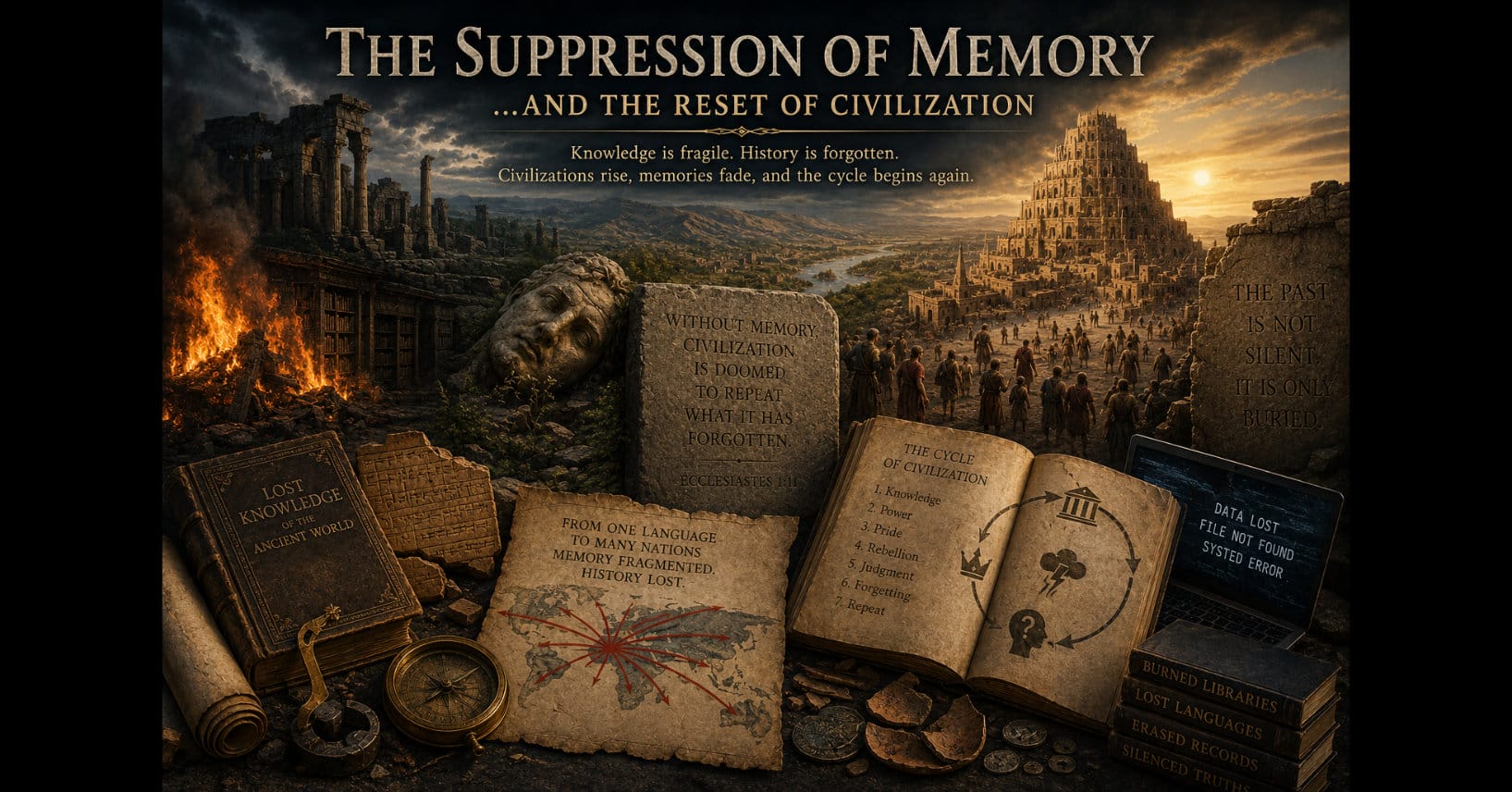
The piece argues that human history is shaped as much by forgetting as by remembering. It suggests that knowledge is fragile, civilizations fragment memory, and stories such as flood traditions and lost wisdom may preserve distorted traces of older events.
It also warns that modern information is vulnerable to loss despite digital abundance. Drawing on biblical themes of remembrance, it asks whether humanity is repeating ancient patterns of pride, decline, and suppressed memory rather than steadily advancing.
“There is no remembrance of former things; neither shall there be any remembrance of things that are to come with those that shall come after.” — Ecclesiastes 1:11 (KJV)
History is often presented as a record of what humanity remembers.
In reality, history is equally a record of what humanity has forgotten.
Entire civilizations have vanished.
Languages have disappeared.
Libraries have burned.
Knowledge has been lost.
Stories have become myths.
Facts have become legends.
And with each passing generation, humanity’s understanding of its own past grows increasingly fragmented.
This raises a fascinating question:
What if the greatest loss after the Flood was not infrastructure?
What if it was memory?
The Fragility of Human Knowledge
Modern society often assumes that knowledge is permanent.
We have books.
Databases.
Cloud storage.
Digital archives.
Information appears more secure than ever.
Yet history tells a different story.
The ancient world is filled with examples of knowledge disappearing almost overnight.
The destruction of a city can erase centuries of records.
The collapse of a civilization can end entire fields of expertise.
The death of a language can make vast amounts of information inaccessible.
Knowledge is not nearly as durable as we imagine.
It survives only when people intentionally preserve it.
The Myth of Continuous Progress
One of the defining assumptions of modern culture is that humanity continually advances.
Each generation is presumed to know more than the one before.
More technology.
More science.
More understanding.
Yet history often moves in cycles.
Civilizations rise.
Civilizations fall.
Knowledge expands.
Knowledge contracts.
Periods of remarkable achievement are frequently followed by periods of decline.
The collapse of the Western Roman Empire provides a familiar example.
Roads deteriorated.
Trade networks fractured.
Literacy declined.
Infrastructure disappeared.
Knowledge survived, but often in fragmented form.
The same pattern may help explain the ancient world after the Flood.
When Memory Becomes Myth
One of the most intriguing features of ancient cultures is their tendency to preserve stories that sound strangely familiar.
A global flood.
Heavenly beings.
A lost golden age.
Ancient wisdom.
Catastrophic judgment.
The details vary from culture to culture.
Yet the recurring themes remain remarkably consistent.
Many modern scholars dismiss these stories as mythology.
Perhaps some are.
But mythology itself often serves a purpose.
It preserves memory.
Not always accurately.
Not always completely.
But memory nonetheless.
The further humanity moves from an event, the more history tends to become legend.
Legend becomes folklore.
Folklore becomes mythology.
The original event remains buried beneath layers of interpretation.
Babel and the Fragmentation of History
The Tower of Babel may represent one of the most significant turning points in human memory.
Before Babel, humanity shared a common language.
A common culture.
A common heritage.
A common historical memory.
After Babel, everything changed.
Languages multiplied.
People dispersed.
Nations emerged.
Information fragmented.
The descendants of Noah carried pieces of the same story into different parts of the world.
Over centuries, those stories evolved independently.
The result may explain why flood narratives, divine visitor traditions, and accounts of lost knowledge appear across multiple civilizations.
The stories diverged.
The memory remained.
The Survivors of Ancient Memory
Even today, traces of these ancient memories persist.
Archaeological discoveries regularly challenge long-held assumptions.
Ancient sites continue to reveal unexpected sophistication.
Lost cities emerge from jungles.
Buried structures appear beneath deserts.
New technologies uncover evidence previously hidden from view.
Each discovery reminds us how incomplete our understanding of history remains.
The past is larger than our records.
The absence of evidence is not always evidence of absence.
Sometimes it simply means we have not yet uncovered what was forgotten.
The Modern Information Paradox
Ironically, the digital age may be creating a new form of historical vulnerability.
Humanity now generates more information than any civilization in history.
Yet much of it exists in fragile formats.
Hard drives fail.
Platforms disappear.
File formats become obsolete.
Entire digital ecosystems can vanish within a generation.
Future historians may face challenges remarkably similar to those faced by archaeologists today.
The quantity of information does not guarantee its survival.
Preservation requires intentional effort.
Otherwise, even modern knowledge can disappear.
Why the Suppression Matters
The title of this article refers to suppression, but not necessarily in the sense of a conspiracy.
Sometimes knowledge is suppressed intentionally.
Governments classify information.
Institutions restrict access.
Political powers shape historical narratives.
Those realities exist.
But there is another form of suppression that may be even more powerful.
Neglect.
Forgetting.
Disinterest.
Civilizations often lose knowledge not because someone hid it, but because no one valued it enough to preserve it.
What is forgotten eventually becomes inaccessible.
What becomes inaccessible eventually becomes unknown.
The Biblical Perspective
Scripture repeatedly warns humanity about the danger of forgetting.
The Israelites were instructed to remember God’s works.
Parents were commanded to teach future generations.
Monuments were erected as memorials.
Festivals preserved historical memory.
Why?
Because forgetting changes people.
A generation that forgets its history becomes vulnerable to repeating its mistakes.
The same principle applies on a civilizational scale.
The loss of memory often precedes the repetition of error.
Are We Forgetting Again?
This may be the most important question in the entire series.
What if humanity is not simply advancing?
What if it is repeating?
The pursuit of power.
The desire for autonomy.
The elevation of knowledge above wisdom.
The confidence that technology can solve fundamentally spiritual problems.
These themes appear in Eden.
They appear before the Flood.
They appear at Babel.
And they appear throughout history.
Perhaps the greatest danger is not that humanity has forgotten its past.
Perhaps the greatest danger is that it remembers just enough to repeat it.
Looking Ahead
Throughout this series, we have explored the possibility that fragments of pre-Flood knowledge survived, spread across the ancient world, and influenced the rise of civilization.
In our final article, we will bring the discussion into the present day and ask a sobering question:
If the patterns of Noah’s world are returning, what lessons should we learn before history repeats itself once again?