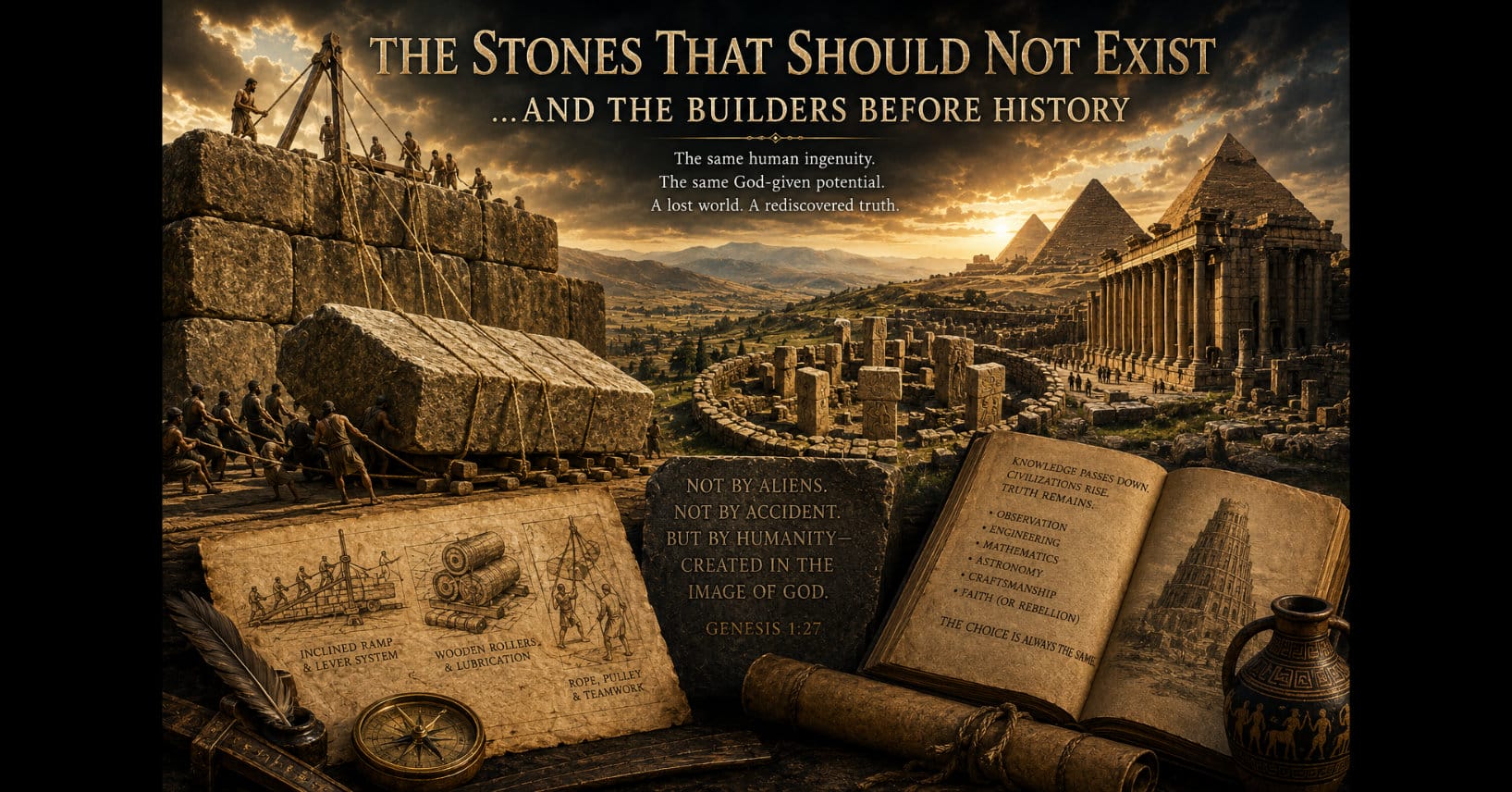
The post argues that megalithic monuments are better explained by human capability than by ancient astronaut theories. It uses examples such as Göbekli Tepe and Baalbek to suggest that ancient builders had organization, skill, and knowledge that modern assumptions often underestimate.
It presents a biblical framework in which humanity, made in God’s image, possessed real creative and engineering abilities before and after the Flood. The article also suggests that some knowledge may have survived through Noah’s family and sets up a follow-up discussion of shared ancient traditions.
“Is any thing too hard for the LORD?” — Genesis 18:14 (KJV)
Few subjects ignite the imagination more than ancient megalithic structures.
Massive stone blocks weighing hundreds of tons.
Monuments aligned with astonishing precision.
Ancient sites that continue to challenge modern assumptions about what early civilizations could accomplish.
For many people, these structures seem impossible.
And whenever something appears impossible, an increasingly popular explanation emerges:
Aliens.
Ancient astronaut theories have become the default answer for many unexplained archaeological mysteries. Television programs, documentaries, and online discussions frequently suggest that humanity required extraterrestrial assistance to build some of the world’s most impressive monuments.
The biblical worldview offers a different possibility.
What if these structures were built by humans?
And what if humanity has been capable of far more than we often assume?
The Problem with Modern Assumptions
One of the greatest obstacles to understanding the ancient world is our tendency to underestimate it.
Modern people often imagine history as a steady upward climb from primitive ignorance to advanced knowledge.
Reality is rarely that simple.
Ancient civilizations built roads that still survive.
Constructed monuments that continue to stand.
Engineered water systems that remained functional for centuries.
Created mathematical and astronomical systems of remarkable sophistication.
Human intelligence did not evolve during the last few thousand years.
The people who built the ancient world possessed the same fundamental intellectual capacity that we do today.
The question is not whether they were intelligent.
The question is what knowledge they possessed and how they applied it.
Göbekli Tepe and the Challenge to History
When archaeologists uncovered Göbekli Tepe in modern-day Turkey, it forced a reconsideration of many long-held assumptions.
The site contains massive carved stone pillars arranged in complex circular structures.
The workmanship demonstrates planning, organization, and skilled labor.
More importantly, the site appears older than many researchers expected for a structure of its complexity.
Göbekli Tepe does not prove the existence of a pre-Flood civilization.
Nor does it validate ancient astronaut theories.
What it does demonstrate is that ancient people were capable of organized construction projects much earlier than previously believed.
Every major discovery of this kind forces historians to ask an uncomfortable question:
What else might we be underestimating?
Baalbek and the Megalith Mystery
Perhaps no site illustrates this challenge better than Baalbek.
Some of the stones used in its platform construction weigh hundreds of tons.
Moving such blocks would be difficult even with modern equipment.
Because of this, many observers conclude that ancient builders could not possibly have accomplished the task themselves.
Yet history repeatedly shows that human beings are capable of extraordinary feats when sufficient labor, organization, and ingenuity are applied.
The fact that we do not fully understand a construction method does not mean the builders lacked one.
Nor does it require an extraterrestrial explanation.
The tendency to invoke aliens often reveals more about our assumptions than about the evidence.
The Ancient Astronaut Problem
The popularity of ancient astronaut theories raises an interesting question.
Why do so many people find them persuasive?
Part of the answer lies in the modern worldview.
If the supernatural is rejected, yet ancient mysteries remain, people naturally seek alternative explanations.
Aliens become a substitute for angels.
Advanced visitors replace supernatural beings.
Extraterrestrial intervention replaces spiritual activity.
Ironically, many ancient astronaut theories function much like modern mythology.
They explain the unexplained by introducing powerful beings from beyond the human realm.
The names change.
The pattern remains remarkably familiar.
A Biblical Alternative
Scripture never attributes humanity’s achievements to extraterrestrial intervention.
From the earliest chapters of Genesis, mankind is presented as creative, capable, and innovative.
Human beings build cities.
Develop tools.
Create music.
Work metals.
Organize societies.
The biblical account consistently portrays humanity as possessing remarkable capabilities because people were created in the image of God.
This does not mean every mystery has been solved.
Many archaeological questions remain unanswered.
But the existence of unanswered questions does not justify abandoning the biblical framework.
Human accomplishment remains the most reasonable explanation until evidence suggests otherwise.
Could Knowledge Have Survived the Flood?
This is where the discussion becomes particularly interesting.
If the pre-Flood world possessed significant knowledge, could portions of that knowledge have survived?
The Bible indicates that Noah and his family emerged from the Flood with memories, skills, and experience.
Civilization did not restart with complete ignorance.
Knowledge would have traveled with the survivors.
Some technologies may have been lost.
Others may have been preserved.
Still others may have been rediscovered over time.
This possibility helps explain why post-Flood civilizations appear to emerge with surprising speed.
The descendants of Noah were not creating civilization from nothing.
They were rebuilding.
The Real Mystery
The greatest mystery may not be how ancient people moved enormous stones.
The greater mystery may be why modern people find it so difficult to believe they could.
Our culture often assumes that technological advancement is the only measure of intelligence.
Ancient civilizations remind us that capability takes many forms.
Organization.
Patience.
Craftsmanship.
Engineering.
Generational knowledge.
These qualities can accomplish extraordinary things.
The builders of the ancient world may not have possessed computers or satellites.
But they possessed minds created by the same God who created ours.
What the Stones Reveal
The world’s megalithic structures point to something important.
Not alien intervention.
Not secret extraterrestrial civilizations.
Not hidden cosmic visitors.
They point to the remarkable capabilities of humanity itself.
The biblical worldview does not require us to diminish ancient people in order to explain history.
In many ways, it encourages the opposite.
The descendants of Adam were not primitive creatures struggling toward intelligence.
They were image-bearers of God.
Capable of creativity.
Capable of innovation.
Capable of greatness.
And, unfortunately, capable of rebellion.
The same qualities that built monuments also built Babel.
The same ingenuity that created civilization also contributed to corruption.
That tension runs throughout human history.
Looking Ahead
If knowledge survived the Flood and spread through Noah’s descendants, why do cultures around the world preserve similar stories about divine beings, lost wisdom, and civilization’s origins?
In the next article, we will examine how ancient traditions across multiple civilizations may preserve fragments of a shared memory—and why those memories continue to shape the modern world’s understanding of humanity’s distant past.