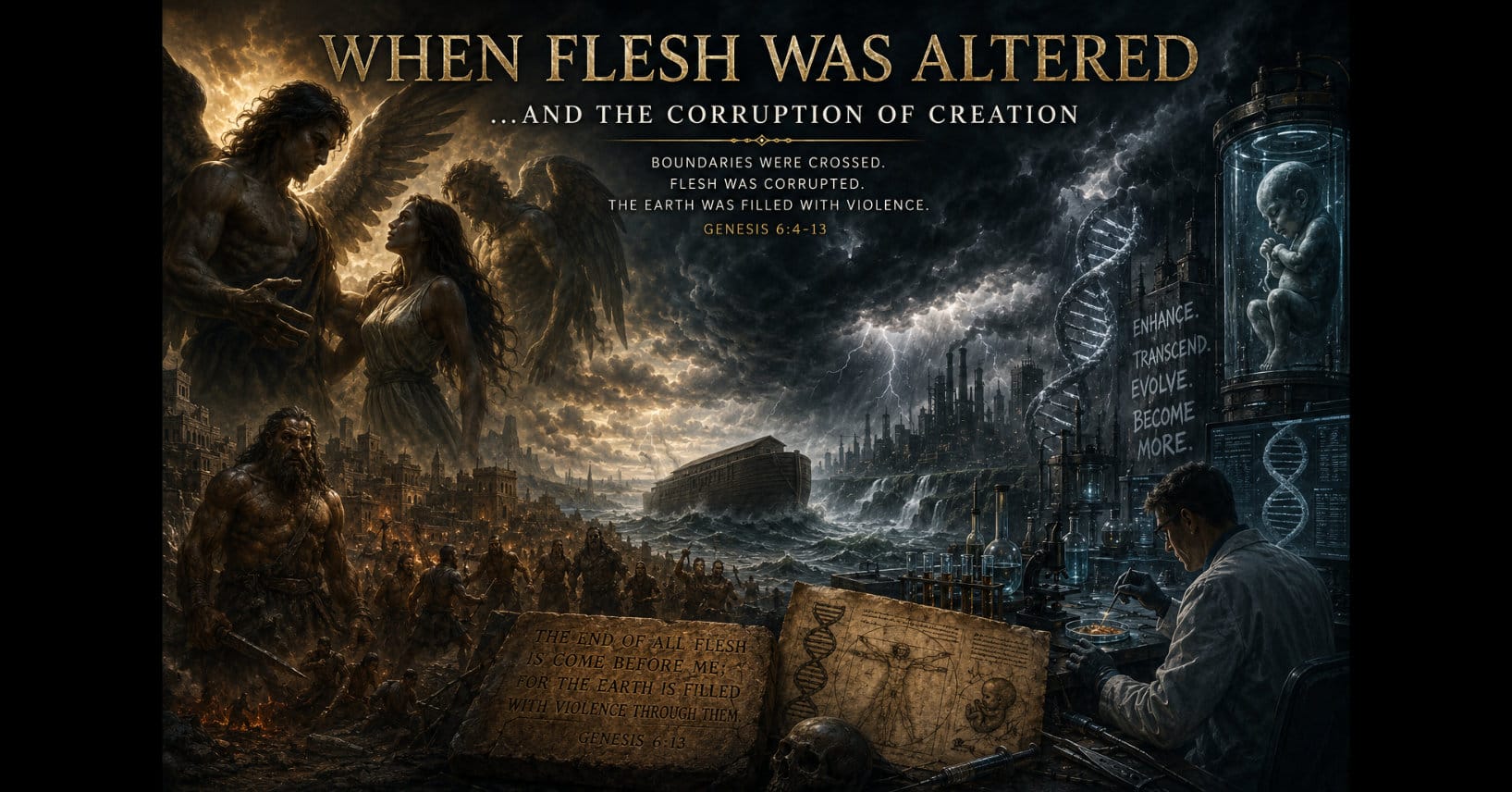
The piece reflects on Genesis 6 and the Flood, focusing on whether the crisis involved not only human wickedness but a deeper corruption of creation. It surveys interpretations of the “sons of God,” ancient traditions about hybrid beings, and the idea that the Flood answered a violation of divinely established boundaries.
It then connects those themes to modern genetic engineering, transhumanism, and human enhancement. The article argues that current technologies raise familiar questions about autonomy, limits, and what it means to remain human, and it closes by previewing a discussion of Watcher traditions and forbidden knowledge.
“And GOD saw that the wickedness of man was great in the earth, and that every imagination of the thoughts of his heart was only evil continually.” — Genesis 6:5 (KJV)
Among all the mysteries surrounding the days of Noah, perhaps none is more controversial than a simple question:
Why was the Flood necessary?
The Bible certainly describes widespread violence, corruption, and rebellion. Yet many ancient traditions associated with Genesis 6 suggest that something even deeper may have been taking place.
Was humanity merely sinful?
Or had the created order itself become corrupted?
This question has fascinated theologians, scholars, and students of prophecy for centuries. While Scripture provides only limited details, the implications of those details have generated considerable discussion.
As always, it is important to distinguish between what Scripture explicitly states and what remains speculative.
The biblical text must remain our foundation.
The Strange Language of Genesis 6
Genesis records:
“There were giants in the earth in those days; and also after that, when the sons of God came in unto the daughters of men, and they bare children to them…” (Genesis 6:4)
This passage has produced multiple interpretations throughout Christian history.
Some understand the “sons of God” to be descendants of Seth intermarrying with the descendants of Cain.
Others understand the phrase to describe angelic beings crossing boundaries established by God.
The purpose of this article is not to settle that debate.
What matters for our discussion is that many ancient readers understood Genesis 6 as describing an extraordinary corruption of creation itself.
This interpretation became particularly influential in ancient Jewish writings and traditions that sought to explain why the Flood was necessary.
The Theme of Corrupted Flesh
One detail often overlooked appears later in the Flood narrative.
God declares:
“The end of all flesh is come before me; for the earth is filled with violence through them…” (Genesis 6:13)
Notice the phrase: all flesh.
The emphasis extends beyond humanity alone.
Some ancient traditions interpreted this language as evidence that corruption had spread throughout creation itself.
Again, Scripture does not explicitly explain the mechanism.
The traditions simply attempted to answer a difficult question:
Why would a worldwide judgment be required if only human behavior had become corrupt?
Their answer was that corruption had reached deeper than conduct.
It had reached creation.
Whether one accepts that interpretation or not, it reveals how seriously ancient readers viewed the crisis described in Genesis 6.
Ancient Traditions and Hybridization Narratives
Outside the biblical text, numerous ancient writings describe the emergence of hybrid beings before the Flood.
The Book of Enoch is perhaps the best-known example.
According to these traditions, supernatural beings crossed divinely established boundaries and produced offspring that contributed to the corruption of the world.
These accounts are not Scripture.
Christians are not obligated to accept them as historical fact.
Yet they remain significant because they demonstrate how many ancient readers understood Genesis 6.
To them, the issue was not merely moral decline.
It was the violation of boundaries established by God.
Throughout Scripture, boundaries matter.
The separation of light from darkness.
The separation of land from sea.
The distinction between humanity and the animal kingdom.
The distinction between Creator and creation.
Genesis repeatedly portrays order as something established by God and rebellion as an attempt to overturn that order.
Why This Matters Today
For centuries, discussions about Genesis 6 remained largely theological.
Today, they have become surprisingly relevant.
Humanity now possesses technologies capable of altering life itself.
Genetic engineering.
Gene editing.
Synthetic biology.
Human enhancement research.
These technologies hold enormous promise.
They may cure diseases, reduce suffering, and improve quality of life.
Yet they also raise profound ethical questions.
Where should the boundaries be drawn?
What should never be altered?
What does it mean to remain human?
The Bible does not directly address modern genetic engineering.
It does, however, repeatedly warn about humanity’s tendency to pursue capability faster than wisdom.
The question is not whether something can be done.
The question is whether it should be done.
The Modern Pursuit of Human Enhancement
Across academia and technology circles, discussions about transhumanism continue to grow.
Some envision a future where genetic modification eliminates disease.
Others imagine cognitive enhancement, biological upgrades, or even the merging of humans with machines.
Many of these goals are presented as humanitarian efforts.
Some undoubtedly are.
But beneath the discussion lies a familiar temptation.
The desire to transcend the limitations established by God.
The promise sounds remarkably familiar:
Become more.
Become greater.
Become something beyond what you were created to be.
It echoes the ancient temptation of Eden.
It echoes the ambitions of Babel.
And it raises questions that Christians cannot afford to ignore.
The Pattern Behind the Corruption
One of the recurring themes throughout Scripture is that rebellion often disguises itself as progress.
The serpent promised enlightenment.
Babel promised unity.
False gods promised power.
The ultimate issue was never knowledge itself.
It was autonomy.
The desire to redefine reality apart from God’s authority.
That same pattern appears throughout human history.
The most dangerous deceptions are rarely presented as evil.
They are presented as advancement.
As improvement.
As the next step in human evolution.
The question believers must continually ask is simple:
Who defines what humanity is supposed to become?
Project Genome Unity and the Future
Readers of As It Was in the Days of Noah… And the Return of the Watchers will recognize this theme immediately.
One of the central concerns explored in that story is humanity’s increasing willingness to modify itself in pursuit of power, perfection, and control.
Whether the corruption before the Flood involved literal hybridization remains a matter of debate.
What is not debatable is that modern humanity is now acquiring the ability to alter life itself.
For the first time in history, discussions that once belonged exclusively to speculative fiction are becoming scientific realities.
That alone should give us pause.
Looking Ahead
If knowledge survived the Flood, where did it go?
How did post-Flood civilizations recover so quickly?
Why do ancient cultures around the world preserve remarkably similar stories about divine beings, lost wisdom, and the origins of civilization?
In the next article, we will examine the traditions surrounding the knowledge of the Watchers and explore how ancient accounts connected forbidden teachings to the rise of metallurgy, astronomy, warfare, and the earliest forms of what might be called proto-science.