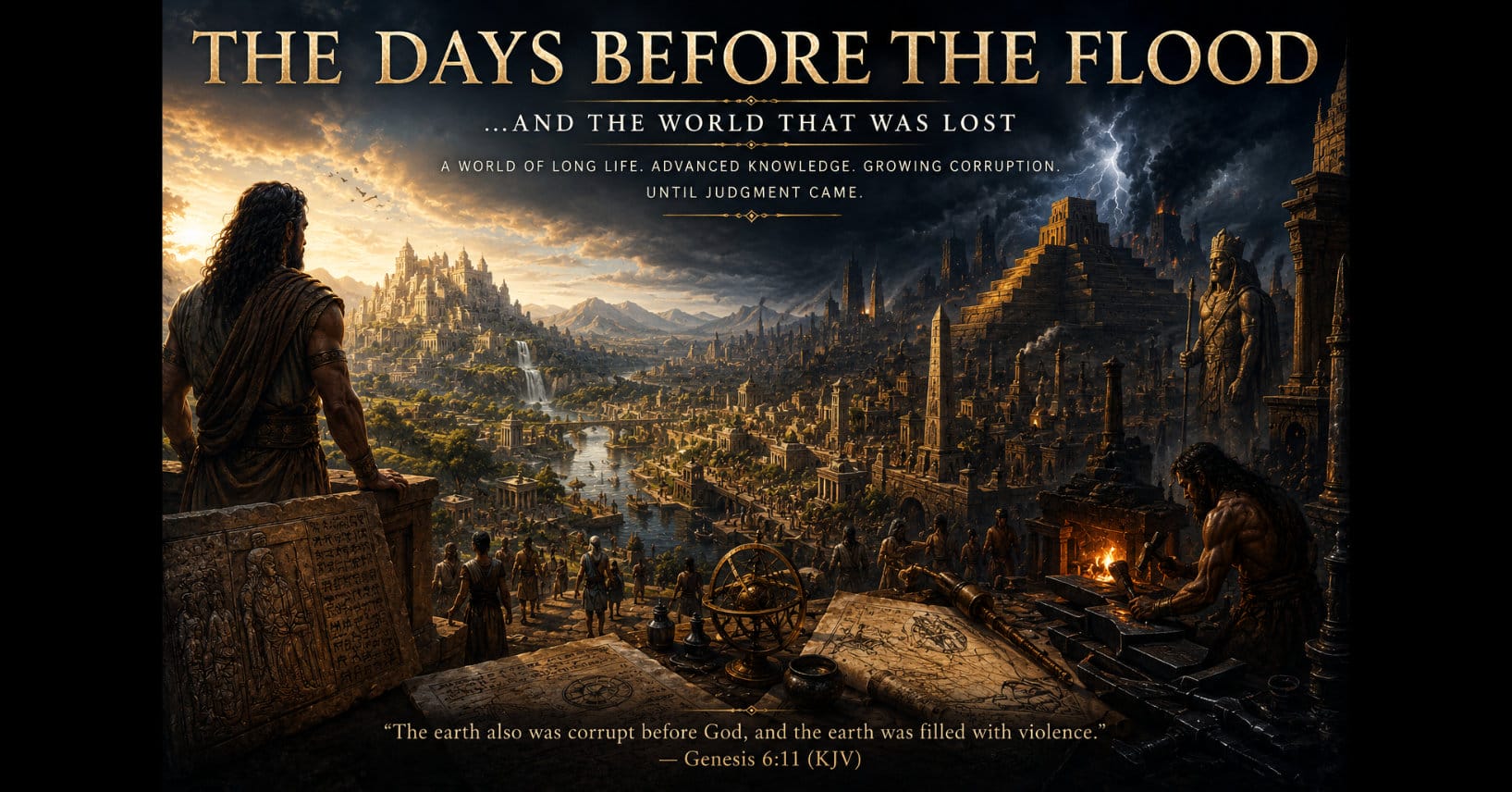
The post argues that the pre-Flood world in Genesis may have been more advanced than is often assumed. It points to extraordinary human longevity, overlapping generations, and early signs of urban life, specialized trades, metallurgy, and artistic development.
It also contrasts human achievement with the moral corruption that led to the Flood, warning that technological progress without righteousness can lead to destruction. The piece closes by suggesting that ancient knowledge may have had unusual origins and sets up further discussion of Genesis 6.
“The earth also was corrupt before God, and the earth was filled with violence.” — Genesis 6:11 (KJV)
When most people imagine the world before the Flood, they often picture a primitive society struggling to survive with little more than basic tools and simple settlements.
The biblical record paints a different picture.
Genesis describes a world populated by people who lived for centuries. Adam lived 930 years. Methuselah lived 969 years. Jared lived 962 years. These were not short-lived generations constantly rebuilding lost knowledge. They were individuals capable of accumulating centuries of experience, passing discoveries directly to their descendants, and contributing to the development of civilization across multiple generations.
What kind of world might emerge under those conditions?
Scripture does not provide a detailed technological inventory of the pre-Flood era. Yet it does provide enough clues to suggest that the ancient world may have been far more sophisticated than many assume.
The possibility is worth exploring.
A World of Extraordinary Longevity
Modern civilization benefits from the accumulation of knowledge. Scientists build upon the discoveries of earlier generations. Engineers improve upon existing designs. Researchers spend entire careers advancing specialized fields.
Now imagine a world where a brilliant inventor could continue learning and refining his work for eight or nine centuries.
The pre-Flood world described in Genesis would have possessed a unique advantage: continuity of knowledge.
Adam was still alive when Lamech, the father of Noah, was born. Multiple generations overlapped simultaneously. Information could pass directly from eyewitnesses rather than through centuries of retelling.
Knowledge would not need to be rediscovered every few generations.
It could continually accumulate.
This alone does not prove technological advancement. It does, however, challenge the assumption that ancient humanity was necessarily primitive.
Early Civilization Was Already Developing
Even before the Flood, Genesis records significant cultural development.
Cain built a city and named it after his son Enoch.
Jabal became known as the father of those who dwell in tents and raise livestock.
Jubal became associated with musical instruments.
Tubal-cain worked with brass and iron.
These brief references reveal organized society, specialized occupations, urban development, metallurgy, and artistic expression.
“And Zillah, she also bare Tubal-cain, an instructer of every artificer in brass and iron…” (Genesis 4:22)
The Bible offers only a few details, but those details point toward a civilization that was already diversifying and advancing.
The pre-Flood world was not beginning civilization.
It was developing one.
What Could Nine Hundred Years Produce?
This question moves us into the realm of speculation.
Suppose humanity possessed centuries of uninterrupted learning, large populations, and stable knowledge transfer.
Would architecture advance?
Would engineering improve?
Would astronomy become increasingly sophisticated?
Would methods of agriculture, transportation, and communication become more efficient?
Most likely.
The modern world has experienced explosive advancement in only a few hundred years. The Industrial Revolution, the Information Age, and the rise of artificial intelligence all occurred within a remarkably short period of history.
The pre-Flood world may have enjoyed thousands of years of uninterrupted development before judgment arrived.
The Bible does not tell us what technologies existed.
But it certainly leaves room for the possibility that the world Noah knew was more complex than we often imagine.
The Mystery of Ancient Megaliths
One reason this question continues to fascinate researchers is the existence of ancient megalithic structures.
Sites such as Göbekli Tepe, Baalbek, and other ancient complexes demonstrate levels of planning, organization, and labor that challenge conventional assumptions about early civilizations.
To be clear, none of these structures can be definitively linked to the pre-Flood world.
Most were built after the Flood according to current archaeological dating.
Yet they reveal something important.
Ancient people were capable of remarkable achievements.
The popular tendency to assume that older societies were automatically less intelligent or less capable than modern humanity is not supported by either history or archaeology.
Human intelligence did not suddenly appear in the modern era.
The descendants of Adam were fully human from the beginning.
A Different Explanation Than Aliens
Whenever ancient structures or unexplained accomplishments appear in the archaeological record, a familiar explanation often emerges.
Aliens.
Ancient astronaut theories have become increasingly popular because many people struggle to explain how earlier civilizations accomplished certain feats.
Yet the biblical worldview offers a different possibility.
What if ancient achievements were exactly what they appear to be?
Human accomplishments.
Human ingenuity.
Human creativity.
Human beings created in the image of God.
The Bible never attributes humanity’s accomplishments to extraterrestrial intervention. Instead, it presents mankind as uniquely gifted, capable of creativity, innovation, and stewardship over creation.
The real mystery may not be whether aliens helped humanity.
The real mystery may be whether we have underestimated humanity itself.
Why the World Was Lost
While speculation about technology can be fascinating, Genesis emphasizes something far more important.
The defining characteristic of the pre-Flood world was not its knowledge.
It was its corruption.
“And GOD saw that the wickedness of man was great in the earth, and that every imagination of the thoughts of his heart was only evil continually.” (Genesis 6:5)
Whatever accomplishments existed before the Flood ultimately failed to save civilization from judgment.
Knowledge increased.
Power increased.
Capability increased.
But righteousness declined.
This pattern appears repeatedly throughout history.
Humanity becomes more capable without becoming more virtuous.
Technology advances faster than wisdom.
Power expands faster than character.
The result is often disaster.
A Warning for the Modern World
The modern age faces a similar challenge.
Artificial intelligence continues to evolve.
Genetic engineering grows more sophisticated.
Human enhancement technologies move from science fiction toward reality.
The question is not whether these developments are impressive.
The question is whether humanity has learned the lesson of the Flood.
The biblical warning is not against knowledge.
It is against knowledge disconnected from God.
A civilization can become extraordinarily advanced and still move toward destruction.
The people of Noah’s day discovered that reality firsthand.
Looking Ahead
If the pre-Flood world possessed significant knowledge and capability, an even more intriguing question emerges.
Where did that knowledge originate?
Ancient traditions repeatedly point toward mysterious sources, heavenly beings, and forbidden teachings that were never intended for humanity.
In the next article, we will examine one of the most controversial aspects of the Genesis 6 narrative: the traditions surrounding hybridization, corruption of flesh, and the possibility that the Flood was about more than violence alone.