The post interprets Genesis 6 as part of a larger biblical pattern in which humanity seeks knowledge and power apart from God. It discusses the debated identity of the “sons of God,” notes related ancient traditions about forbidden knowledge, and connects these themes to Eden and Babel.
It argues that technology and capability are not inherently evil, but become dangerous without wisdom and accountability. The piece ends by raising questions about the pre-Flood world and whether knowledge that once existed was lost in the Flood.
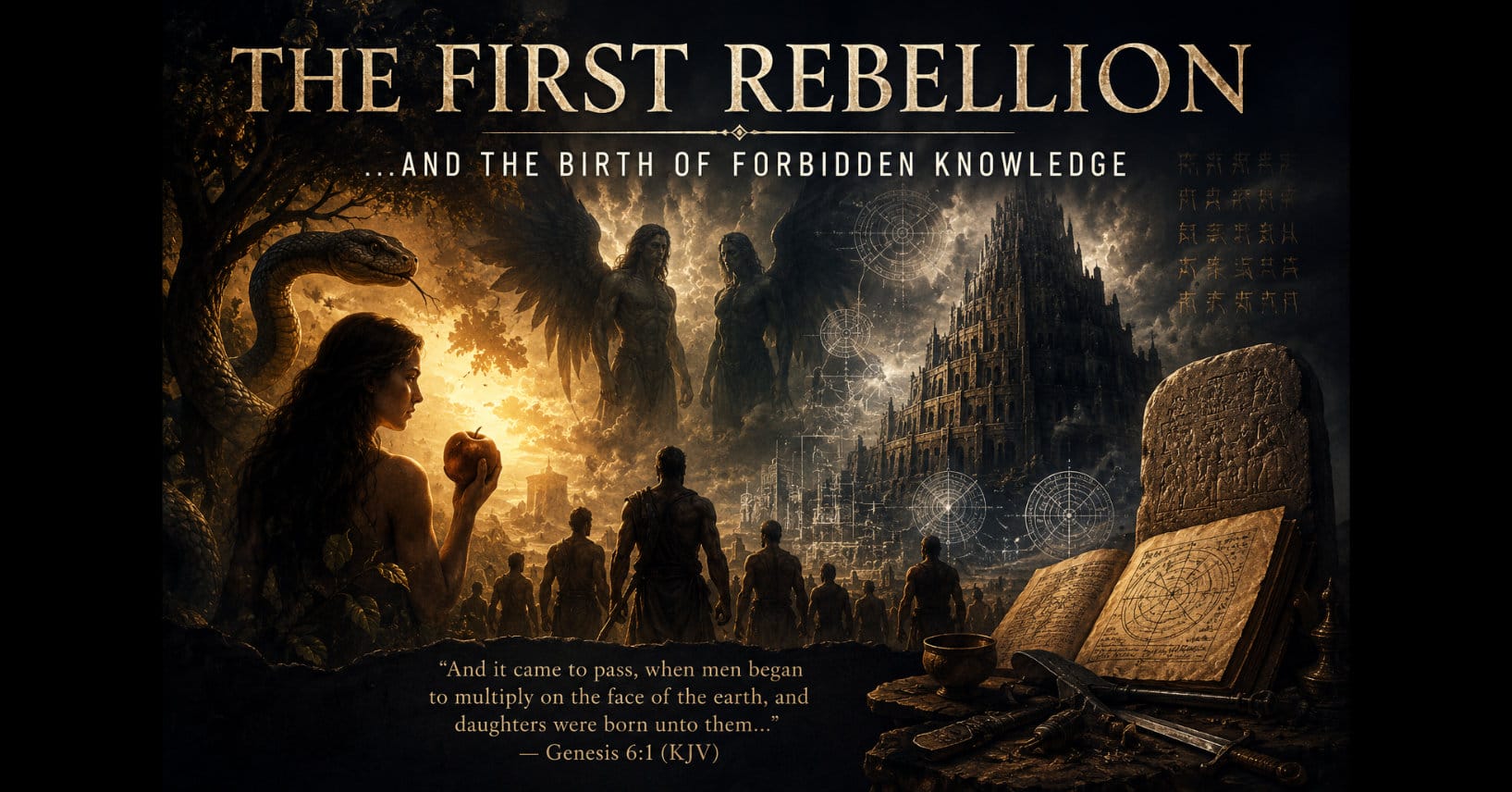
“And it came to pass, when men began to multiply on the face of the earth, and daughters were born unto them…” — Genesis 6:1 (KJV)
Few passages in Scripture have generated more debate than Genesis 6. In just a few verses, the Bible introduces mysterious figures known as the “sons of God,” describes a world descending into corruption, and sets the stage for the judgment of the Flood.
For many readers, the passage is puzzling. For others, it raises questions about ancient traditions that appear throughout history—stories of divine beings, forbidden knowledge, and civilizations that seemed to possess capabilities beyond what we might expect for the ancient world.
The Alien Deception Chronicles has often explored a central question: What if many of the world’s ancient myths are distorted memories of real spiritual events? Genesis 6 may provide one of the earliest examples.
Before proceeding, an important distinction must be made. The Bible does not explicitly describe advanced technology in Genesis 6. Any discussion of “pre-Flood technologies” is necessarily speculative. Scripture remains our foundation. The purpose of this series is not to add to the biblical account but to examine possibilities that arise from the text and from ancient traditions surrounding it.
A Pattern Established in Eden
The first rebellion did not begin with the Flood.
It began in Eden.
The serpent offered Eve something that appeared desirable:
“Ye shall be as gods, knowing good and evil.” (Genesis 3:5)
The temptation was not merely disobedience. It was the acquisition of knowledge apart from God’s authority.
Knowledge itself is not evil. God created humanity with the capacity to learn, discover, build, and create. Throughout Scripture, wisdom is celebrated as a gift from God.
The problem arises when knowledge becomes detached from obedience.
The pattern established in Eden appears repeatedly throughout the biblical narrative. Humanity seeks power, wisdom, and capability while rejecting the One who grants them.
Genesis 6 may represent the culmination of that pattern before the Flood.
The Mysterious Sons of God
Genesis records:
“That the sons of God saw the daughters of men that they were fair; and they took them wives of all which they chose.” (Genesis 6:2)
Christians have long debated the identity of the “sons of God.”
Some interpret the phrase as referring to the godly line of Seth intermarrying with the ungodly line of Cain. Others understand the phrase to describe angelic beings who crossed boundaries established by God.
The purpose of this article is not to settle that debate.
What is noteworthy is that many ancient Jewish traditions understood these beings as supernatural entities who introduced forbidden knowledge to humanity. The Book of Enoch, while not Scripture, preserves one of the most detailed examples of this tradition.
According to these accounts, certain heavenly beings taught humanity skills and practices that accelerated corruption rather than righteousness.
Whether one accepts those traditions or not, they reveal how ancient readers understood Genesis 6: not merely as a moral failure, but as a profound corruption of the created order.
When Knowledge Becomes a Weapon
One of the most striking themes in ancient traditions surrounding the Flood is the connection between spiritual rebellion and the transmission of knowledge.
Weapons. Metallurgy. Astrology. Sorcery. Manipulation of nature.
Again, these claims come from extra-biblical traditions, not from Scripture itself.
Yet they raise an interesting question.
Why do so many ancient cultures preserve stories of forbidden knowledge descending from supernatural beings?
The modern world often assumes that knowledge is inherently beneficial. History suggests otherwise.
Every major technological breakthrough amplifies human intent. A hammer can build a home or become a weapon. Artificial intelligence can assist medical research or facilitate mass surveillance.
Technology is not inherently moral or immoral.
The heart of the user determines the outcome.
This principle appears repeatedly throughout Scripture.
Knowledge without wisdom becomes dangerous.
Power without righteousness becomes destructive.
Capability without accountability becomes tyranny.
From Eden to Babel
The story does not end with the Flood.
After judgment came Babel.
Humanity once again united around a common project. Once again, mankind sought to build upward without God.
The issue was not architecture.
The issue was autonomy.
The tower represented humanity’s desire to establish its own destiny apart from divine authority.
In many ways, Babel echoes Eden.
And Genesis 6 may represent the bridge between them.
The same temptation appears throughout:
Acquire power.
Gain knowledge.
Become self-sufficient.
Leave God behind.
Why This Matters Today
Modern society often views technological advancement as humanity’s path to salvation.
Artificial intelligence promises unprecedented capability.
Genetic engineering offers the possibility of redesigning life itself.
Transhumanist movements openly discuss enhancing humanity beyond its natural limitations.
None of these developments are inherently evil.
Yet Scripture consistently warns that capability without submission to God leads humanity into dangerous territory.
The question is not whether technology is advancing.
The question is whether wisdom is advancing with it.
Genesis 6 serves as a warning across the centuries.
The first rebellion was never simply about information.
It was about authority.
Who determines what should be known?
Who determines what should be done?
Who ultimately decides what humanity is meant to become?
Those questions remain just as relevant today as they were before the Flood.
Looking Ahead
In the next article, we will examine the world that existed before the Flood and consider a provocative possibility: What if the ancient world was far more sophisticated than we imagine?
Not because of alien visitors.
Not because of lost extraterrestrial civilizations.
But because humanity may have inherited knowledge that was never intended to be used apart from God.
And if that knowledge once existed, the next question becomes unavoidable:
Did all of it perish in the Flood?